Our communion with God and with other people in the Church is manifested in holy services, where we gather to glorify God and to thank Him for all visible and invisible blessings. By regularly participating in the services of the Church, we gradually, often imperceptibly, acquire many gifts. One of these gifts is the gift of singing.
Singing was an integral part of sacred worship even in early Christianity. The Lord Jesus Christ and His disciples, as the Gospel testifies, used singing in their gatherings. The holy apostles and evangelists Matthew and Mark write that, after the Last Supper, Christ and His disciples “sang praise” and went out to the Mount of Olives (Mt. 26:30; Mk. 14:26).
Only man was endowed by God with speech, hence he can utter a voice and thus be like his Creator. Saint John Chrysostom says that our speech is born from our soul just as the Logos is born from the Father. Speech also has a social dimension. It is a way for man to communicate with other people.
Through speech, man also communicates with God. Since we humans cannot always worthily express the ineffable divine mystery, we resort to chanting, as confirmed for us by the words of Saint Nile of Sinai: “God should be glorified in words, respected in deeds, and adored in thoughts.”
In Orthodox chanting, word and melody are inextricably linked. Melody is a complement, a “dressing” of the word. The word expressed through melody says much more than the “bare” word. But melody is not an artificial complement, but, like the word, it arose from human nature, it is a gift.
God, creating the world, also created a certain rhythm of movement of that world, as well as the rhythm of time (the alternation of day and night, the movement of the planets, etc.). Thus, rhythm appears as part of divine harmony, it reveals the presence of divine beauty in the world. It also has an ethical dimension, because by respecting the divinely established order and participating in it, man conforms to the divine rhythm, that is, conforms to God. Rhythm is also inseparable from word and melody.
The glorification of God through singing is common to both angels and people, and shows the gratitude of the created world to God. After the Incarnation, singing became a liturgical church institution. The new life in Christ opened up pedagogical possibilities for singing. It becomes a factor in man’s transformation into a new life, because it expresses a new faith, a new worship, a new way of being, and all this in universal dimensions.
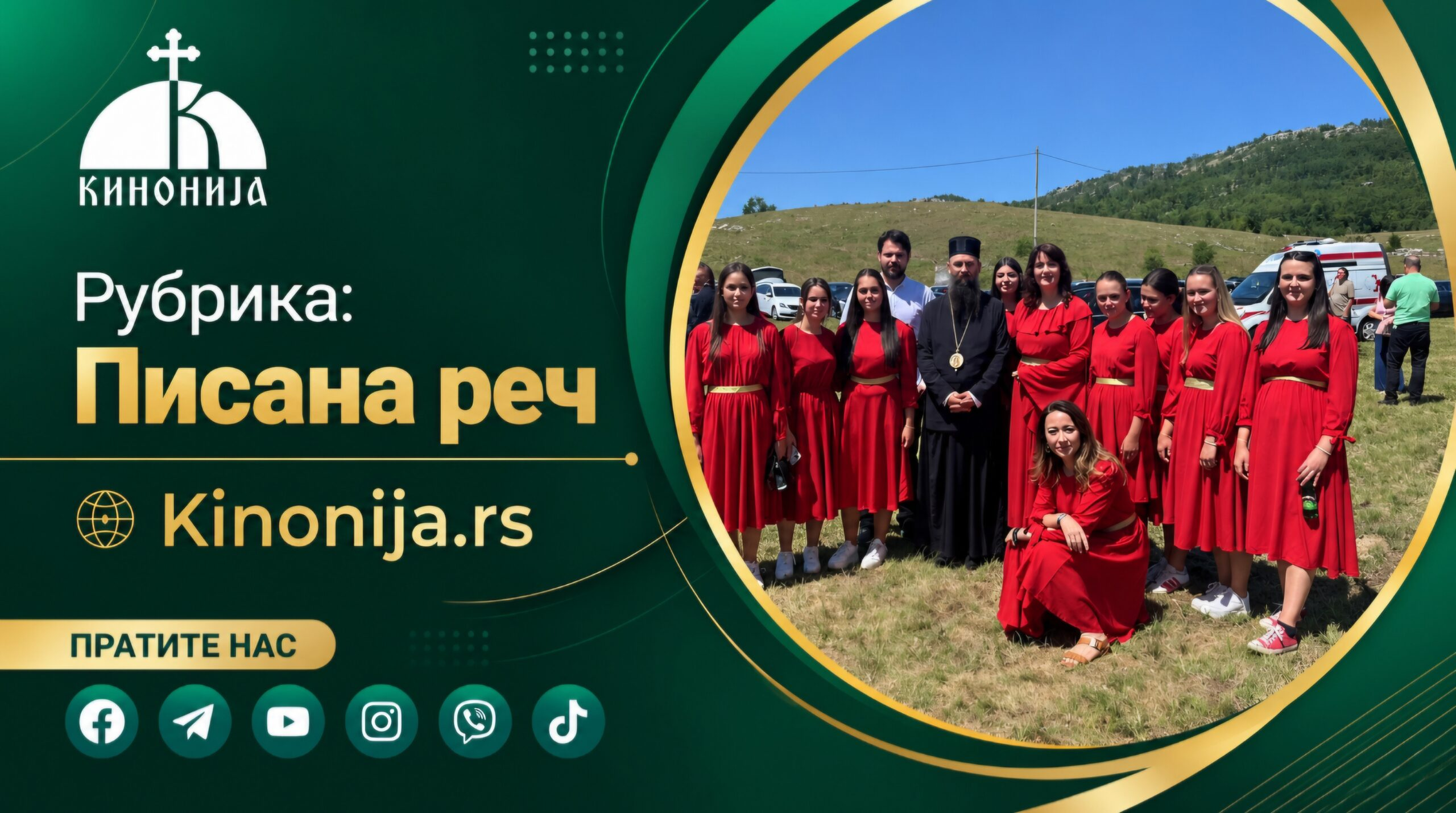
By the providence of God, the love of the venerable mother Angelina and the paternal care of the late Metropolitan of Montenegro and the Littoral, Amfilohije, 25 years ago, at the Cathedral Church of St. Basil of Ostrog in Nikšić, the choir of the venerable mother Angelina was founded, which from its inception to the present day has been artistically directed by the respected professor Ana Bojić.
During the quarter of a century of its existence, this choir has become a spiritual hive in which the best, purest, most beautiful and most precious flowers from God’s meadow are gathered. This choir has become an immaterial ladder that stretches from earth to heaven, a ladder by which the pure hearts and radiant souls of the wonderful members of the choir of the venerable mother Angelina ascend.
This wonderful choir, over which a great blessing rests, has, in its twenty-five years of existence, become a unique expression of active love, first of all love for God, and then love for all people. It is difficult to adequately describe the twenty-five blessed years of this choir, but we will not be wrong if we call this year’s anniversary “twenty-five years of the heartbeat of love”. Love is the name, and communion is the surname of the Nikšić choir. Love and communion are the most important qualities that should adorn every soul, as one of the liturgical exclamations that begins the central part of the holy Anaphora reminds us of: “The grace of our Lord Jesus Christ, and the love of God the Father, and the communion of the Holy Spirit, be with you all”.
Just as the venerable mother Angelina guided her children on the path of holiness with maternal care, so the respected professor Ana Bojić has carefully watched over every member of the choir for twenty-five years. Professionally, devotedly, constantly and with love, she stands before the choristers as their mother and perfect pedagogue, as their teacher, but above all, as their friend who directs them to the only true friend, our Lord Jesus Christ.
In these twenty-five years, the choir has sung several times before the Serbian Patriarch and our local Church’s hierarchs, and has also raised its melodious singing below the sacred arches of the greatest shrines, next to the holy relics of countless saints. The choir’s chronicle is already a rich treasury that contains not only certain historical facts, but above all precious testimonies about the spiritual dimension of the choir as a community that transforms.
In the year when the choir of the venerable mother Angelina simultaneously celebrates its feast day and its twenty-fifth anniversary, it is fitting that I address words of prayer that come from the heart to professor Ana Bojić and all choir members:
“Twenty-five years of the heartbeat of love. Dear choristers, in this time period, you have shown with your lives and service to our holy Church that love is not an emotion, but a living relationship, a relationship that is realized and built in community. You have shown that love is a selfless activity, a movement, a coming out of oneself, an all-encompassing self-sacrificing turn towards another. Our human love is impermanent, and what is “constant love”? It is the love of Christ. According to the words of the Apostle Paul, we are called to know the love of Christ that surpasses understanding (Eph. 3:19). My dears, you have become witnesses of that love that surpasses reason, you testify to that love with your life and works, glorifying God with song. “By this all will know that you are my disciples, if you have love for one another” (Jn. 13:35); this word of Christ is known to you and you testify to it. Where there is one, there is no love. Where two are united, there is only a shadow of love. Where three or more are united, there is love, so you too shine with love and proclaim it to everyone. I wish that in the decades ahead, love continues to dwell in you, and that you sow that same love with song in the souls of those who have the joy of enjoying the beauty of your voices.
WRITTEN BY: Catechist Branislav Ilić, editor of the portal “Kinonia”
*The text was published on the portal Kinonia in the section “From the Editor’s Pen”, August 11, 2026.