
We continue with the patristic interpretation of the Gospel, beginning with verses 15–16:
Then Peter answered and said to Him, “Explain this parable to us.” So Jesus said, “Are you also still without understanding?”
St. Cyril of Alexandria explains why, at this point, the Lord reproves the apostles:
“The Lord calls them lacking in understanding because, like the Pharisees, they were still thinking in bodily terms and had not yet turned their attention to the inner man. Thus, Christ teaches that food nourishes the body but does not touch the heart; and whatever does not touch the heart cannot defile the true man or render him unclean.”
The great teacher of the ancient Church, St. Basil the Great, uses this passage to explain a truth that can be fully understood only within the life of the Church: namely, that our spiritual growth, our closeness to God, and our understanding of divine mysteries depend upon us and upon our response to God’s grace:
“If ‘the Lord gives wisdom; from His mouth come knowledge and understanding’ (Prov. 2:6), and if ‘to one is given through the Spirit the word of wisdom, and to another the word of knowledge according to the same Spirit’ (1 Cor. 12:8), why then does the Lord rebuke His disciples, saying, ‘Are you also still without understanding?’ And why does the Apostle describe some as lacking understanding (Rom. 1:31)? Whoever knows the goodness of God, ‘who desires all men to be saved and to come to the knowledge of the truth’ (1 Tim. 2:4), and whoever understands the care with which the Holy Spirit distributes and bestows the gifts of God, also knows that spiritual ignorance is not the result of any negligence on the part of the Divine Benefactor, but rather of the unbelief of those who receive His gifts. It is therefore entirely just that the one who lacks understanding should be reproved, just as one who deliberately closes his eyes at sunrise deserves blame for remaining in darkness rather than lifting his gaze to receive the light.”
The Next Four Verses:
“Do you not yet understand that whatever enters the mouth goes into the stomach and is eliminated? But those things which proceed out of the mouth come from the heart, and they defile a man. For out of the heart proceed evil thoughts, murders, adulteries, fornications, thefts, false witness, and blasphemies. These are what defile a man, but to eat with unwashed hands does not defile a man.”
St. Chromatius of Aquileia once again emphasizes the true purpose of the Old Testament commandment concerning clean and unclean foods:
“Since everything appointed by God for human nourishment was created and blessed by Him from the very beginning, and since all creation has retained the goodness of its original nature, why then did the Law of God later permit the Jewish people to eat certain foods as clean while forbidding others as unclean? First of all, these ordinances were given because of the Israelites’ lack of self-control in matters of food. Having surrendered themselves to eating and drinking, they began to forget the commandments of God. They cast for themselves the golden calf at Horeb, and, as Scripture says, ‘The people sat down to eat and drink, and rose up to play’ (Exod. 32:6). The Lord imposed these restrictions so that, by abstaining even from desirable foods and restraining their excessive appetite, the people might more readily submit themselves to the order and rule of God. It was only after their sin with the golden calf that such prohibitions were introduced. Thus, as though gently reproving this stiff-necked people, the Lord says with patience and compassion: ‘This food shall be unclean for you.’ He does not say that the food is unclean in itself, but that it shall become unclean for them. Nor does He declare it unclean for all people, but only for the Jews. In this way He makes it clear that the food itself was never inherently impure, nor was it regarded as impure for anyone outside Israel. Moreover, the people had brought this restriction upon themselves, for they preferred the meat, melons, and cucumbers of Egypt to the heavenly manna provided by God.”
St. John Chrysostom writes here about an important spiritual principle: the impurity that resides in the human heart continues to defile a person even after it has proceeded outward. He explains:
“The impurity of the heart, says Christ, remains within and defiles a person not only while it dwells inside him, but also after it comes forth. The Lord begins by enumerating the evil thoughts characteristic of the Jews, no longer drawing His argument from bodily nature, but from the fact that some things originate in the stomach while others arise in the heart; some remain within a person, while others do not. What enters a person from without eventually passes out of him, but what is conceived within continues to defile him even after it has come forth—indeed, it defiles him all the more at that point. Christ employs this line of reasoning because His disciples were not yet able to receive this teaching with the necessary spiritual understanding.”
St. Ephrem the Syrian explains why the observance of God’s commandments is of such fundamental importance:
“Honour piety as you honour God. Know that it is good to do what is good, and understand that it is evil even to entertain evil thoughts. For even if you do not carry out what you have conceived in your mind, the evil you contemplate nevertheless leaves its imprint upon your soul; likewise, the image of what is good also remains engraved within you. … Awaken your soul so that, through the wisdom dwelling within it, it may recognize what is worthy of that wisdom and, by means of the free will with which it has been endowed, accomplish what has been commanded.”
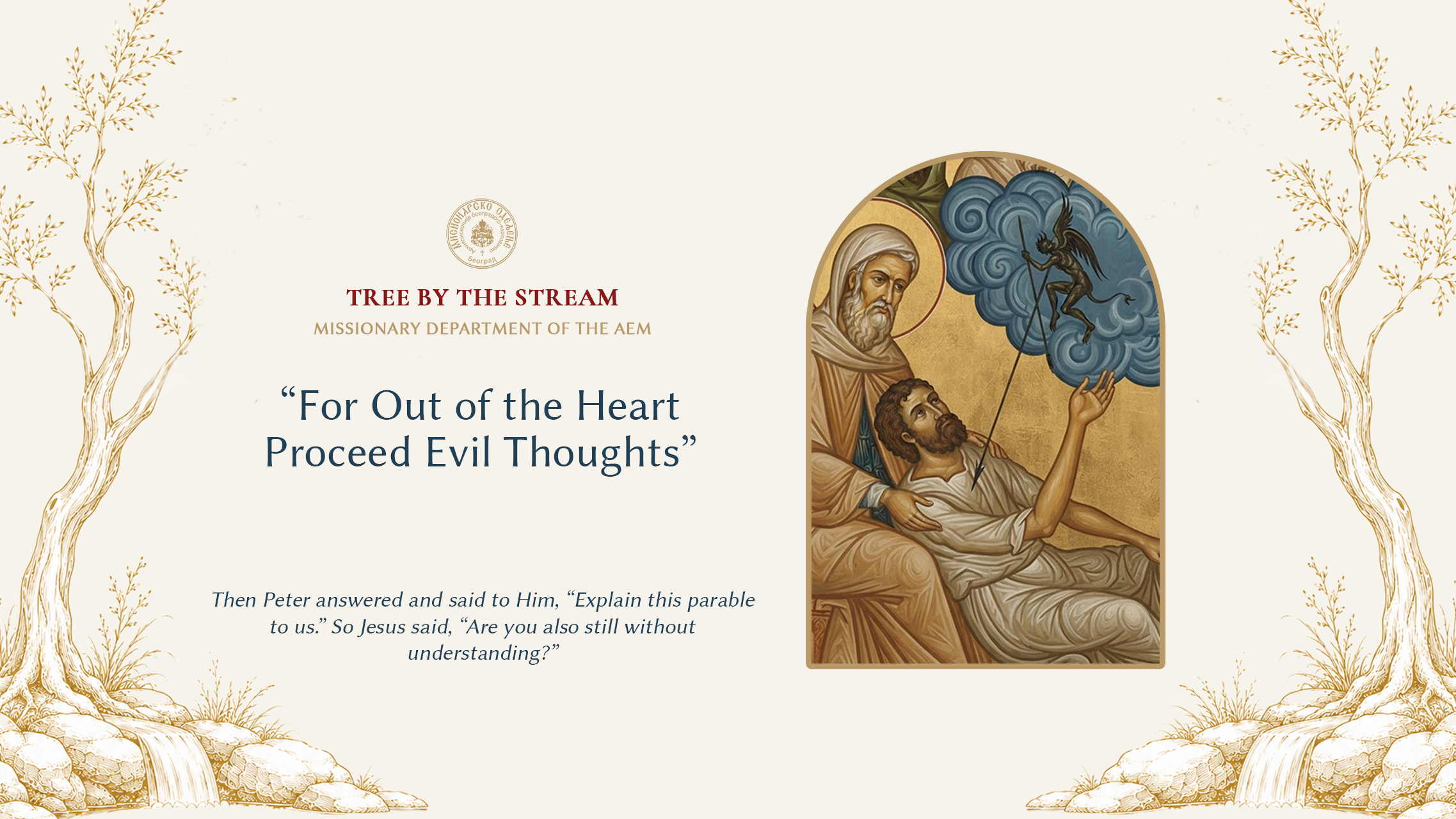
We may also cite the profound explanation offered by Blessed Jerome concerning the nature of spiritual warfare, the manner in which the devil presents evil thoughts to us, and the origin of those thoughts:
“Christ says that evil thoughts proceed from the heart. Thus, the principal faculty of the soul resides not in the brain, as Plato taught, but in the heart, as Christ Himself teaches. Therefore, those who claim that evil thoughts are implanted by the devil rather than arising through a person’s own will must be refuted. The devil can only provoke and stimulate evil thoughts; he cannot create them. Although the devil, ever vigilant in laying his snares, fans the smallest spark of our thoughts into a consuming flame for his own purposes, we must not imagine that he penetrates the hidden secrets of the human heart. Rather, he judges what is taking place within us by observing the condition of our body and our outward actions. For example, if he notices that we repeatedly fix our gaze upon a beautiful woman, he concludes that our heart has already been wounded by the arrow of passion.”
From these words we clearly see that evil thoughts arise within our own hearts, while the devil encourages them, intensifies them, and seeks through them to bring about our downfall. Just as God calls us to cooperate freely in the work of our salvation, so too participation in sin cannot be attributed to the devil alone; our own free will is also involved.
St. Theophan the Recluse explains how it is that evil thoughts spring forth from our hearts:
“From where do they arise within the heart? Their root lies in the sin that dwells within us, while their branching, multiplication, and concrete forms are shaped by each person’s own free will. What, then, should we do? First, cut away everything that proceeds from self-will. This is like cutting the leaves, branches, and trunk of a tree almost down to its very root. Then do not allow new shoots to appear, and the root itself will gradually wither. In other words, do not permit evil thoughts to proceed from your heart, and reject and drive away those that do arise. In this way, the sin dwelling within us will no longer receive nourishment; it will grow weak and eventually lose all its strength. This is the essence of the commandment: ‘Be sober; watch over yourselves. Gird up the loins of your mind.’ Alongside vigilance, discernment is equally necessary. For not only evil but also good thoughts arise from the heart; yet not every seemingly good impulse should immediately be put into practice. Discernment determines which thoughts ought truly to be fulfilled. It is like the gardener’s pruning knife, which cuts away certain branches while tending and cultivating others.”
St. Isidore of Pelusium continues this line of thought, explaining why evil thoughts arise within our hearts and from where these constant companions of our daily life originate. He writes:
“You ask: Why do evil thoughts proceed from the human heart and defile a person? It is because those who are entrusted with keeping watch have fallen asleep instead of remaining vigilant and guarding the fruit of the good seed that has been sown. If we were to persevere continually in watchfulness over ourselves, if we did not surrender to gluttony and excessive sleep, and if we did not defile the image of God within us—that is, if we did not allow the good seed to be replaced by evil—then the sower of tares would find no way to approach us and would be unable to cultivate within us those weeds that are destined for the fire.”
As we can see, the Holy Fathers speak unequivocally: we are responsible for our own sins, and constant vigilance over ourselves is indispensable if we are to live a genuine spiritual life.
In conclusion, we present the remarkably timely words of St. Luke of Crimea:
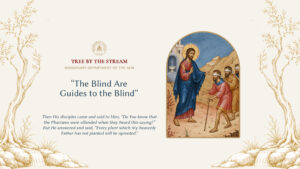
“The Apostle Peter asked the Lord: ‘Please explain these words of Yours. What do You mean when You say that nothing entering the mouth defiles a person?’ … The Pharisees failed to perceive the impurity of their own hearts. They did not understand that nothing created by God is inherently unclean. What truly defiles a person is only that which proceeds from the heart. When the human heart does not serve as a temple of the Holy Spirit, it can instead become a dwelling place for demons—those demons who incite people to evil thoughts, murder, adultery, fornication, theft, false witness, and blasphemy. The Pharisees did not understand this. They did not know how to teach people that they must purify their hearts, cast out the demons, and build their hearts into temples of the Holy Spirit. They were blind guides of the blind. Therefore, the Lord said: ‘Leave them alone!’ Thanks be to God, we have long possessed another Guide—the Lord Jesus Christ—whom we follow and shall always continue to follow. I could conclude my homily here, yet I wish to add one further observation. Those who refuse to fast often justify their attitude by appealing to the Lord’s words that nothing entering the mouth defiles a person. They also cite the words of the holy Apostle Paul: ‘Receive one who is weak in the faith, but not to disputes over doubtful things. For one believes he may eat all things, but he who is weak eats only vegetables. Let not him who eats despise him who does not eat, and let not him who does not eat judge him who eats; for God has received him’ (Rom. 14:1–3). Thus they argue: ‘There is no need to concern ourselves with food at all. Only those who are weak believe they should eat vegetables and abstain from meat and dairy products. We are not weak; we possess a deeper understanding, and therefore fasting is unnecessary for us.’ Is there any truth in such reasoning? … The Church’s regulations concerning fasting were never intended to protect us from being defiled by particular foods. Their purpose is entirely different. Holy Church established fasting in order to teach us self-restraint. By beginning with abstinence from rich foods, by disciplining the stomach that constantly craves satisfying and pleasurable nourishment, we gradually learn to discipline the heart itself. We learn to guard it against passions, sinful desires, and all that truly defiles us. This is our true task—to become free from the tyranny of the passions and lusts. Indeed, this is the fundamental aim of the Christian life. … As we train ourselves to restrain the appetite of the body, we gradually acquire the strength to restrain our other passions as well. Those who fail to understand this misuse the words of Christ and of the Apostle Paul to justify their unwillingness to discipline the stomach or to deny themselves anything that gratifies the senses or flatters self-love. Therefore, practice self-restraint—above all, restrain yourselves from those things that truly defile you as they proceed from your mouths: lies, curses, condemnation of others, quarrels, and slander. Abstain from these, and your heart will gradually become purer and purer, until, little by little, it is transformed fro m a dwelling place of demons into a temple of the Holy Spirit. Amen.”
Adapted for the contemporary reader based on the interpretations of the Holy Fathers by Stanoje Stanković.