Upon entering the house, the Magi saw, as the Evangelist Matthew writes, the Child with Mary His Mother. Here, Matthew carefully preserves the proper order of reverence: first to the Child—God made flesh—and then to His Most Pure Mother according to the flesh.
St. John Chrysostom remarks that Divine Providence arranged for Joseph to be absent from the house at that moment so that the Magi’s thoughts would not be darkened, lest they assume he was the father of Jesus.
St. Nikolai of Ohrid, on the other hand, asserts that the Magi did in fact see Joseph, but for them, he was of no significance. He writes:
“Providence placed Joseph beside Mary for the sake of the Jews, not for the Gentiles. Joseph needed to be called Mary’s husband in order to protect her from the contempt of the scribes and the severity of earthly laws. For the Gentiles coming from afar, Joseph might as well not exist. This is what the divinely inspired Evangelist wishes to convey by mentioning Jesus and Mary, and omitting Joseph’s name.”
This exemplifies how patristic interpretations may differ on details, but never on the core truths of the faith. Whether the Magi saw Joseph or not does not belong to the set of truths upon which our salvation depends.
St. Nikolai further offers a profound explanation of the words they fell down and worshipped Him, noting that the Magi were thanking God for the spiritual freedom they had gained:
“They who once bowed before the stars with fear and dread now fall to the ground with great joy before the living Lord, who had come to earth to deliver them from bondage to the stars and belief in blind fate.”
These words of St. Nikolai help us understand why Christians call themselves servants of God without shame or self-deprecation. Some neo-pagans mock this term, viewing it as a sign of weakness or self-loathing. But as St. Nikolai explains, serving God frees a person from passions, delusions, and enslavement to the devil. Those who refuse to serve God, are free to do so. But they should be under no illusion that they are serving God’s adversary, who hates them and wishes their eternal damnation. We serve God out of love, and have no reason to be ashamed of being called His servants. As Christ Himself says in John 15:15:
“I no longer call you servants… I have called you friends, for everything that I learned from my Father I have made known to you.”
The Gifts and Their Mystical Meaning
The Holy Fathers emphasize that the Magi’s choice of gold, frankincense, and myrrh was not random. St. Gregory the Great writes:
“Gold befits a King; frankincense is offered in worship to God; and myrrh is used to anoint the bodies of the dead. Thus, through these gifts, the Magi proclaim the mystery of the One they worship: with gold—as King; with frankincense—as God; and with myrrh—as the One who will suffer death.”
Blessed Theophylact of Ohrid also links the gifts to the prophecy of Balaam—through whom the Magi had learned of the star. He cites Numbers 24:9:
“He crouched, he lay down like a lion, and like a lioness—who will rouse him?… Blessed are those who bless you.”
Theophylact explains:
“Do you see the faith of the Magi, who through Balaam’s prophecy came to know that the Lord is both God and King, and that He would die for us? The lion represents royal dignity; lying down signifies death; and divinity is indicated by the power to bless.”
Thus, through their gifts, the Magi revealed the very truths prophesied centuries earlier.
St. Nikolai also reflects on the enduring nature of the gifts:
“Each of the three gifts symbolizes permanence and incorruptibility: gold remains gold, frankincense continues to burn, and myrrh retains its fragrance. No other three earthly objects could so faithfully represent the mission of Christ, nor more clearly express the permanence and eternity of His work on earth and the spiritual and moral values He brought from heaven. He brought truth, prayer, and immortality.”
Verse 12: The Departure of the Magi
“And being warned in a dream not to return to Herod, they departed to their own country by another way.”
St. John Chrysostom praises their faith and obedience:
“See the kind of faith they had—they were not scandalized, but obedient and wise. They did not question: ‘If this Child is truly great and powerful, why must we flee and be led away secretly like fugitives, when we came so boldly before such a multitude and a mad king?’ They had no such thoughts. This is the height of faith—not to seek reasons for what one is commanded to do, but simply to obey.”
Blessed Theophylact interprets this event as a sign of their spiritual growth:
“Notice the progression. First, God brought them to faith through the star. Then, in Jerusalem, they learned from the prophets that the Christ would be born in Bethlehem. Finally, God spoke to them through an angel in a dream.”
The Symbolic Meaning of “Another Way”
St. Gregory the Great offers a mystical interpretation:
“There is a profound message in the Magi returning to their homeland by another route. Our homeland is Paradise. Having encountered Jesus, we are forbidden to return by the path we once walked. For we left our homeland through pride, disobedience, attachment to the visible world, and desire for forbidden fruit. Therefore, the way back must be through humility, obedience, detachment from the visible, and restraint of carnal desires.”
Verse 13: The Flight into Egypt
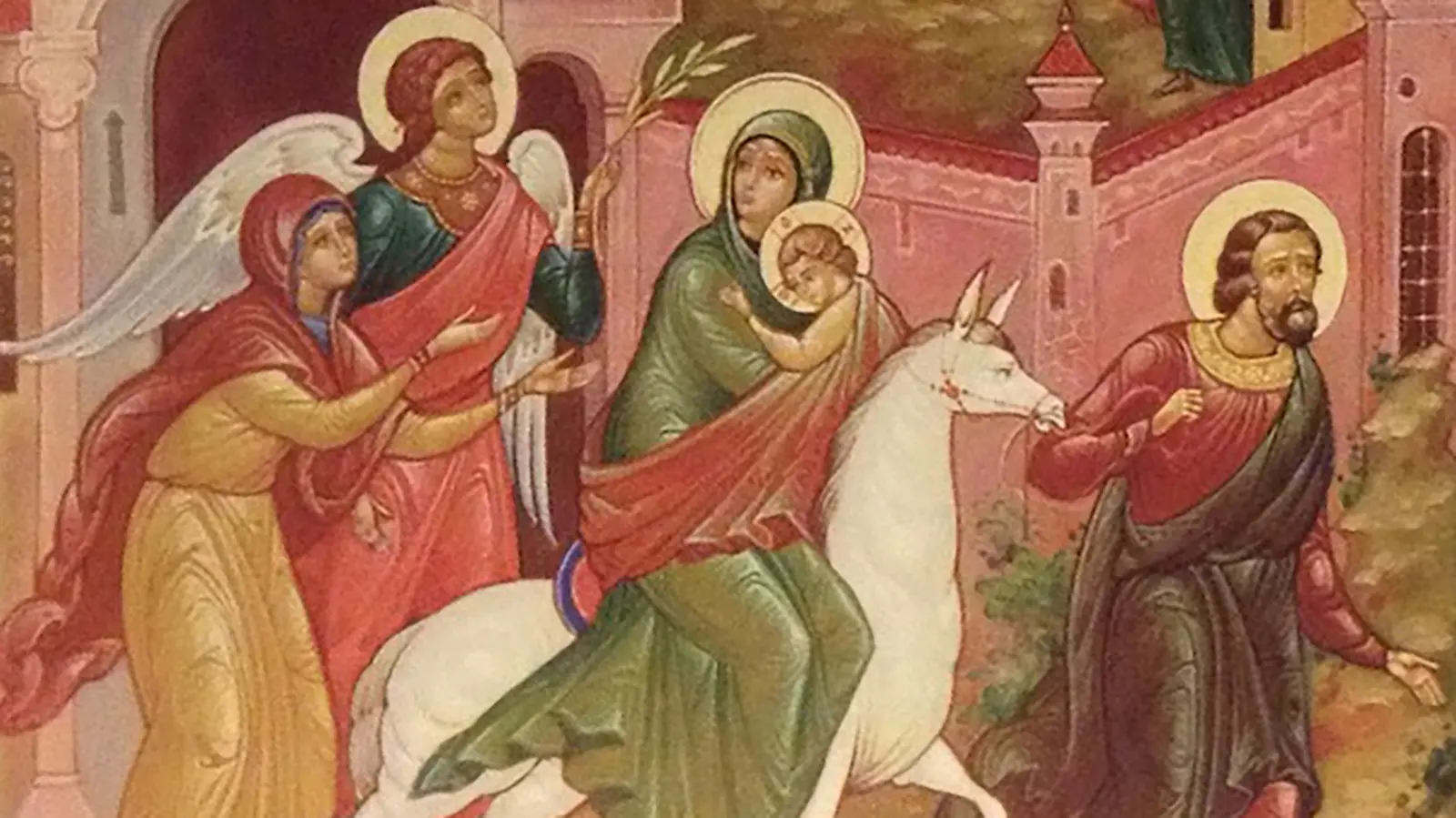
“Now when they had departed, behold, an angel of the Lord appeared to Joseph in a dream and said: ‘Rise, take the Child and His mother, and flee to Egypt, and remain there until I tell you. For Herod is about to search for the Child, to destroy Him.’”
Understanding the timeline of the events around Christ’s birth can be difficult due to the vivid narrative style of the Gospels. Euthymius Zigabenus explains that the angel’s warning came after the 40 days prescribed by the Law, during which the Holy Family travelled to Jerusalem for the presentation at the Temple, where they encountered Simeon and the prophetess Anna. After fulfilling all the requirements of the Law, they returned to Nazareth (Luke 2:39), and it was then that the angel appeared to Joseph in a dream.
Blessed Theophylact makes a meaningful observation about the language used by the angel:
“Do you now see why God allowed the Virgin to be betrothed? Here you are told: So that Joseph could care for her and protect her. The angel no longer refers to her as ‘your wife,’ but as ‘His mother.’ He does not say, ‘Take your wife,’ but ‘Take the Child and His mother.’ The suspicion had passed; Joseph, convinced by the miraculous birth, now fully believed that all was of the Holy Spirit.”
Adapted and presented for the contemporary reader, based on patristic interpretations, by Stanoje Stanković.