St. John Chrysostom reflects on the flight of the Holy Family and the return of the Magi to their land with the following words:
“We ought to consider why neither the Magi nor the Child remained in place. The Magi returned to Persia, and the Child with His Mother fled to Egypt. Why? Should the Child have fallen into Herod’s hands and escaped death while in his power? Had that occurred, one might question whether He truly assumed a human body, and disbelieve in the grandeur of the work of salvation.”
The Fathers note that God foresaw the emergence of the Docetist heresy—which denied the reality of Christ’s humanity and His true body—and thus, through these Gospel accounts, stripped the heretics of any justification for their false teaching.
When the angel says that Herod “will seek the child to destroy him”, he is revealing Herod’s future intentions. St. Nikolai of Ohrid writes:
“The angel speaks in the future tense. This means that Herod had not yet taken any concrete action against the living Child. But Herod constantly bore within his heart the fear of the Infant and the intention to kill Him. No one on earth knew Herod’s inner thoughts. But to God, the thoughts of man are like an open book. Only God knows what Herod plotted against Jesus. Only God can reveal the secret locked within Herod’s murderous mind.”
Verses 14–15:
“And he rose and took the child and His mother by night and departed to Egypt, and remained there until the death of Herod. This was to fulfill what the Lord had spoken by the prophet: ‘Out of Egypt I called my son.’”
Though we may overlook the circumstances surrounding this escape to Egypt, the Holy Fathers do not. St. Innocent of Kherson gives a vivid description of how traumatic and sacrificial this journey must have been for the elderly Joseph—over 80 years of age—and the Theotokos with the Divine Infant. We might find it burdensome to set out on a long journey by car in the middle of the night, even with all the conveniences of modern travel. They had only a donkey, and Joseph, aged and weary, had to walk on foot. St. Innocent writes:
“Imagine the holy elder rising suddenly in the dark of night from a poor bed; imagine him, filled with the gravity of the angel’s message, walking with trembling steps toward the sleeping Virgin and Child, gently waking her. Then he quietly tells her that they must immediately leave—not only the house but their homeland—and flee to Egypt. See them packing a few essentials, the Mother taking the sleeping Child into her arms and mounting a lowly animal, and the elder following behind with uncertain steps—and all this, at night. Who among us would set out on such a journey without dire necessity? The path from Bethlehem to Egypt was treacherous and difficult: through mountains and forests, waterless places, and shifting sands, under threat of wild beasts and bandits. And thus the Saviour of the world, a small child in His Mother’s arms, fled by night along this road.”
This shows that Christ began His suffering for our sake from the very beginning of His earthly life.
St. John Chrysostom explains why the journey led specifically to Egypt:
“Since Babylon and Egypt were the lands most inflamed with the fire of paganism, the Lord, in the very beginning, showed that He would transform and redeem their inhabitants. In doing so, He signalled that the whole world should expect salvation. Thus, He sent the Magi to Babylon and Himself journeyed to Egypt with His Mother.”
He continues with a crucial teaching for those new to faith who may expect only blessings and ease:
“What do we learn from this? That from the very beginning we must expect trials and attacks. See how this begins from Christ’s infancy: as soon as He is born, a tyrant rages, and a flight into another land takes place. The sinless Mother flees into a land of pagans. So if you are honoured with a spiritual calling and then suffer great trials, do not be shaken and say, ‘Why this suffering? Shouldn’t I be crowned and glorified for doing God’s will?’ Rather, look to Christ’s example, and endure all courageously. This is the lot of the spiritually-minded—to be tried from every side.”
Yet this does not mean that the life of the faithful is only suffering. God also grants joy and consolation to strengthen us in love towards Him, to draw us near. As the Apostle Paul writes: “We know that in all things God works for the good of those who love Him” (Romans 8:28). Chrysostom explains elsewhere:
“The God of love sweetens Joseph’s trials with joy, as He does with all the Saints. He never leaves them in continual peril, nor in uninterrupted peace, but governs their lives through both.”
Concerning the phrase “Out of Egypt I called my son”, Blessed Theophylact answers those who claim that the prophecy of Hosea (Hos. 11:1) refers to the people of Israel and not to Jesus Christ. He responds:
“Let us ask: Who is the true Son of God? The Jewish people who worshipped idols and the image of Baal Peor—or the One who is truly the Son of God?”
St. Philaret of Moscow sees this episode as a mystical foreshadowing of the later rejection of the Messiah by the Jews. He writes:
“Thus, the salvation of the Gentiles, who were called to faith through the unbelief of the Jews, was prophetically prefigured in this flight of the Savior—driven out of Judea and hidden among the Gentiles. To prepare the unfaithful for the grace of the Gospel, the Son of God left the rule of Herod, His persecutor, and took refuge in the land of the most superstitious pagans.”
In other words, the Light of the world goes into the greatest darkness to begin breaking the dominion of the prince of darkness.
Verse 16:
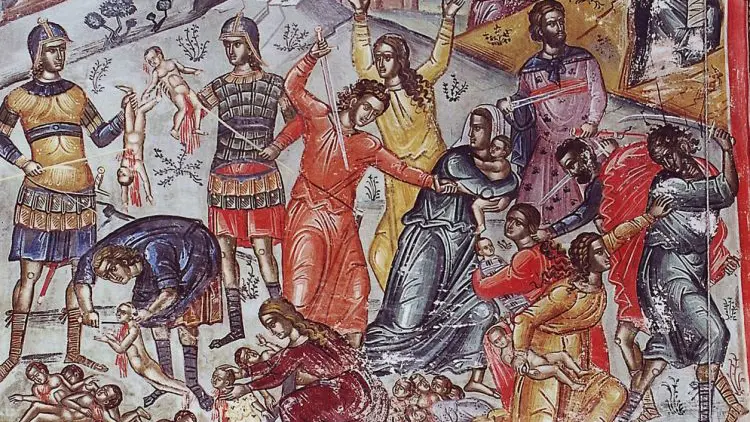
“Then Herod, when he saw that he had been tricked by the wise men, became furious, and he sent and killed all the male children in Bethlehem and in all that region who were two years old or under, according to the time that he had ascertained from the wise men.”
One natural question that may arise is: Why did God permit the massacre of innocent children? St. John Chrysostom addresses this directly:
“You may say: Herod acted unjustly—but why did God allow it? What can we answer? I will point again to a rule I constantly repeat—whether in church, in the square, or anywhere. Keep this rule close, for it answers many such questions. What is it? That the unjust sufferings we endure are accounted by God either as forgiveness of sins or as reward. But you may ask: What sins had these children committed, that they should atone with their blood? Indeed, this may apply to adults who have sinned greatly. But what sins had these infants? Have you not heard what I said? If there are no sins to atone for, then their suffering is rewarded in the life to come.”
One might read that Herod had been “tricked” by the Magi and suppose this gave him some justification for his cruelty—as if he acted out of retaliation. But the Evangelist Matthew makes it clear how Herod perceived the situation. St. Nikolai of Ohrid explains:
“The Eastern stargazers did not deceive Herod. They made him no promises. The Gospel says only: ‘having heard the king, they went their way.’ But Herod, used to having his every word obeyed, considered it treachery that they did not return to Jerusalem to report on the divine Child.”
Adapted and presented for the contemporary reader, based on patristic interpretations, by Stanoje Stanković.