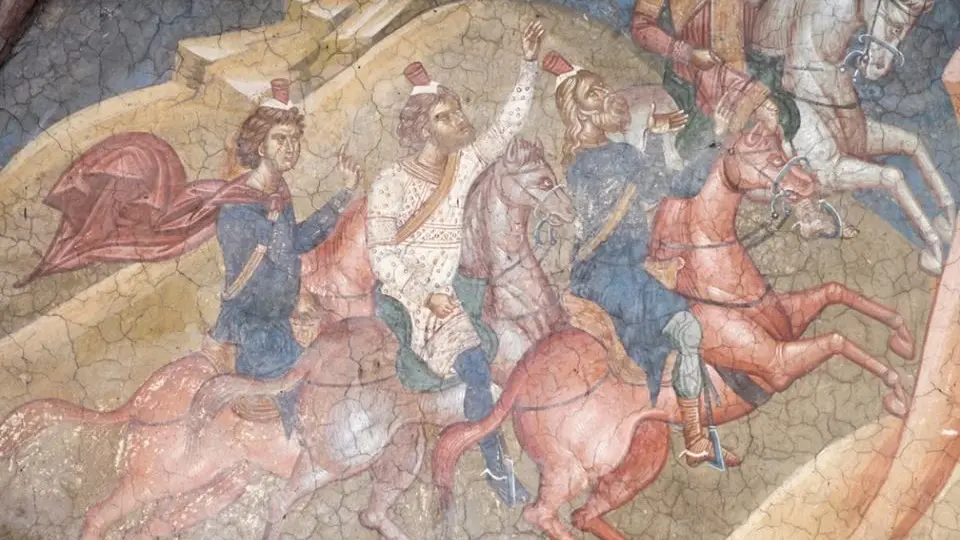
St. John Chrysostom draws attention to a subtle but meaningful detail: Herod tells the Magi to inquire about the child, not about the King, even though the Magi had spoken of the “King of the Jews” who had been born. Chrysostom explains the reason for this:
“Herod did not say, ‘Go and inquire about the King,’ but ‘about the child.’ It was unbearable for him even to pronounce the word that implied royal authority. The Magi, out of their great piety, did not notice this and could not have suspected that they were dealing with such malice—nor did they imagine that someone would dare to oppose so wondrous an order. Suspecting nothing of the sort, and judging others by themselves, they departed.”
This final remark from Chrysostom is especially profound: we humans tend to judge others by our own inner condition. On this theme, a brief but insightful teaching from Elder Paisios of Mount Athos may be added. His words help illuminate the psychological truth that people judge according to the content of their own thoughts:
“The spiritual state of a person is revealed by the kinds of thoughts he has. People judge things according to the content of their own minds. If someone’s thoughts are lacking in spiritual depth, he will draw false conclusions and do injustice to others. For example, a man who gives alms at night so as not to be seen will never think anything bad when he sees someone else walking late at night. But if that same person is seen by someone who spends his nights in sinful living, he will say: ‘Just look at that scoundrel—I wonder where he spent the night,’ because he is speaking from experience. Or, if someone hears a thumping sound at night from the floor above, a person with good thoughts will say: ‘That person is making prostrations,’ while someone with corrupt thoughts will say: ‘He’s dancing all night.’”
According to the Holy Fathers, the star disappeared after the Magi entered Jerusalem, but reappeared when they resumed their journey to Bethlehem. St. John Chrysostom explains the reason:
“It disappeared so that, deprived of their guide, they would be compelled to consult the Jews—thus making the event known to all. When they inquired and learned from the very opponents of Christ, the star appeared again.”
The Star and the Rejection of Astrology
St. Gregory the Great used this passage to refute astrology:
“It is necessary to know that the heretics known as Priscillianists believe that every person is born according to the determinations of the stars. As proof of this error, they cite the fact that a new star appeared when the Lord was born. But let us consider what the Gospel actually says about the star: ‘It went before them and stood over the place where the Child was.’ So the Child did not go to the star; rather, the star came to the Child. The faithful heart should never entertain the thought that fate rules our lives. Only the Creator, who made life, also governs it. Man was not made for the stars; the stars were made for man.”
In this same commentary, St. Gregory, Bishop of Rome, explains the mysterious meaning of Herod’s futile search for Christ. He asserts that Herod represents all hypocrites who pretend to seek the Lord but never find Him—because they seek Him insincerely.
The words “until it came and stood over where the child was” may often go unnoticed, yet they reveal a miracle. Blessed Theophylact of Ohrid explains why this kind of star movement was supernatural:
“This too was miraculous, for the star descended from the heights and, drawing near to the earth, indicated the exact location of the child. Otherwise, how could they have known precisely where Christ was, had the star remained high in the sky? Celestial bodies cast their light over vast distances. You may see the moon above your house and I may see it above mine, and anyone might say that the moon is directly overhead. But this star could not have pointed to Christ unless it descended and stood directly above His head.”
This commentary reinforces the argument that this was no ordinary star at all, but rather an angel assuming the appearance of a star.
From the Law to the Heavens: A Shift in Divine Pedagogy
St. Gregory Palamas interprets the reappearance of the star as a sign that one should no longer seek divine meaning solely in the teachings of the Law and the Prophets—but rather look to the heavenly teaching that the Lord has brought from above.
We continue with verses 10 and 11:
“When they saw the star, they rejoiced exceedingly with great joy. And going into the house, they saw the child with Mary His mother, and they fell down and worshipped Him. Then, opening their treasures, they offered Him gifts: gold, frankincense, and myrrh.”
The joy of the Magi was natural, for their longings and expectations were fulfilled. Their sacrifice was immense—they had undertaken a long and dangerous journey, left behind the comfort and security of their way of life, all to behold the promised Messiah of the Jewish people.
St. John Chrysostom reflects on the great effort and devotion of these three men:
“They brought gold, while you scarcely offer bread to the poor. They rejoiced at the sight of a star, while you remain unmoved even when you see Christ Himself—naked and abandoned (referring to the poor, as in Matt. 25:45). Among all of you, is there anyone, even one, who having received so many blessings from Christ, would undertake a journey for His sake like these wisest of the wise—these barbarians? And what am I saying—journey? Many of our women are so delicate that if they are not carried on donkeys, they cannot walk even a single street to see Christ in His spiritual manger (he means the Church). Even those who can come to Christ often prefer their household duties—or worse, the stadium—to the Church. Barbarians who had not even seen Christ travelled far for Him. And you, even after seeing Him, do not imitate them. You look at Him, then turn away and rush off to stare at nonsense. You see Christ lying in the manger and run off to watch women on the stage. What thunderbolts and lightning are such deeds not worthy of!”
St. Innocent of Kherson remarks that the Magi, despite the honour and praise they received in Jerusalem, felt deeply uneasy there. They yearned once more for the freedom and divine guidance they had known before. Thus, they were filled with great joy when the star reappeared after they departed the city.
The Evangelist Matthew states that they entered a house, whereas Luke mentions a manger in a cave where animals were kept. This suggests a lapse in time—most likely, once the census crowds had diminished, the Holy Family was able to find proper shelter.
The Fathers also comment on the reverence and worship the Magi offered to the Child. St. John Chrysostom ponders how such esteemed and wise men, seeing such humble conditions—a poor mother, a child, a modest home—could fall down and offer divine honors. He answers:
“It was the star, and the divine illumination of their minds, which gradually lifted them to the highest knowledge. Otherwise, they would not have shown such honor under such humble circumstances. To the senses, nothing was impressive—only a stable, a shed, and a poor mother. Here you can clearly see their love of wisdom. Understand that they did not approach Christ as a mere man, but as God and Benefactor. They were not scandalized by anything external or visible. Instead, they offered worship and gifts—not like the Jewish sacrifices of animals, but, as if true Christians, they brought understanding, obedience, and love.”
Adapted and presented for the contemporary reader, based on patristic interpretations, by Stanoje Stanković.