We continue with the interpretation of verse 22, chapter 8.
St. Cyril of Alexandria explains that everything Christ required of others, He first demonstrated by His own example. Here is St. Cyril’s commentary: For Christ Himself, for the benefit of those who were with Him, disregarded [the bodily attachment to] His Mother and brethren, saying: Who is My mother, and who are My brethren? Behold My mother and My brethren (Mt. 12:48–49).
St. Luke of Crimea beautifully connects the command of the Lord Jesus with our spiritual life. Here are the words of the holy physician Luke (Voino-Yasenetsky): “We are obliged to think of death. The inevitability of death must remind us that after it we shall stand before the Judgment of God. The death of the body must remind us that only the body dies, while the soul will live forever. The death of the body should not terrify those who remain steadfast on the path of Christ: all the Saints awaited death calmly, even joyfully. And because our disposition towards death should be such—that we ought not to be anxious about death and about dead works—the Lord said to the man who wished to become His disciple: Let the dead bury their own dead. There will be others to bury your father, men occupied solely with earthly affairs, but you, follow Me. See then that these words, which appear so severe, are not such. They are holy words that remind us of eternal life, for it is to that life that all of us are destined.”
Now we arrive at verses 23 and 24:
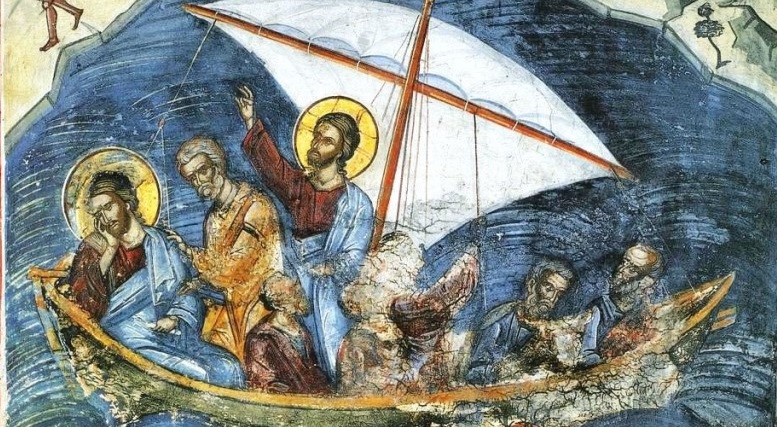
And when He entered into a boat, His disciples followed Him. And behold, a great tempest arose on the sea, so that the boat was covered with the waves; but He was asleep.
St. John Chrysostom, at this point, teaches that the Lord intentionally separated the Apostles from the rest of the crowd, because He wished to prepare them for the struggle that lay ahead. The saint says: “Christ first dismissed the multitude, and then took the disciples with Him, as they themselves testify. He did not take them without purpose or aim, but so that they might become witnesses of the miracle that was to take place. Jesus, as the best teacher of children, instructed the Apostles so that, on the one hand, they might become fearless in the midst of trials, and on the other hand, that they might remain humble amidst honours. In order that they should not grow proud because the Saviour had sent the others away while retaining them, Christ both attained this aim and simultaneously trained the Apostles to endure trials with courage by permitting them to struggle with the waves. Although the previous miracles were indeed great, this one carried within itself profound instruction and served as a sign akin to the ancient wonders. For this reason, the Saviour took only the disciples with Him. Where only miracles were performed, there Christ allowed the multitude to be present; but where trials and terrors arose, there He took with Him only the ascetics of universal stature whom He desired to instruct.”
Euthymius Zigabenos develops Chrysostom’s thought on the instruction of the disciples and writes: “Jesus slept with wise intent, so that the disciples might be greatly afraid; for if the Lord had been awake, the Apostles would not have been afraid at all, or, at most, only a little. It was necessary that they experience great fear, in order that they might more strongly perceive His power and acquire great faith in Him.” This can also be observed in the lives of the great missionaries of the Church—all of them first underwent the necessary preparation for the struggle that was to follow. There was a gradual training for the ascetic task; they did not, as some might romantically imagine today, suddenly decide one day that preaching was appealing or fulfilling. Rather, it was a difficult but profoundly exalted service in the eyes of the Lord.
Blessed Jerome of Stridon points to an Old Testament foreshadowing of this event in the Book of Jonah. Here are Jerome’s words: “Concerning the prefiguration of this miracle, we read in the book of the prophet Jonah. Jonah, while others on the ship were troubled, slept peacefully and was at rest. When he was awakened, he delivered those who roused him by his authority and by the mystery of his suffering.”
The same applies to our spiritual life. Here we may cite an instructive interpretation of St. Ignatius Brianchaninov concerning this passage of Holy Scripture. See how he relates the event to our inner life: “The sleep of the Saviour signifies our forgetfulness of God. Through temptation, this forgetfulness is dispelled. God, whom we remember and invoke for help, calms the winds and the sea. The All-good and Almighty One grants a great calm (Mt. 8:26) to all who remember God and call upon Him for aid in the time of trial.” And the ancient Father St. Ambrose of Milan notes that how we perceive God’s care in the moment of trial depends on our spiritual condition. Ambrose writes: “Christ is still asleep for the disciples, and here He teaches us that He sleeps for the fearful, while He is awake for the perfect.”
Now let us read the following two verses, 25 and 26:
And His disciples came to Him, and awoke Him, saying: Lord, save us: we perish! And He saith unto them: Why are you fearful, O you of little faith? Then He arose, and rebuked the winds and the sea, and there was a great calm.
St. John Chrysostom explains why the Lord rebukes the Apostles: “Jesus first reproves His disciples, showing thereby that one ought to be courageous even in the midst of the strongest waves, for God orders all things for good. Even their very agitation was of benefit, since the miracle appeared to them far more important and was fixed forever in their memory. When God intends to accomplish something wondrous, He first arranges many things beforehand so that it may be firmly imprinted in the memory of men, lest they forget the miracle He has wrought.”
Blessed Theophylact, for his part, explains a nuance in Christ’s words addressed to the frightened disciples. He writes: “He did not call them ‘unbelieving,’ but ‘of little faith.’ When they said, Lord, save us, they showed thereby their faith; but the words, we perish, were not of faith, for Jesus was with them in the boat, and there was no reason for fear. Do you see how He reproves them for their cowardice, wishing to show them that fearfulness itself brings danger? Therefore He first calms the turbulence in their souls, and only afterwards the storm on the sea.”
Let us now listen to an interpretation of this passage that relates directly to our spiritual life. Blessed Augustine writes: “You are sailing across the sea of this life, and the wind rises; storms and temptations assail you. Why is this, if not because Jesus has fallen asleep within you? If He were not asleep within you, would you delight in inner calm? What does it mean that Jesus falls asleep within you, if not that Christ’s faith slumbers in your heart? What must you do to be delivered? Awaken Jesus and say: Lord, we perish! He will awaken, faith will return and remain within you. When Christ is awake, then even amidst the violent surges of the waters your boat will not be submerged. Your faith will command the winds and the sea, and the danger will pass.” We see, therefore, that temptations often arise in our lives when we weaken in faith, when our spiritual life falters. This is why the Fathers direct us first to turn inward and to seek within ourselves the causes of what befalls us in life.
Blessed Peter Chrysologus writes here about the condition for security in the life of the Church, noting that we are safe only so long as we remain on the ship in which Christ Himself is present. The saint writes these words: “Christ always abides in the ship of His Church, calming the waves of this life so that by a peaceful voyage He may bring to the heavenly homeland those who believe in Him. In this way, those whom He has already made partakers of His human nature He will make fellow citizens of His kingdom. Thus, Christ has no need of the ship, but the ship has need of Christ, for without the Heavenly Helmsman the ship of the Church is unable to cross safely the sea of this life and reach the heavenly harbour amidst so many dangers.”
Ava Justin of Ćelije (St. Justin Popović), in his unique manner, writes about the absolute dominion of the Lord Jesus over nature. Justin writes: “He spoke to the sea. But does the sea have ears? Who else speaks to the sea with words? The Lord Christ knows the language of the sea, the soul of the sea. And there arose a great calm from Him—the only true calm, from Him, the Creator of the sea. The storm of the sea troubled the souls of the disciples; the calm of Christ quieted the stormy sea. The disciples did not know the mystery of the sea; they did not know, because of their little faith, that the Lord Christ has authority even over that mystery, that the mystery of the sea is in Him. They were greatly afraid of the storm because they did not understand that while He slept in the body, His all-embracing soul was awake and unceasingly watching over the universe and over the innumerable solar systems and worlds, as well as over every bird, plant, and insect; He watches also over every cherub and angel, over the sea and the wind, and over every human being.”
Adapted for the contemporary reader from the patristic commentaries by: Stanoje Stanković