
This text was published on the Kinonia portal, in the section “Written Word,” on 8 September 2025.
The internet sphere and electronic media represent a new field of work and a new challenge for the mission of the Church. At the beginning of the 21st century, certain clergy and theologians recognized the importance of the voice of the Church’s presence in this new space. Data showing a large number of internet users across all generations, as well as the increase in the average daily time spent online, provided clear evidence that some response of the Church to this emerging social phenomenon was necessary.
Beginnings are always difficult, filled with uncertainties that often result in error in terms of approach or the finding of the adequate solution. So it was in this case as well. Many of the initially good missionary initiatives, have for various reasons arrived at a point where they need to be reevaluated and improved. Chief among these shortcomings was the absence of theological content, which alone could provide the deeper foundation for the surface forms necessary for witness to the contemporary world. Without such grounding, we have increasingly encountered sermons and various forms of instruction (both in electronic media and within churches and other settings) which dazzle with impressive form and rhetoric, but fail to initiate the process of transformation in their listeners. They remain remembered as eloquent speeches, “good lines,” or witty remarks, spoken of much like other passing internet content—yet lacking any organic connection with the essence of the Church.
It was precisely in such an environment, at the close of the first quarter of the 21st century, that Kinonia emerged as the portal of the Missionary Department of the Archdiocese of Belgrade–Karlovci. Its principal contribution—something that ought to be self-evident for all forms of Church mission—is that it has established theological content as its very foundation.
Kinonia reminds us that the most important source of theology is the liturgical life of the Church. This life rests on the presence of Christ. Before His saving Passion, Resurrection, Ascension, and the Descent of the Holy Spirit upon the apostles, this presence was manifested in His personal communion with the apostles and His other disciples. The many miracles—multiplying loaves, turning water into wine—were a foreshadowing and foretaste of that which would be fulfilled in the Church, born on the day of Pentecost: the communion of love of the Triune God with the faithful. From the Father, through the Son, in the Holy Spirit.
In this sense, encompassing trinitarian, ecclesiological, christological, pneumatological, and anthropological aspects, numerous texts have been published on Kinonia in the past year. Their authors include hierarchs of our local Church, clergy of all ranks, as well as members of the faithful. They have presented and illuminated many dimensions of the liturgical life from which theology continually draws its nourishment. In their writings, they have relied both on the truths proclaimed by the prayerful liturgical experience of the Church and on patristic theology as a faithful witness to the divinely revealed mysteries.
At the same time, visitors of the Kinonia portal have the opportunity to read original patristic texts written many centuries before, which strengthen us in the awareness that the Church has persevered for centuries in the confession of the true faith. Naturally, Scripture and the Gospel writings serve as inspiration for many authors, from which reflections on numerous contemporary topics are then drawn.
At the beginning of the 20th century, one distinguished Serbian sociologist insisted on a theory that the economic prosperity of society depends upon the moral elevation of the individual. In the 1930s, St. Bishop Nikolaj (Velimirović) raised the bar even further, teaching that the moral character of the individual—and subsequently the social and economic climate of a society—depends upon the purity of dogmatic confession of faith. It is precisely this sequence order that Kinonia cultivates and advocates: dogmatics, ethics, and then sociology.
The Kinonia portal thus presents itself before us as a signpost amid uncertainties and as a platform for the latest efforts to link theology with art, journalism, ecology, medicine, and psychology. It has achieved this in the past year. We firmly believe that in the time ahead, under the leadership of its editor-in-chief Mr. Branislav Ilić, with an ever-growing number of diligent and gifted collaborators—and with the help of the All-Good Lord—Kinonia will continue to be an evangelizing hallmark which gives rise to faith in human hearts (Rom. 10:17). Indeed, it has taken these very words of the holy Apostle Paul as its motto, its programme, and its promise, which together we shall strive to fulfill.
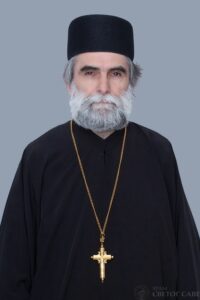
By: Protopresbyter Aleksandar Jevtić, permanent associate of the Kinonia portal