We begin the patristic interpretation of the fourth chapter of the Gospel of Matthew.
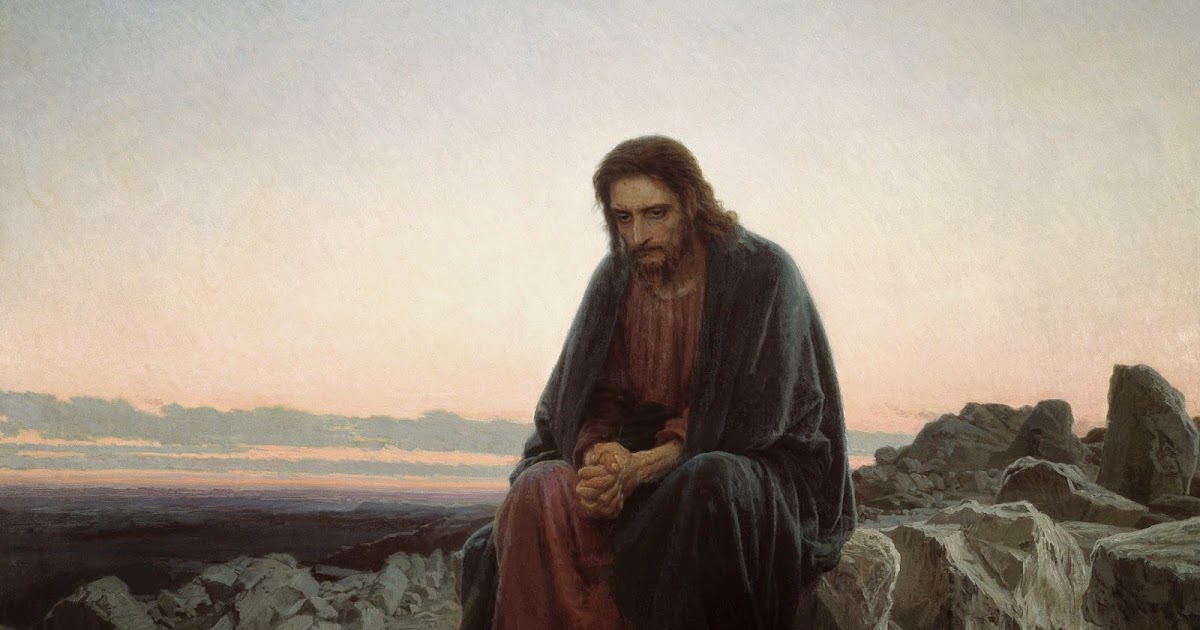
Then Jesus was led by the Spirit into the wilderness to be tempted by the devil.
The desert into which the Holy Spirit led the Lord Jesus is located between Jericho and the Dead Sea. One of the mountains in that area is even named the Mount of Forty Days, after the fast. When reading the words that the Spirit led Jesus, some might wonder whether the Lord truly respects human freedom, and whether Jesus voluntarily went into the wilderness for the ascetic struggle. This verb “led” can, according to the interpretation of the Church Fathers, mean that someone was indeed forcefully taken somewhere, but also that one agreed to someone’s suggestion. An example of this can be found in the first chapter of the Gospel of John, when Andrew brings his brother Simon, the future Peter, to the Lord Jesus: He first found his own brother Simon and said to him, ‘We have found the Messiah’ (which means Christ). He brought him to Jesus (John 1:41–42). Thus, just as Peter agreed to be brought by Andrew, so the Lord Jesus also went voluntarily into the wilderness. Blessed Jerome of Stridon comments: “Jesus was not led against His will, He was not dragged there as a prisoner, but went voluntarily.” It is also important to emphasize something essential — according to the words of St. Ephrem the Syrian, the very fact that the Spirit leads the Son of God into the desert bears witness to their equality in power, authority, and honor — that the Spirit is not lesser than the Son, nor is the Son lesser than the Spirit, contrary to the heresies that arose in antiquity.
St. Luke of Crimea reflects on this Scripture passage with the following words: “The account of His temptation in the wilderness refutes the heresies of the Monophysites, Eutyches and Dioscorus, who taught that in the Lord Jesus the human nature was almost swallowed up by the Divine. No, it was not swallowed; He was truly man and at the same time truly God. In His most holy person, human nature was united indivisibly and unconfusedly with the true Divine nature. In Him were present all human feelings and human will. He endured human suffering. And behold, this true God was led by the Holy Spirit into the wilderness; He did not go on His own, but was led by the Holy Spirit. What does this mean — why was it necessary for the Holy Spirit to lead Him into the desert to be tempted by the devil? Again, because He was truly man, and again, because it was difficult for Him as man to take upon Himself this indescribable struggle — the struggle of a forty-day fast, of life in the wild desert with lions, hyenas, and wolves.” Thus, we see that the Holy Fathers teach us that the Lord felt all the hardships of human life on earth. He did not avoid the sufferings and burdens that press down upon humanity. However, in one respect He was different from us — within Him there was no struggle with sin. He was sinless and never, throughout His life on earth, committed any sin, nor did He have the internal struggle with sin which all humans endure due to their fallen nature.
Some are also confused by the fact that the Lord permitted Himself to be tempted by the devil — that rebellious creature whom the Lord Himself had created. St. Gregory the Dialogist (Gregory the Great) wisely responds to this dilemma: “When it is said that the God-man is led up to a high mountain or taken into the Holy City by the devil, the mind is struck with perplexity, and human ears are hesitant even to hear such a thing. However, we should not regard this as incredible, considering the other events related to the Lord. It is well known that the head of all the ungodly is the devil, and that the members of this head are all the ungodly. Was not Pilate a member of the devil, as were the Jews who persecuted Christ, and the soldiers who crucified Him? What, then, is strange in that He permitted the devil to lead Him, when He also allowed the devil’s members to crucify Him? It is therefore not unworthy of our Redeemer that He permitted Himself to be tempted, for He came to be put to death. Indeed, it was just that He should, by His temptations, overcome our temptations.”
Saint John Chrysostom, in his divine wisdom, explains a phenomenon that often confuses many people who are taking their first steps in the life of the Church. They say: “While I lived in sin, I never had any real problems or difficulties, but as soon as I was baptized, I immediately encountered temptation. What is going on here?”
Saint Chrysostom responds: “Since Christ did everything and endured everything for our instruction, He also now allows Himself to be led into the wilderness and to enter into battle with the devil so that no one who is baptized and later suffers more temptations than before might be disturbed as though something unexpected were happening. Rather, he should bravely endure every trial as something entirely normal. For you did not receive armour in order to remain idle, but to fight. That is why God does not prevent trials from coming upon you. Firstly, He allows them so that you might recognize that you have become stronger. Secondly, that you might remain humble and not become proud because of the greatness of the gifts you have received, as you see that trials are able to humble you. Thirdly, so that the cunning spirit, who still doubts that you have turned away from him, might, by seeing your endurance in trials, be convinced that you have truly abandoned him. Fourthly, that through these trials you might become firmer and stronger than iron. Fifthly, that you might receive clear testimony concerning the treasure you have obtained.”
This same saint addresses another dilemma: if Jesus, as the all-knowing God, knew that the devil would tempt Him in the desert, why did He go there? Scripture says: Pray that you do not enter into temptation (Mt. 26:41), and in the Lord’s Prayer we ask: Lead us not into temptation, but deliver us from evil (Mt. 6:13). Saint Chrysostom continues: “How, you ask me, is it said: Pray that you do not enter into temptation? That is why the Evangelist tells you that Jesus did not go on His own but was led into the desert by divine command, thereby showing that we ourselves ought not to deliver ourselves into temptation. However, when we are drawn into them, we must hold firm with courage. And see where the Spirit led Him — not into a city, not into a marketplace, but into the desert. He seems to have wanted to attract the devil, to give him the opportunity to tempt not only through hunger but also through the very solitude of the place, for the devil especially attacks us when he sees that we are alone. Thus he first approached the woman, finding her alone, without her husband. When he sees us in the company of others, he is less bold and does not dare attack. For this reason, it follows that we should gather more frequently, so that the devil cannot easily ensnare us.” In this final thought, the saint shows yet another reason why communal prayer in church is so important for the faithful. The Fathers also say that the first Adam fell in the Garden of Paradise, while the Second Adam, the Lord Jesus Christ, began His redeeming mission in a place utterly opposed to the garden — in the barren wilderness.
The second verse reads:
And after fasting forty days and forty nights, He was hungry.
Saint Chrysostom explains an important point in spiritual life, namely, that the devil is not a proponent of fair combat, so to speak — that he waits precisely for our weakness to strike. Therefore, it is essential to continually seek the protection of God so that He might constantly guard us and shield us from the devil and his influence. The saint also explains why the Lord began His public ministry precisely with fasting: “Look at the cunning with which Satan approaches, the moment he waited for. The devil does not come while Jesus is fasting, but when He is hungry. From this, understand how great a good and how powerful a weapon against the devil is fasting; understand and learn that, having been cleansed by the waters of Baptism, one should not surrender to indulgence, drunkenness, and the abundance of food, but rather practice fasting. That is why Christ Himself fasted — not because He needed to fast, but for our instruction. Service to the stomach was the cause of sins committed before Baptism. Just as a physician, after healing a patient, forbids him from doing what caused the illness, so too Christ, after Baptism, introduces fasting. Adam was cast out of Paradise because of gluttony; in Noah’s time, it caused the Flood; and on the Sodomites, it brought down fire. Though their sin was also lust, the root of both punishments came from indulgence of the stomach.”
Chrysostom also explains the length of Christ’s fast, why it lasted exactly forty days: “Christ fasted forty days, showing us the healing remedy. He did not go beyond that, lest the miracle appear too excessive and thus cast doubt on the reality of the Incarnation. Such doubt is impossible now, for before Him, Moses and Elijah, strengthened by divine power, were also able to fast for that long. Had Christ continued fasting further, many would have taken that as an excuse to doubt the truth.”
Blessed Theophylact of Ohrid provides an explanation regarding the Lord’s ascetic labour and writes: “He became hungry when He Himself allowed His (human) nature to feel it, so that He might give the devil the opportunity to tempt Him with hunger, and thereby conquer and defeat him through His endurance, and grant us the victory.”
Saint Gregory the Dialogist (Gregory the Great) offers another interesting interpretation of why the Lord fasted for forty days. He says that the strength of the Ten Commandments given by God to Moses is fulfilled by the four Gospels. When these two numbers — ten and four — are multiplied, we obtain forty, because we fulfill the Ten Commandments when we live in perfect accordance with the Gospel. Saint Gregory thus shows that the same God gave the moral law in both the Old and New Testaments and that the Old Testament should not in any way be underestimated as a part of Holy Scripture.
Adapted and composed for the modern reader based on patistic commentaries by: Stanoje Stanković