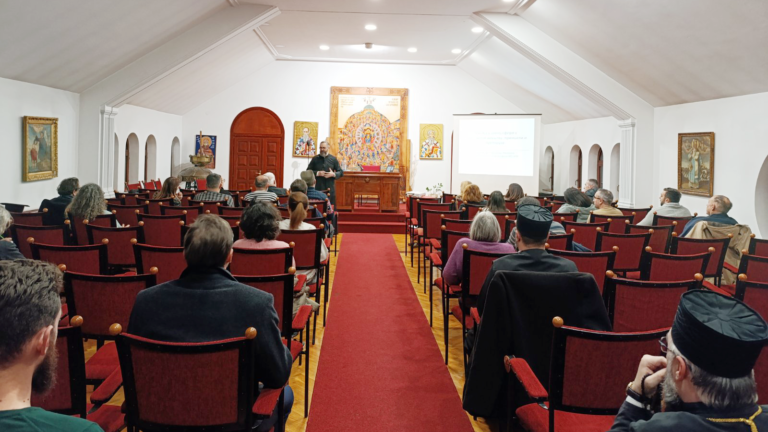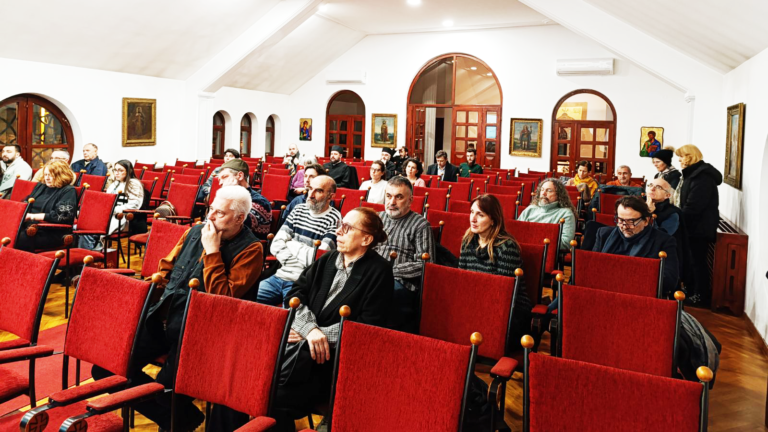
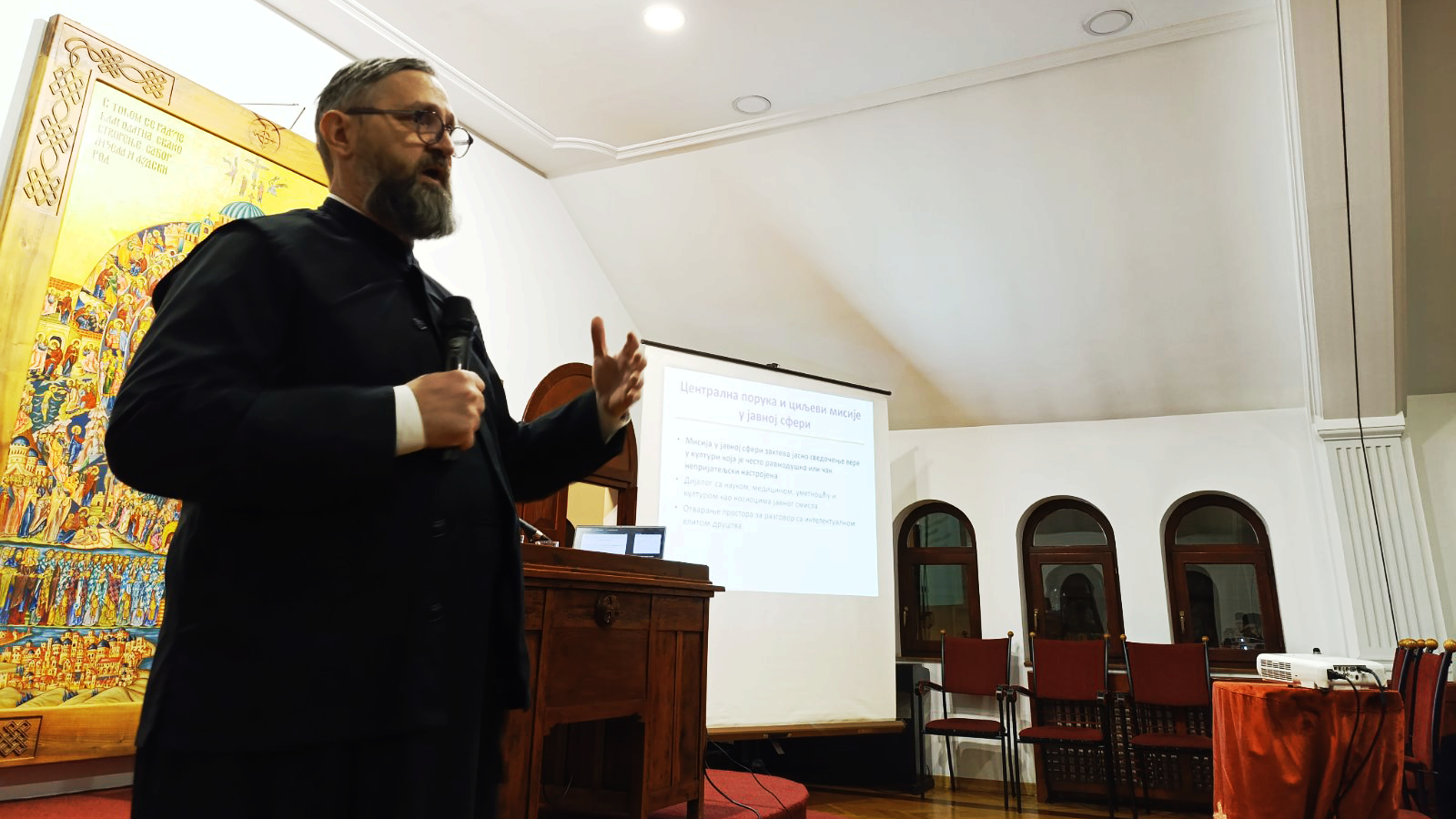
The second lecture of the Missionary Seminar, entitled “Mission in the Public Sphere within a Secular Society: Principles and Recommendations,” was held on 26 December 2025, at 7:00 p.m., in the parish hall of the Church of St. Alexander Nevsky in Belgrade. In addition to the registered participants interested in this topic, the lecture was also attended by Archimandrite Theophilus (Dimitrić), abbot of the Monastery of Osovica in the Diocese of Banja Luka, as well as by a priest of the Archdiocese of Belgrade–Karlovci.
The lecture was delivered by Presbyter Dr Aleksandar Milojkov, Coordinator of the Section for Dialogue in the Public Sphere of the Missionary Department of the Archdiocese of Belgrade–Karlovci. In the introductory part of the presentation, it was emphasized that missionary activity is essential to the life of the Church and that it arises from its very nature. Christ’s commandment, “Go therefore and make disciples of all nations” (Matt. 28:19), represents the foundation of the Church’s mission, whose ultimate goal is the incorporation of the human person into the Church and union with the Body of Christ through baptism.
Speaking about the public sphere, the lecturer referred to his experience of translating Western Fathers of the Church from the Latin language, emphasizing that in their writings the verb clamare frequently appears, denoting public, strong, and courageous testimony. In the formulation apostolus clamat—“the apostle cries out”— it is precisely the aspect of public witness to the Gospel that is emphasized, addressed to all, without exception.
Although a literal translation might render the phrase as “the apostle proclaims loudly” or “the apostle cries,” in this context the verb signifies that the apostle proclaims the Gospel publicly and with a powerful voice, preaching in such a way that all may hear. In other words, he speaks openly, before everyone—in the public sphere.
In the continuation of the lecture, it was emphasized that the mission of the Church in the public sphere entails responsible and dignified witness to the faith within contemporary society, which is often indifferent or critically disposed towards religious language. For this reason, it is necessary for the Church to appear as an authentic and competent agent in the shaping of public discourse and cultural meaning, entering into dialogue with science, medicine, art, and culture.
It was particularly stressed that one of the key goals of the Church’s public engagement is the dismantling of deeply rooted prejudices about the Church, formed during the period of communist atheist regime, as well as the continuous building of public trust. Faith, it was emphasized, must present itself as reasonable, well-argued, and capable of dialogue with present-day knowledge and with all areas of human intellect and spirit—not in a syncretistic sense, but as mature and responsible.
The Church, therefore, is not an opponent of science and intellect, but rather their ally in the search for truth and in the formation of a healthy public ethos. The public sphere is not a place of conflict, but of encounter and witness—where the Christian is called to be clear in his or her convictions, yet non-imposing or overbearing in approach.
The lecture also presented the principles guiding the Church’s missionary activity in the public sphere:
– competence as the source of authority;
– a humble tone that does not provoke ideological conflicts and extinguishes ideological hostility;
– witness that confirms the arguments presented;
– respect for the person of one’s interlocutor;
– clarity of expression combined with gentleness of approach;
– the complementarity of faith and reason, rather than their opposition;
– the understanding that truth is not imposed, but radiates in and of itself.
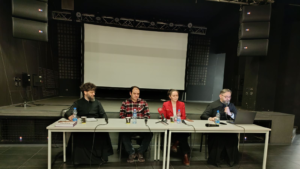
The speaker also pointed to concrete formats of missionary engagement, such as panel discussions, media appearances, lectures, and the creation of well-argued written content, which reaches diverse audiences and communities: the academic community, scientists, physicians, philosophers, psychologists, students, journalists, parents, and others.
Finally, practical recommendations were highlighted: that mission must always rest upon a prayerful and liturgical ethos, that it requires serious preparation and responsibility, as well as a readiness to hear the questions, doubts, and needs of one’s interlocutors.
A particularly strong impression was left by the lively interaction with the participants of the Seminar who are interested in this form of mission of our Church. Through their numerous questions, comments, and suggestions, those present demonstrated great interest in the relationship between faith and public space, as well as a need for further in-depth and responsible dialogue. This lecture once again confirmed that mission in the public sphere is a significant and indispensable segment of the life of the Church in contemporary society.
We hereby call upon all Orthodox Christians members of the academic community in Serbia who wish to contribute to the mission of the Church, to join the activity of the Section for Dialogue in the Public Sphere of the Missionary Department, with the prior blessing of their spiritual father or the relevant priest.
Contact address of the Missionary Department of the Archdiocese of Belgrade–Karlovci:
misionarsko.odeljenje@gmail.com