Verses 24 and 25 are before us:
“Therefore whoever hears these sayings of Mine, and does them, I will liken him to a wise man who built his house on the rock; and the rain descended, the floods came, and the winds blew and beat on that house; and it did not fall, for it was founded on the rock.”
Let us listen to the words of Saint Ignatius Brianchaninov regarding the great spiritual benefit that Christians derive from the study of Holy Scripture:
“A person who builds his life upon the study of the Gospel and the fulfillment of its commandments has laid his foundation upon the firmest of rocks. Whatever position in life he may find himself in due to external circumstances, he will continuously make spiritual progress, even though his labour, his ascetic struggle, and his success may be imperceptible and incomprehensible to others. Whatever sorrows and temptations may befall him, they will not be able to bring him down… Here, life and the state of the soul are likened to a house; and this house gains extraordinary strength from the Divine, limitless power imbued in Christ’s words. Clearly, no other means can grant the soul such steadfastness as the fulfillment of Christ’s commandments does; the power of Christ is active in His commandments.”
It is precisely for this reason that Mark the Ascetic writes: “The Lord is hidden in His commandments. To those who seek Him, He reveals Himself in proportion to their fulfillment of them.”
We thus see that the essence lies in the fulfillment of the commandments. A contemporary ascetic teaches that we Christians must not build our life upon principles that are not the essence of Christianity. Take fasting, for example—Hindus fast, Muslims fast, and so do Buddhists. Nor should one build life upon solitude, for even non-Orthodox ascetics practice it. Therefore, our trust should not lie in external forms, but in the essence—and the essence of Orthodoxy is the Gospel.
Saint Justin cites Saint John Chrysostom in his interpretation of the imagery of water and wind, writing:
“By ‘waters’ and ‘winds’ we must understand human misfortunes and tribulations: slander, grief, death, the loss of loved ones, insults, and every other evil that may befall one in this life. Yet the soul of the righteous man cannot be overcome by any of these, for it is founded on the rock. And by ‘rock,’ Christ refers to the firmness of His teaching. Indeed, His commandments are harder than stone. Through them, the righteous man rises above all the waves of temptation, and by zealously fulfilling the Saviour’s commandments, he overcomes not only human persecutions but also scatters all unclean powers into dust. Job is a witness to this—he remained unshaken in the midst of all the devil’s schemes. The Apostles also bear witness… Tell me, what life could be more blessed than this? No one else can promise us such a life—not bodily strength, nor fame, nor power, nor anything else, but only and exclusively the acquisition of virtue. Apart from the virtuous life, it is absolutely impossible to find any other way of living that is free from all evil. The Apostles were attacked from every side; many storms struck them, yet none of this was able to shake their courage or cast them into despair… In the same way, each of us may experience this, provided we zealously fulfill the commandments of Christ.”
Blessed Jerome adds the following: “The rain that seeks to destroy the house is the devil. The rivers are all the antichrists who plot against Christ. The winds are the crimes committed by demons in the lower heavens.”
Saint Macarius the Great, for his part, draws attention to thoughts and states, that only with the help of divine thoughts can one build a firm structure and overcome the temptations that arise. He writes: “The God-loving soul that desires to build a house according to the Lord’s word does not raise it upon the sand of deceitful thoughts of sin, but digs and deepens the place for the foundation, cutting off from itself, as much as possible, the evil thoughts which are like sand. And so it continues until it finds the firm and unshakable thoughts of the faith of Christ, until it finds Christ—the true Rock which even the gates of Hades shall not overcome (Matt. 16:18). In a similar way, the soul builds its house, and through a good life it has a pure heart, a good conscience, and sincere faith… In this way it completes the spiritual construction of the house of God, which is clean on the inside, and even cleaner on the outside.” However much it may sometimes seem to us that paying attention to one’s thoughts is a task reserved solely for monastics, from the patristic commentaries we see that this applies to us in the world as well. Of course, we cannot undertake the same struggle as monks due to our way of life, but that does not mean we should neglect what takes place in our mind and soul.
We continue now with the patristic interpretation. Verses 26 and 27 read:
But everyone who hears these sayings of Mine and does not do them will be like a foolish man who built his house on the sand; and the rain descended, the floods came, and the winds blew and beat on that house, and it fell. And great was its fall.
Saint John Chrysostom speaks profoundly of the tragedy of a sinful life—both here and in eternity. Here is what Saint John says on the matter: “Vice renders its followers most irrational. ‘And great was its fall,’ says the Saviour. And indeed, the danger here threatens not matters of little importance, but the soul, and it threatens the loss of heaven and its incorruptible blessings. Yet even before that, the sinful man lives the most miserable life, full of unending sorrow, fear, worries, and great unrest, as pointed out also by the Wise Solomon who says: The wicked flee when no one pursues them (Proverbs 28:1). Indeed, such people tremble at shadows, suspecting friends, enemies, servants, those known and unknown. In this way, even before the eternal torments, they already endure the harshest suffering. In showing all of this, Christ said: And great was its fall. Thus, even through the misfortunes of this life, He strongly persuades even the most obstinate unbelievers to avoid vice.” And indeed, everything that Chrysostom speaks of can be seen if one reads a book or watches a film about the lives of well-known dictators, criminals, or evildoers.
Here is the commentary of Saint Cyril of Alexandria, from which one can see the full depth of the patristic interpretation and all the nuances to which the Fathers pay attention when explaining Christ’s words. Here is Cyril’s explanation: “The Lord said of the wise man: I will liken him; and of the foolish: he will be like. For the man who labours in virtue can do all things through Christ who gives him strength, from whom comes everything by which people progress, from whom come wisdom, understanding, and good. In the foolish man, God is not the cause of his evil and irrationality, but he himself becomes like the senseless when he departs from what is according to nature and finds himself in that which is contrary to nature.”
Blessed Theophylact of Ohrid explains who Christ is speaking about here, and that this is not at all about those who do not believe in God. Here are his words: “Unbelievers do not fall, because they already lie upon the ground; but the believer (who does not live according to the commandments of God) does. Therefore his fall is great, since he is a Christian.” That is why Saint Justin of Ćelije also says the following: “The one who builds the house of his soul on sand is not only the man who builds himself on the non-Christ and the Antichrist, but also the man who hears the words of Christ, who knows the words of Christ, who believes in the words of Christ, yet does not carry them out; the man who is a Christian by name, by garment, but not by heart and soul. A man who believes in Christ but does not do the works of Christ.”
It is noteworthy that Saint Ignatius Brianchaninov includes among the Christians who build their house on sand even those who build their entire life upon bodily asceticism while neglecting the commandments of Christ. He speaks of something that can be seen even today, when many fast, go to church to receive Communion, all under the motto “it is proper, it should be done.” Thus the years go by, and such people never even ask themselves what all this is for—what is the purpose of all that fasting, all those customs they observe—not to mention reading the Gospel. Here are the words of Saint Ignatius: “The life that outwardly appears good is easily destroyed in those people who lay as its foundation nothing but some bodily struggle, or even many struggles, sometimes very difficult and very prominent, yet do not pay proper attention to the evangelical commandments. It very often happens that ascetics do not pay the slightest attention to the evangelical commandments, openly trample them underfoot, giving them no value and having no understanding of their importance. Such ascetics, when faced with a temptation that arises unexpectedly or with an unforeseen change in life, not only quickly falter, but are exposed to complete moral collapse—which in the Gospel is called the dreadful fall of the house of the soul.”
We continue with the final verses of the seventh chapter, verses 28 and 29:
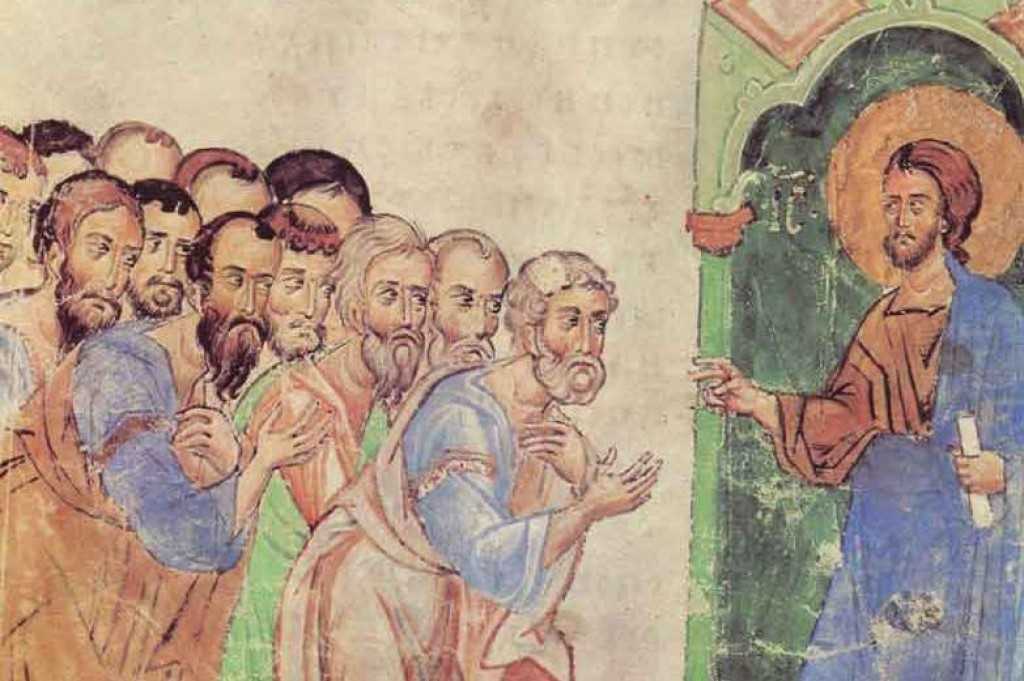
And it came to pass, when Jesus had ended these sayings, that the people were astonished at His teaching. For He taught them as one having authority, and not as the scribes and Pharisees.
Saint Philaret Amphiteatrov offers an excellent observation on these verses and says: “This Sermon does not leave upon many of us the saving effect that came upon the people who heard Jesus Christ. The reason for this is not the word of God, but the unpreparedness of our hearts to receive it.” A contemporary ascetic says that we have already grown accustomed to the words of the Saviour—it seems to us that they go without saying. Unfortunately, today we no longer feel their full sharpness, significance, and extraordinary character. The people who heard the Sermon on the Mount for the first time were astonished at the Lord’s teaching. This sermon is not in accordance with so-called common sense—neither with what people adhered to then, nor with what they adhere to today. The Lord teaches us a completely different approach to life.
Listen to how Saint John Chrysostom explains this phenomenon—this amazement on the part of the people—even though all logic would have deemed such a reaction nearly impossible. Here are his words: “Judging by the severity of the proposed commandments and the loftiness of the precepts, the people should have been troubled and fallen into despondency; yet the power of the Teacher was such that He won over many and brought them into a state of profound wonder. By the sweetness of His words, He persuaded them not to turn away from Him, but rather to follow Him all together. That is how great a love He instilled for His words! However, what amazed them most was His authority, because He did not speak His discourse through another, like the prophet Moses, but constantly showed that He Himself possessed authority. Thus, in giving the laws, He repeatedly added: But I say to you, and by reminding them of the Last Day, He presented Himself as the Judge—both in regard to punishment and to reward. All of this should have disturbed the listeners. For if the scribes wanted to stone Christ and persecute Him even after He had proven His authority through His works, how then could the people not be scandalized when the Lord Jesus was proving His authority by words alone—especially when these words were spoken at the very beginning, before He had revealed His power? And yet, nothing of the sort happened with the people. For when the heart and mind are well-disposed, they are easily convinced by words of truth. That is why the scribes were scandalized even when miracles testified to His power, whereas these listeners paid attention only to His teaching, submitted to it, and followed Him.”
In this final thought of the saint—that openness of mind and heart is the key to accepting the truth—lies the reason why some people, though clearly aware of what Christianity teaches, still make the choice not to be with God.
Adapted for the contemporary reader from the patristic commentaries by Stanoje Stanković.