We worshipfully glorify and admire the beautiful example of the holy, glorious and victorious great martyr Marina, the saint of the fiery faith. Like many other Greek and Roman paired names, Marina is the feminine version of a masculine name. It is likely that Marin was once a surname, or rather a family nickname, in ancient Rome, which was passed down through generations. Marin — “marīnus” — means “of the sea”, and Marina, accordingly, means “of the sea”. In Roman mythology, for example, the goddess Venus was often called the epithet Marina (Venus Marina). This arose from the fact that the Roman Venus was identified with the Greek goddess Aphrodite, born from the foam of the sea. Just as Aphrodite was called Aphrodite Anadyomene (emerging from the foam) or Aphrodite Pelagia (of the sea), so Venus was also called Venus Marina. In this sense, Pelageya and Marina, despite the difference in pronunciation, are synonymous names. The name Marina came to us from Greece. Since the 8th century, widespread veneration of the Great Martyr Marina of Antioch has been celebrated in Greece, and the Orthodox Church celebrates her sacred liturgical memory every year, on July 17/30.
The Holy Martyr Marina lived during the reign of Emperor Claudius (around 270). She was born in Antioch of Pisidia (in Asia Minor) and was the daughter of the pagan priest Edesius (Edesima). Her mother died when she was twelve years old, and her father entrusted her care to a village nurse. Marina’s association with local Christians and her natural inclinations encouraged the growth of the seeds of true faith in her heart. By the time she turned fifteen, her love for Christ was so strong that Marina wanted and thought of only one thing – to participate in martyrdom and shed her blood in the name of her love for Christ. Unafraid of her desire, Marina was not afraid to publicly declare her Christian faith and ridicule the cult of idols. This brought her the hatred of her father, who deprived her of her inheritance.
One day, Olybrius, the prefect of Asia, on his way to Antioch, saw the saint tending her flocks with other women from the village. Enchanted by Marina’s beauty, he desired to marry her and ordered his men to bring her. Arriving at the palace, she appeared before the magistrate, who asked her to tell him her name. The girl confidently replied: “My name is Marina, I am the daughter of free parents from Pisidia, but I am the handmaid of our Lord and Saviour Jesus Christ, who created heaven and earth.” She was then imprisoned, awaiting a great pagan festival scheduled for the next day.
When she was brought to trial again and ordered to sacrifice to the gods along with everyone else, Marina replied: “I will offer a sacrifice of praise to my God, but never to your mute, lifeless idols!” Olybrius begged her to preserve her youth and beauty. But she protested that all physical beauty fades, while suffering endured for the name of Christ adorns the soul and prepares it for eternal bliss. The magistrate, enraged by such impudence, ordered the girl to be stretched out on the ground, beaten with pointed rods and torn apart with iron hooks. The saint’s blood flowed profusely, but Marina did not utter a cry of pain and remained motionless, as if someone else were suffering in her place.
After several hours of torture, she was thrown into prison, where she prayed to the Lord not to abandon her in her temptation and confession of her faith. Suddenly, an earthquake struck the prison, releasing a huge snake from the depths of the earth. Its eyes spewed fire and smoke, its tongue was blood-red, and the monster hissed terrifyingly as it approached the saint. Overcome with great fear, Marina turned in prayer to the Lord, our Saviour, who had deprived Satan of his power and had freed the dead from hell by his cross. Then the serpent turned into a hideous black dog, but the saint, now strengthened by the grace of God, seized it by the fur, crushed its neck with her foot, and, taking a copper hammer, killed it with blows to the head and spine.
A bright light shone in the prison, emanating from a huge cross on which a white dove sat. The dove landed beside Marina and said: “Rejoice, Marina, spiritual dove of the Lord, for you have conquered the evil one and covered him with shame. Rejoice, faithful servant of the Lord, whom you love with all your heart and for whose sake you have abandoned all fleeting earthly pleasures. “Rejoice and be glad, for the day has come when you will receive the crown of victory and, clothed in it, together with the wise virgins, will worthily enter the bridal chamber of your Bridegroom and King!”
In the morning, Marina was again brought before the governor. Since she was firmer than ever in her decision, Olybrius ordered her to be stripped and burned with torches. After this ordeal, she was thrown headfirst into a tub of water. The dove reappeared, carrying a branch in her beak, and a cross shone above the tub, from which she rose, freed from her chains. A dove was heard saying: “Marina, go to the Groom of all the righteous!” Seeing this miracle, many converted to the true faith and asked the saint to teach them the teachings that grant salvation. In great anger, the governor ordered that they all be beheaded, along with Saint Marina.
Arriving at the place of execution, the martyr asked the executioners to give her time to pray and, turning to the east, turned to the Lord with a request to recognize the sanctity of the souls and bodies of those who stood up for her defense. Having finished the prayer, she called on the executioner to fulfill his task, but, overcome by pious fear, he converted to the Christian faith and refused to lay a hand on the saint. Marina then said: “You will not help me if you delay the fulfillment of your commandment.” With a trembling hand, he cut off her head. A certain Christian named Theotimus, who secretly brought food to the saint in prison, came for her body and buried her with dignity.
Theotimus placed the relics of the Great Martyr Marina in a stone tomb. Soon healings and other miracles began to occur. Especially often, the possessed and mentally ill were healed here. At that time, Saint Marina began to be widely revered by Christians, although formal canonization had not yet been completed.
In the eighth century, the Byzantine Empress Maria transferred the relics of the saint to Constantinople. Until 1204, when the Crusaders entered the Pantepontine Monastery, the relics remained there. At the same time, in the early Middle Ages, the veneration of Saint Marina was renewed in Western Europe, with the only difference that she was now known as Margaret of Antioch. The change of name from Marina to Margaret should not be a cause for concern, since Margaret was only a nickname for Saint Marina. Her hagiographer, Theotimus, describing Marina’s beauty and stature in his life, calls her „Margarita“ (which means „pearl“). The different names for the saint in the East and West took root during the era of the division of the churches. Moreover, in Western Europe, Saint Marina (Margarita) began to be revered together with Saints Barbara and Catherine and was depicted trampling on a dragon. Hundreds of Orthodox churches have been erected in Greece today in honour of the Great Martyr Marina, and on Mount Athos four monasteries keep parts of her relics. May her prayerful patronage always remain with us, and may her wonderful example of life and ascetic struggle be a sacred thread that will always direct our steps towards the path of holiness.
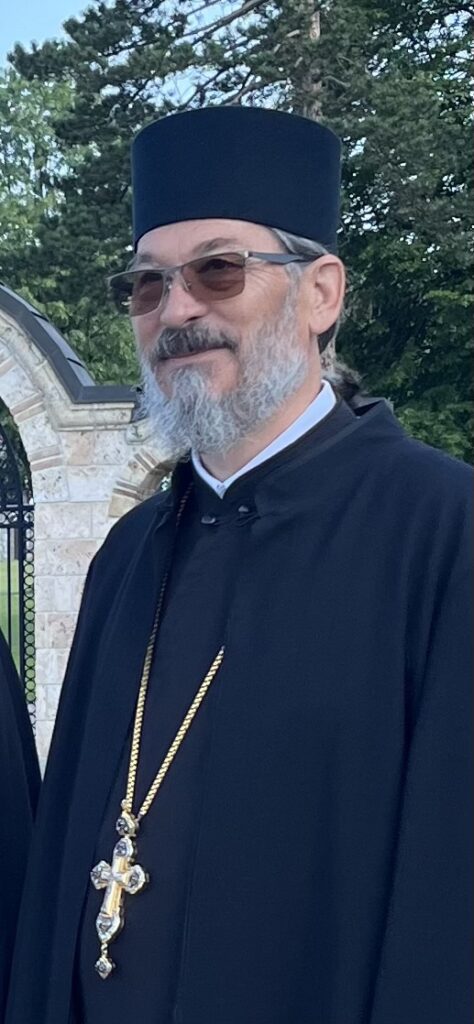
WRITTEN BY: Catechist Branislav Ilić, editor of the portal “Kinonia”
*The text was published on the portal Kinonia in the section “From the Editor’s Pen”, July 30, 2026.