Verses 33–34:
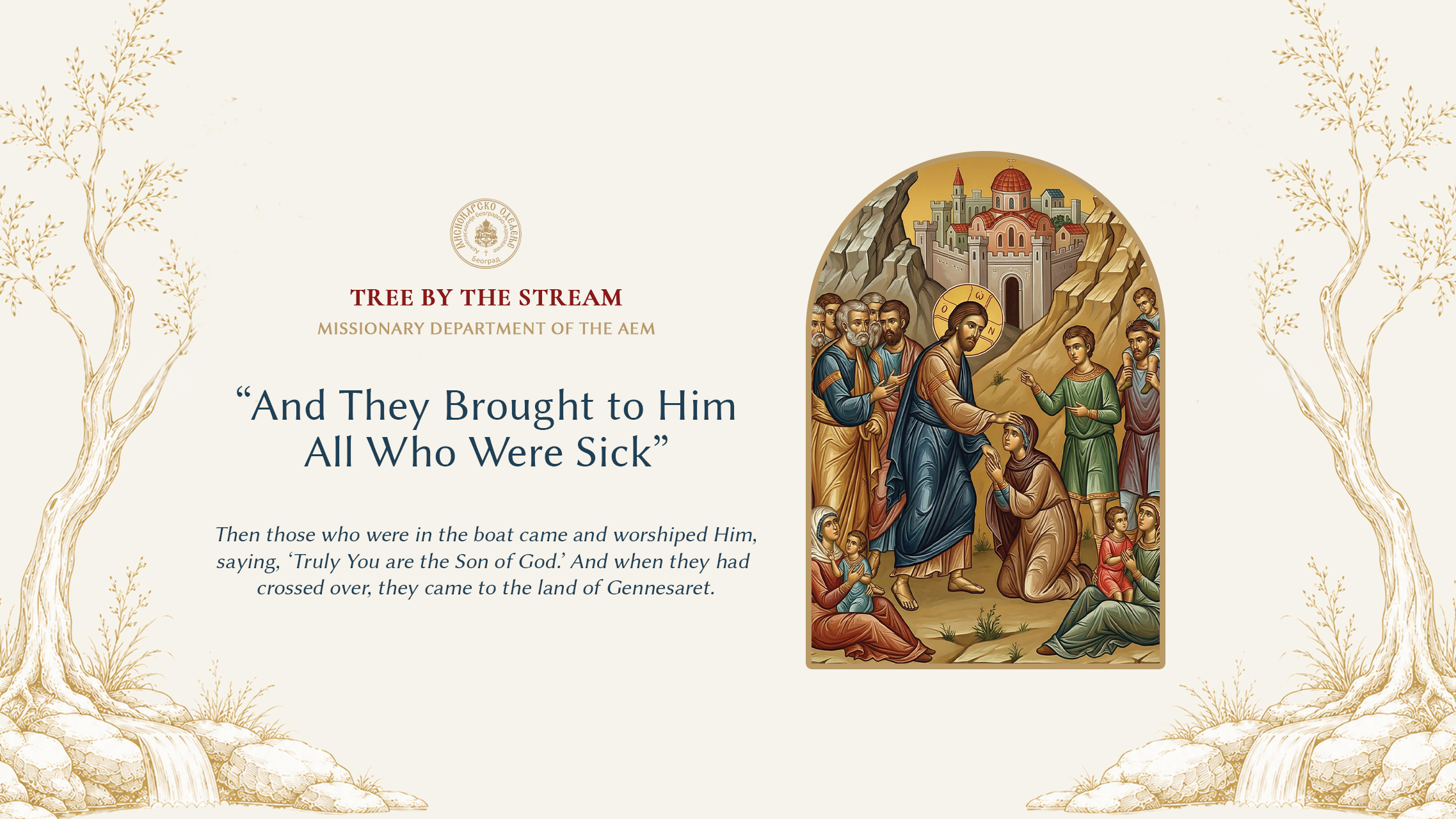
Then those who were in the boat came and worshipped Him, saying, “Truly You are the Son of God.” And when they had crossed over, they came to the land of Gennesaret.
Saint John Chrysostom here speaks about Christ’s response after the disciples confessed His divinity. This is an important apologetic passage in the New Testament, for it reveals what Jesus Himself thought about the public confession that He is God. Chrysostom writes:
“Because He Himself walked upon the sea, commanded another to do the same, and then saved him from danger, the disciples’ faith increased greatly. Previously, Jesus had rebuked the sea; now He did not calm it, but instead manifested His power in another way, and in the highest degree. Therefore the Apostles said: Truly You are the Son of God. And what then? Did Jesus forbid them to say this? Quite the contrary. He confirmed what they had confessed by immediately proceeding, with great authority, to heal those who came to Him.”
Saint Nikolaj of Ohrid draws attention to the transformation that had taken place in the consciousness of the Apostles:
“When the Lord first calmed the storm at sea and stilled the winds, the disciples spoke as ordinary people of little faith would speak: Who is this, that even the winds and the sea obey Him? But since then they had witnessed many signs performed by their Teacher and had heard many of His teachings, so that their faith had grown considerably stronger. Now, at this new and mighty miracle, they no longer ask: Who is this? Instead, kneeling before Him, they confess: Truly You are the Son of God. This is the first time that all the disciples together confess Jesus as the Son of God. Naturally, Judas was also among them. Undoubtedly, he too made this confession.
The inner meaning of the words, those who were in the boat came and worshiped Him and confessed Him as the Son of God, is profoundly instructive for every Christian. Namely, when the Lord once enters into us, everything within us should bow before Him and confess His Name: our mind together with all our thoughts; our heart together with all our feelings; and our soul together with all its desires and aspirations. Then our whole being will become full of light, and there will be no darkness within it.
But woe to us if, having once received Christ within ourselves, we later drive Him out through sin or deny Him, as Judas did. The latter condition will be worse than the former. For when Christ departed from Judas, then Satan entered into him (John 13:27). Let us never forget, even for a single moment, that God is not to be trifled with—far less than with living fire (Hebrews 12:29).”
This final observation, found not only in Saint Nikolaj but also in many other Fathers, is especially significant because it vividly illustrates the reverential fear that today is preserved in its fullness within the Orthodox Church in its relationship with God the Creator.
Saint Ignatius Brianchaninov offers an allegorical interpretation of these verses and sees in this event the fulfilment of a spiritual law within the soul of the faithful believer:
“When the storm of the heart is calmed through the invocation of the Lord, and the winds that stirred it—that is, demonic thoughts—withdraw, then the thoughts of the soul bow in worship before the Son of God. They worship Him in spirit and confess Him through the conviction they have acquired concerning the Son of God and God Himself, the Saviour of the world—a conviction obtained within the very depth of the soul.”
Here are the final verses of the fourteenth chapter:
And when the men of that place recognized Him, they sent throughout all that surrounding region, brought to Him all who were sick, and begged Him that they might only touch the hem of His garment. And as many as touched it were made perfectly well.
Saint John Chrysostom sees here an inner transformation that had also taken place among the people themselves. He explains:
“Now they come to Jesus with requests different from those they had made previously. They no longer invite Him into their homes, nor do they seek for the Lord to touch them with His hand or heal them by a spoken command. On the contrary, with sublime wisdom and abundant faith, they ask only for healing. The woman with the issue of blood had taught them all this wisdom. The Evangelist, however, wishing to show that the Lord Jesus had not been in that region for a long time, says: When the men of that place recognized Him, they sent throughout all that surrounding region and brought to Him all who were sick. Time had not weakened the people’s faith; rather, it had strengthened it and preserved it in all its vigour.”
Blessed Jerome continues by highlighting the faith and love of Christ’s contemporaries:
“See how great was the faith of the inhabitants of the land of Gennesaret. It was not enough for them that only those already present should be healed; they sent also to the neighbouring towns, from which everyone hastened to the Physician.”
We now begin chapter fifteen of the Gospel according to Matthew. The first two verses read:
Then the scribes and Pharisees who were from Jerusalem came to Jesus, saying, “Why do Your disciples transgress the tradition of the elders? For they do not wash their hands when they eat bread.”
Saint Justin of Ćelije explains why the tradition of the elders enjoyed such great authority in Israel during the earthly ministry of the Lord Jesus. He writes:
“According to Jewish belief, God gave Moses two Laws on Mount Sinai: one written and the other oral. Moses entrusted the oral Law to Joshua, Joshua to the judges, the judges to the prophets, until it was eventually written down in the Talmud. This came to be known as the tradition of the elders, that is, of the ancient men and forefathers, and the Jews regarded it as binding. The scribes and Pharisees were especially strict in preserving these traditions; indeed, their strictness reached such an extent that they overlooked what belonged to God. Yet their strictness was directed more towards others than towards themselves.”
Saint John Chrysostom draws attention to the incorrigible malice of the Pharisees and explains the purpose for which they continually introduced new regulations into the life of the Jewish people. He interprets the passage as follows:
“Then—when was this? After Jesus had performed countless signs, after He had healed the infirm simply by their touching the fringe of His garment. For this reason the Evangelist deliberately emphasizes the timing, thereby revealing the extreme and unconquerable wickedness of the scribes and Pharisees.
The scribes and Pharisees were scattered throughout all the tribes of Israel and divided among the twelve regions; nevertheless, those who lived in the capital were far worse than the others, for they enjoyed greater honour and were much more arrogant. Observe how, even in their very question, they attempt to ensnare the Lord. They do not ask, ‘Why do Your disciples transgress the Law of Moses?’ but rather, ‘Why do they transgress the tradition of the elders?’ From this it is evident that the priests had introduced many innovations, even though Moses, under the threat of severe punishment and with many warnings, had forbidden anyone to add to or take away from the Law.
Yet despite this, they introduced new regulations, such as the rule that one must not eat with unwashed hands, that cups and vessels had to be washed, and that they themselves were to undergo ritual purification. At a time when the Jewish people should already have abandoned the earlier regulations, they imposed still more upon them, fearing the loss of their authority and wishing the people to fear them even more because they themselves had become lawgivers.
Thus matters reached such a degree of impiety that their own commandments were carefully observed, while the commandments of God were neglected; and their authority had become so great that such conduct was no longer even regarded as a transgression. Therefore, they bore a double guilt: first, for introducing new regulations, and second, for neglecting the ordinances of God while zealously defending their own.
Passing over regulations worthy only of ridicule—such as the washing of pots and vessels—the scribes instead emphasized what appeared, at first glance, to deserve greater attention, intending, in my opinion, to provoke the Lord. For this reason they referred to the elders, so that if He failed to show them due respect, they would have grounds to accuse Him.
We must first consider why the disciples ate with unwashed hands. Why did they behave in this way? They did not do so deliberately, but because they had already learned to disregard what was superfluous and cared only for what was necessary. The Apostles did not regard washing or not washing as a matter of law; rather, they acted according to the circumstances. And indeed, how could they concern themselves with such things when they did not even concern themselves with the food necessary for their own sustenance?”
Adapted for the contemporary reader based on the interpretations of the Holy Fathers by Stanoje Stanković.