The text was published on the Kinonia portal, in the column “From the Editor’s Pen,” on October 31, 2025.
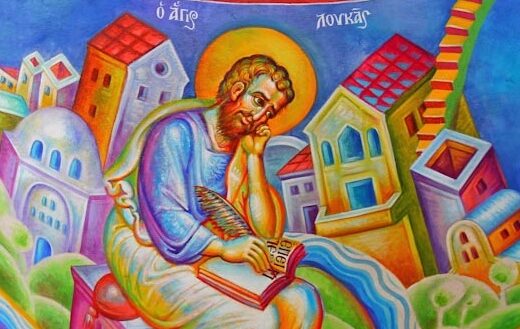
Saint Luke the Apostle and Evangelist, born in Antioch of Syria, is a wondrous figure among the Seventy Apostles. He came from a cultivated Greek milieu, and after mastering the Jewish Law, he learned the art of medicine and became acquainted with Greek philosophy. He had perfect command of both the Greek and Egyptian languages. The Apostle Luke was an untiring co-worker in the missionary labours of Saint Paul the Apostle. The beginnings of his fervent discipleship to Christ are connected with Palestine. According to the testimony of the Holy Scriptures, he was one of the first disciples to whom the Risen Christ appeared on the road to Emmaus.
Thanks to Saint Simeon Metaphrastes, we possess the Life of Saint Luke the Apostle and Evangelist. Saint Simeon composed this Life drawing upon the testimonies of the early Church writers—Origen, Clement of Alexandria, and the Church historian Eusebius of Caesarea. The saintly author relates that, after the Descent of the Holy Spirit upon the Apostles, Luke remained for some time in Jerusalem and later went to Antioch. According to his biographer, when the Apostle stopped in the Samaritan city of Sebaste to preach the Gospel, he took the right hand of the Prophet John the Baptist and brought it to Antioch. It was precisely in Antioch that the wondrous meeting occurred between the Apostle Luke and the God-wise Apostle Paul, after which the two of them carried out their joint missionary work in Greece. Following the martyrdom of the Apostles Peter and Paul, Luke left Rome and preached the Word of God as he passed through Achaia, Libya, Egypt, and Thebaid.
Saint Luke the Apostle authored the Acts of the Apostles, and the authorship of one of the four canonical Gospels is ascribed to him. According to the tradition of the Church, he was the first iconographer, who painted icons of the Mother of God. “May the grace of Him Who was born of me, and my grace as well, be with these icons,” said the Most Holy Theotokos when she saw the icons painted by the Apostle Luke.
The early ecclesiastical writers report that Saint Luke was the first to use pigment to depict the image of the Most Holy Theotokos holding the Christ Child in her arms. Afterwards, he painted two more icons of the Most Pure Virgin. The earliest preserved historical document in which Saint Luke is mentioned as an iconographer dates to the beginning of the sixth century. In this text, the historian Theodore the Reader (Anagnostes) records that the widowed Empress Athenais Eudocia sent “the greatest relic,” the icon of the Mother of God painted by the Evangelist Luke, from Palestine to her sister Pulcheria, the wife of Emperor Marcian, in Constantinople. Two centuries later, Saint Andrew of Crete also mentions this fact, bearing witness that Saint Luke “by his own hand depicted both the Incarnate Christ and His Immaculate Mother,” and that these icons, known in Rome, were kept in Jerusalem. At the beginning of the tenth century, Saint Simeon Metaphrastes, the compiler of 132 Lives of the saints, wrote: “Most precious of all is this—that Luke the Evangelist painted in wax and colours the human likeness of my Christ and of Her who bore Him and made Him man, thus transmitting them to us to be venerated even to this day.”
Saint Luke the Apostle and Evangelist reposed in the eighty-fourth year of his earthly life, when malicious pagans tortured him and hanged him upon an olive tree in the city of Thebes in Boeotia.
The prayerful veneration of this wondrous servant of God spread swiftly, and to this day he is festively celebrated in the Church’s liturgical life. The divinely inspired hymnographer praises and magnifies the Apostle Luke in the first sticheron at Lord, I have cried, with these words: “How shall I now name thee, O Apostle? As heaven—for thou hast proclaimed the glory of God. As light—for thou hast illumined the whole world. As a cloud—for thou pourest upon us the waters of divinity. As a cup of divine wisdom—for thou dost pour forth the wine that gladdens hearts. But do thou pray that our souls may be saved.” In the same spirit, the hymnographer continues in the second sticheron, chanting: “How shall I call thee, O God-pleasing one? A golden Ark of the Covenant, bequeathed by Christ? A river flowing for us from Paradise? A lamp that shines with spiritual light? A beacon, for thou dost illumine the whole Church? The bread of life upon God’s table? The cup of spiritual drink? Pray thou that our souls may be saved.”
In the liturgical hymns of the sacred commemoration of the Apostle and Evangelist Luke, he is repeatedly called the Apostle of Christ and the writer of divine dogmas. It is emphasized that he was the follower and disciple of Paul, the chosen vessel of God. The hymnographer, drawing from the Saint’s Life, highlights in the hymns the love that the Apostle Luke bore towards the people to whom he preached the Word of God. Thus it is said that he “drew men from the depths of vanity with the reed of grace,” that he “enlightened those who sat in the darkness of ignorance,” and “made them sons of the Lord and of God through faith.” The Church’s hymns also emphasize his ascetical ethos—his readiness to forsake all earthly things and to follow the Saviour who called him into His fellowship.
Among the stichera at the praises, we find the Church poet offering gratitude to the Apostle Luke for his inspired writings: “From thy words, O divine disciple, we have learned, as thou hast said, the certainty of those things concerning which thou hast written to us, being thyself from the beginning an eyewitness. Thus too hast thou been a minister of the Incarnate Word of God. Him didst thou behold after His Resurrection at Emmaus, when thou didst eat bread with Cleopas and thy heart burned within thee with Christ. Fill our souls also with His divine warmth, we who hymn thee.” In the next sticheron, the inspired hymnographer continues in a spirit of thanksgiving: “Rejoice, thou alone who hast recorded for us with joy the salutation ‘Rejoice!’ spoken at the Annunciation to the Most Pure One—she whom the Forerunner, whose conception thou didst describe from the womb, called the Bearer of God. Thou hast recorded the Incarnation of God the Word, His marvellous miracles, words, and sufferings—the Cross and death, Resurrection and Ascension, which thou hast seen. Thou hast preached the Descent of the Spirit and the deeds, especially those of Paul, whose companion thou didst become; thou art both physician and disciple, and the light of the Church, which thou dost preserve forever.”
Saint Luke the Apostle was a wondrous helmsman who exposed all the falsehoods of idolatry and, through his preaching, guided humankind onto the true path of the light of the knowledge of God. In his apostolic zeal, he cast the hook of divine wisdom into the depths of the spiritual sea and drew forth from its deadly abyss the souls of the faithful—thus bearing witness to the words of his Master, Who said that His Apostles would become fishers of men. Though by God’s love he was granted the gift to heal bodily infirmities, enlightened by the Holy Spirit, the Apostle Luke above all healed the hearts of men.
In celebrating Saint Luke the Apostle and Evangelist, we are called to emulate him and to follow his blessed example, for in his life the mystery and beauty of our communion with the Lord are revealed. This saint calls us to make the Lord Himself the Navigator of our lives, that we might sail without wavering across the stormy sea of existence. The Apostle Luke knocks upon our slumbering hearts and awakens us from the sleep of sin; he directs us to arm ourselves with the evangelical virtues so that, through the love of God, we may become victors over sin.
Exalting the Lord Who calls us into the communion of the saints, we prayerfully invoke the intercession of Saint Luke the Apostle with the words:
“O all-wise fisherman, holy disciple, worker of the Saviour and herald of His sufferings, thou hast traversed the whole world in faith, gathering nations out of delusion and bringing them to God as a sweet fragrance. Thou hast ascended to the heavens and standest before the Judge of all; pray that we may be delivered from our lawless deeds and freed from torment on the day of judgment.”
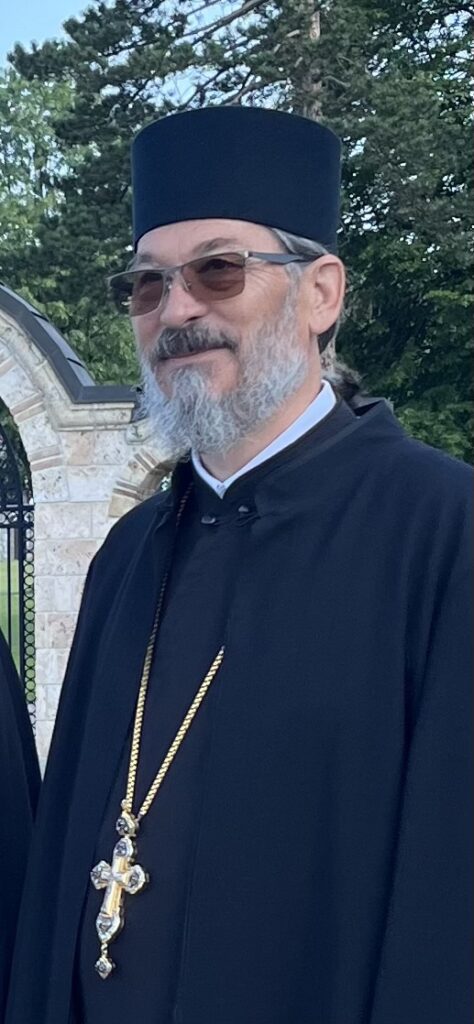
Written by: Catechist Branislav Ilić, Editor of the Kinonia Portal.