
Wahhabism is a reformist and puritanical movement that emerged within Islam in eighteenth-century Arabia. It was named after its founder, Muhammad ibn Abd al-Wahhab (1703–1792). From its inception, Wahhabism advocated a return to the original Islam of the first generations of Muslims, the salaf, the rejection of all subsequent innovations, and an uncompromising emphasis on the unity of God, accompanied by a sharp critique of practices it regarded as idolatry, or shirk, such as the veneration of saints and intercessory prayers. Expressed in Christian terminology, the Wahhabis could be described as zealots within Islam. It is important to stress that Wahhabis are not a sect or a separate grouping within Islam, but rather a specific zealot movement within Sunni Islam itself.
A decisive moment in the spread of Wahhabism was the alliance formed in 1744 between Muhammad ibn Abd al-Wahhab and Muhammad ibn Saud. The first Saudi state arose from this alliance, and over time Wahhabism became the dominant religious doctrine in Saudi Arabia.
Wahhabism is an influential, yet nevertheless minority, current within Islam. Although it has exerted considerable global influence owing to financial and institutional support from Saudi Arabia, many Muslim theologians—Sunni, Sufi, and Shiʿa alike—criticise its literalism and exclusivism.
In our region, Wahhabism has become noticeable and even popular among Muslims, particularly in Bosnia and Herzegovina, since the 1990s. Wahhabi teachers are highly active in digital media and on social networks, through which they disseminate their interpretation and manner of practising Islam, most commonly in the form of practical questions and answers.
Recently, a post appeared on Facebook in one of the many Wahhabi groups criticising the Christian prayer addressed to the Most Holy Theotokos: “Most Holy Theotokos, save us.” The post appeared shortly after the media had reported the instruction given by His Holiness Porfirije, Serbian Patriarch, to the faithful who were waiting in seemingly endless lines to venerate and kiss the Honourable Cincture of the Most Holy Theotokos, which was being kept at the Church of Saint Sava in Vračar at the time. His Holiness instructed those present in the use of short prayers, among which was the prayer to the Most Holy Theotokos: “Most Holy Theotokos, save us.” This short prayer is, moreover, an integral part of our prayer tradition and is included in the dismissal prayers of many church services and rites.
Some Wahhabi teachers also heard this prayer from the lips of our Most Holy Patriarch through the media, and proceeded to launch a fierce attack on what they described as the Christian “violation of monotheism” and “idolatry.” As the basis for their criticism of this Christian prayer, they cited the following verses from the fifth surah of the Qur’an:
And when Allah says: O Jesus, son of Mary, did you say to the people: Take me and my mother as two gods besides Allah? He will say: Glory be to You! It was not for me to say that to which I had no right. Had I said it, You would have known it. You know what is within me, whereas I do not know what is within You. Indeed, You alone are the Knower of all hidden things. (5:116)
I said to them only what You commanded me: Worship Allah, my Lord and your Lord. And I was a witness over them while I remained among them… (5:117)
In these verses, we encounter something far more serious than the Islamic misunderstanding of Christian prayer addressed to the saints—and it is precisely this that must first be explained. Here the Qur’an criticises the Christian doctrine of the Holy Trinity, but does so by presenting this most sublime Christian dogma in a wholly inaccurate manner. Let us consider carefully what, in these two verses, the Qur’an imputes to Christianity:
- Tritheism—the claim that the doctrine of the Holy Trinity teaches the existence of three gods, namely Jesus (ʿĪsā in the Qur’an) and His mother Mary (Maryam in the Qur’an) as two gods alongside Allah.
- The deification of the Virgin Mary—the assertion that the Virgin Mary is a divine being.
- A misrepresentation of the Holy Trinity—the claim that the Holy Trinity consists of Allah, Jesus, and Mary.
The Qur’an criticises the Christian doctrine of the Holy Trinity in several other passages as well. Thus, in Surah 4:171 we read:
O People of the Scripture, do not exceed the bounds in your religion, and say nothing about Allah except the truth. The Messiah, Jesus, son of Mary, was only a messenger of Allah, and His Word which He conveyed unto Mary, and a Spirit from Him. So believe in Allah and His messengers, and do not say, “Three.” Desist—it is better for you. Allah is only One God. Glory be to Him! Far exalted is He above having a son. To Him belongs whatever is in the heavens and whatever is on the earth, and Allah is sufficient as a Guardian.
Then, in Surah 5:73–75 we read:
They have certainly disbelieved who say, “Allah is one of three.” There is no god except the One God. If they do not desist from what they are saying, a painful punishment will surely befall those among them who persist in disbelief. Will they not turn to Allah in repentance and seek His forgiveness? For Allah is All-Forgiving, Most Merciful. The Messiah, son of Mary, was only a messenger; messengers had passed away before him. His mother was a woman of truth, and they both ate food. See how We make the signs clear to them, and then see how they turn away.
In these verses, it is evident that the doctrine of the Holy Trinity is understood as tritheism, that is, the belief in the existence of three gods. If we bear in mind that Islam arose in the seventh century, and that the Qur’an was initially transmitted orally as a series of “revelations,” according to Islamic belief, from the year 610 until the death of Muhammad in 632; furthermore, that it began to be compiled into written form after Muhammad’s death under the first caliph, Abu Bakr, and that this process was only definitively completed under the third caliph, ʿUthmān ibn ʿAffān, around the year 650; and, on the other hand, if we consider that the principal Christian controversies concerning the doctrine of the Holy Trinity had already been resolved in the fourth century, that the Niceno-Constantinopolitan Creed had been formulated at the First Ecumenical Council (325) and the Second Ecumenical Council (381), and that by the time of Islam’s emergence this Creed was universally known and widely confessed throughout the Christian oikoumene, one cannot fail to notice that the author of the Qur’an possessed no accurate knowledge of this doctrine. The claims found in the Qur’an clearly indicate either that its author was unfamiliar with Christian dogmatic theology or that he was acquainted only with a distorted version of it—one that Muhammad most likely encountered through local heterodox communities in Arabia, while one should not exclude the possibility of his own misunderstanding of what he had heard.
Not to mention the numerous writings of the Holy Fathers of the Church—especially those of the fourth century—which explicitly refuted tritheism, the Creed itself is perfectly clear on this point. It begins with the confession of faith in one God the Father, and through the concept of consubstantiality (homoousios) explicitly teaches that the Father, the Son, and the Holy Spirit possess one and the same divine essence, and are therefore one God—not three gods—although they exist as three hypostases, that is, three divine Persons. Thus, St Gregory states:
The true Light that enlightens everyone coming into the world (John 1:9) was the Father. The true Light that enlightens everyone coming into the world was the Son. The true Light that enlightens everyone coming into the world was the other Comforter—the Holy Spirit.
It was, and it was, and it was—yet it was one. Light, and Light, and Light—yet one Light, one God. This is what David beheld beforehand in the Spirit when he declared: “In Your light we shall see light” (Ps. 36:9 LXX). And now we too have seen and proclaim, in the Light—that is, in the Spirit—the Son as Light from the Light of the Father. This is the concise and simple theology of the Trinity…
They say: “If there is God, and God, and God, how then are there not three gods?” … Our reply to them is this: what do you, who honour the Son while having departed from the Spirit, say to us whom you call worshippers of three gods?…
Therefore, when we contemplate the Godhead [the one divine essence], the First Cause and the Monarchy [the one Father as the sole principle], what is before us is the One [Godhead]; but when we contemplate those in whom the Godhead exists, those who are from the First Cause, who are from Him timelessly and share equal glory, we worship the Three. (Oration 31, The Fifth Theological Oration)
Thus, God is one because of the Monarchy (monarchia) of the Father, who timelessly begets the Son and causes the Holy Spirit to proceed. Furthermore, this Monarchy is inseparably connected with the one divine essence—the Godhead—which the Son and the Holy Spirit receive eternally from the Father through begetting and procession. Although the three divine hypostases, or Persons—the Father, the Son, and the Holy Spirit—are distinguished by their personal properties, the Godhead (the divine essence) is not divided among them but remains wholly and undivided in each hypostasis. If the Godhead is not divided within the Trinity but remains one and the same, then the Trinity is not three gods but one God.
A similar exposition is found in the Christian West in the writings of St Augustine:
All the Catholic interpreters of the Old and New divine Scriptures whom I have been able to read, and who wrote before me concerning the Trinity which is God, sought, in accordance with the Scriptures, to teach that the Father, the Son, and the Holy Spirit, by the indivisible equality of one and the same substance, manifest the unity of the Godhead. Therefore, they are not three gods but one God, although the Father begot the Son, and therefore the Son is not the Father; and the Son was begotten by the Father, and therefore the Father is not the Son; and the Holy Spirit is neither the Father nor the Son, but only the Spirit of the Father and the Son, equal to the Father and the Son, and belonging to the unity of the Trinity. (De Trinitate)
There is not a single trace of this theology in the Qur’anic critiques of the doctrine of the Holy Trinity. On the contrary, what we find is an interpretation of this most exalted Christian dogma as a doctrine of tritheism—precisely the error that the patristic tradition explicitly rejected in its controversies with the Arian factions during the fourth and fifth centuries. Regrettably, when someone in the seventh century describes the Holy Trinity as three gods, or as two gods alongside Allah, only one of two conclusions is possible. Either he had never encountered the Christian doctrine of the Monarchy of the Father and, inseparably connected with it, the doctrine of the one and indivisible divine essence—precisely that which is the foundation for calling the Holy Trinity, and for the Holy Trinity truly being, one God (Θεός, Deus), that is, one Godhead (θεότης, deitas, divinitas). Likewise, he had evidently never become acquainted with the fundamental theological concepts of Christian doctrine: hypostasis (ὑπόστασις, substantia), person (πρόσωπον, persona), and essence or being (οὐσία, essentia, substantia). Consequently, he could not have known the very heart of Christian monotheism: one essence, three hypostases/persons (Μία οὐσία, τρεῖς ὑποστάσεις; Una substantia, tres personae). If, however, he had heard of these doctrines, then he certainly did not understand them. Tritheism has no place where the confession of consubstantiality (ὁμοουσιότης, consubstantialitas) is upheld—or, to express the same truth differently, where one confesses one God in the Trinity, one divine nature shared fully and indivisibly by the three divine Persons. As St Gregory the Theologian expresses it:
The Three are One—not one in hypostasis, but one in Godhead; the Unity whom we worship in the Trinity, and the Trinity summed up in the Unity… (Oration 6).
Instead of this, what we find in the Qur’an is a critique of a doctrine that bears absolutely no resemblance to the Christian teaching and understanding of the Holy Trinity. In the aforementioned surah, the Trinity is portrayed as three gods, yet not as the Father, the Son, and the Holy Spirit, but rather as Allah, ʿĪsā (Jesus), and Maryam (Mary). Even if we were to adopt the most charitable possible interpretation, we might say that the author of the Qur’an substituted Allah for the Father and ʿĪsā (Jesus) for the Son—but what became of the Holy Spirit, and why does Maryam (Mary) appear in His place?
As far as we know, throughout the entire history of the Church there has never existed a confession of Mary as a divine being or a divine hypostasis. This is true not only of the Orthodox Church, but such a belief has not even been documented among the known heretical Christian communities. Admittedly, one might speculate that the author of the Qur’an derived such an understanding of Mary from the so-called Collyridians, a sect that rendered to Mary the worship due to God alone. Very little is known about them. Our only source is the fourth-century Panarion of St Epiphanius of Salamis (Cyprus). The sect appeared in the fourth century, probably in northern Arabia or the region of Palestine. Its name derives from the small round loaves (κολλυρίς) that its members offered to Mary as sacrificial gifts. The sect consisted predominantly of women, who believed that Mary should receive worship (λατρεία), which belongs exclusively to God. In his refutation of this heresy, St Epiphanius carefully distinguished between worship (latreia), which is due to God alone, and veneration (τιμή), which properly belongs to the Theotokos and, indeed, to all the saints.
There is, however, no evidence that this sect still existed in the seventh century, at the time of Muhammad, making it highly unlikely that he ever encountered its Marian practices. For this reason, I find it more convincing to conclude that we are dealing here not with the influence of the Collyridians, but rather with the Qur’an’s author’s misunderstanding of the doctrine of the Holy Trinity. The verse in question does not say something such as, “Some of you take Mary to be divine,” or, “Do not follow those who worship Mary.” Instead, it universalises the deification of Mary as though it were the teaching of Christianity as a whole, and even places the condemnation of this supposed doctrine upon the lips of Christ Himself on the Day of Judgment. It therefore seems that the Qur’an is not engaging with the authentic Christian doctrine, but rather with a mistaken conception of it held by its author. If we examine the other Qur’anic passages that criticise the doctrine of the Holy Trinity, nowhere do we find an explanation that the Trinity consists of the Father, the Son, and the Holy Spirit. In other words, nowhere in the Qur’an do we encounter a critique of the Christian doctrine of the Trinity as Christians themselves actually confess it. Nor does the Qur’an ever present the doctrine of the Trinity in the way Christians themselves formulate it. How is this to be explained? The only logical conclusion is that the author of the Qur’an was unfamiliar with authentic Christian theology.
Nevertheless, there is one brief surah in the Qur’an that reads as follows:
Say: “He is Allah, the One! Allah, the Eternal Refuge. He neither begets nor is begotten, and there is none comparable unto Him.” (Surah 112)
Here one may observe that the author of the Qur’an possessed at least some awareness of the hypostatic properties of the Father as unbegotten and of the Son as begotten. Clearly, the passage rejects the Christian teaching concerning God the Father by declaring, “He neither begets,” while simultaneously denying the divinity of the Son by affirming, “nor is He begotten.” Yet I find this short surah particularly intriguing, and I would even suggest that it bears witness to the fact that, despite the author’s intentions, the truth cannot ultimately be concealed. It is almost as though the truth concerning the Holy Trinity as the one God breaks through the text itself. Let us consider how this is so.
If the noun Allah is understood as equivalent to the Christian term God or the Godhead, then it is certainly true that God is one. Furthermore, the Holy Fathers identify the distinctive hypostatic properties of the Father, the Son, and the Holy Spirit. The Father is without beginning (ἄναρχος), unbegotten (ἀγέννητος), the Begetter of the Son (γεννήτωρ), and the Cause of the procession of the Holy Spirit (αἴτιος τῆς ἐκπορεύσεως). The Son is begotten (γεννητός), while the Holy Spirit is the One who proceeds (τὸ ἐκπορευόμενον).
Could all the hypostatic properties of the Father, the Son, and the Holy Spirit be expressed, as in the Qur’an, by means of negative predicates, while still preserving the Orthodox doctrine of the Holy Trinity? The answer is yes. Let us employ precisely the negative expressions found in Surah 112. “He did not beget” is true if it is applied to the Son. “He is not begotten” is true if it is applied to the Father. Are the One who is not begotten—the Father—and the One who did not beget—the Son—one God, as this surah affirms? Indeed they are, because they possess one and the same indivisible Godhead. Someone may object: “But where is the Holy Spirit? You cannot fit Him into this surah!” Our reply is that He is there nonetheless.
At this point we may appeal to the interpretation of the Western Fathers, who strongly emphasised that the Holy Spirit is the Spirit of the Father and of the Son, and that His very name contains what is common to both the Father and the Son. Thus, St Hilary of Poitiers, followed by St Augustine, speaks of this unity expressed in the name itself: Holy Spirit, because the Father is Spirit and the Son is Spirit; the Father is holy and the Son is holy. Now let us return to the negative predicates found in Surah 112. The Holy Spirit certainly did not beget, because He is not the Father; likewise, the Holy Spirit is certainly not begotten, because He is not the Son. Both of these negative predicates—one proper to the Father and the other proper to the Son—may therefore also be predicated of the Holy Spirit, precisely because He is the Spirit of the Father and of the Son.
It is remarkable that, although this surah is intended as a polemic against Christianity, its own terminology can nevertheless serve as a point of departure for articulating the Orthodox doctrine of the personal properties of the Holy Trinity. Therefore, let those who have eyes to see, see.
With regard to the Qur’an’s presentation of Mary as the “third god” of the Trinity, I believe that the explanation may also be the following. The author of the Qur’an most likely heard Christians refer to Mary as the Theotokos, the Mother of God. If this is considered together with the Qur’an’s criticism of the Christian confession that Jesus is the Son of God, and its insistence that Allah “cannot have a son,” the underlying logic may have been as follows: Christians teach the existence of three gods—Allah, who has a Son, and Mary, who gave birth to that Son. Accordingly, the Trinity must consist of Allah, Jesus, and Mary, since if the Son has a Father, He must also have a Mother. I believe this was the author’s conception of the Trinity. This interpretation is further supported by the fact that the divine generation of the Son is understood and criticised in the Qur’an in an anthropomorphic and physical sense.
What, then, is the true meaning of the prayer addressed to the Theotokos: “Most Holy Theotokos, save us”? We shall answer this question at the conclusion of the series Responses to Islamic Wahhabism: Against the Caricaturing of Christian Theology, after examining the other passages in the Qur’an that criticise Christianity, especially those concerning the Lord Jesus Christ. Such a broader examination is essential if the true meaning of the prayer, “Most Holy Theotokos, save us,” is to be properly understood.
We conclude this first article by reaffirming that the Church has never confessed the Theotokos to be a goddess, but always and exclusively a human being—albeit more honourable than the Cherubim and beyond compare more glorious than the Seraphim. Likewise, the Church has always maintained a clear distinction between worship (λατρεία), which belongs to God alone, and veneration (τιμή), which is offered to all the saints, and above all to the Most Holy Mother of God, who bestowed human nature upon our Lord God and Saviour Jesus Christ—begotten of the Father without a mother before all ages as God, and born of the Mother without a father in time for the sake of our salvation as man. To Him belongs all glory, He who is perfect God and perfect Man, the one and only Lord Jesus Christ.
To be continued…
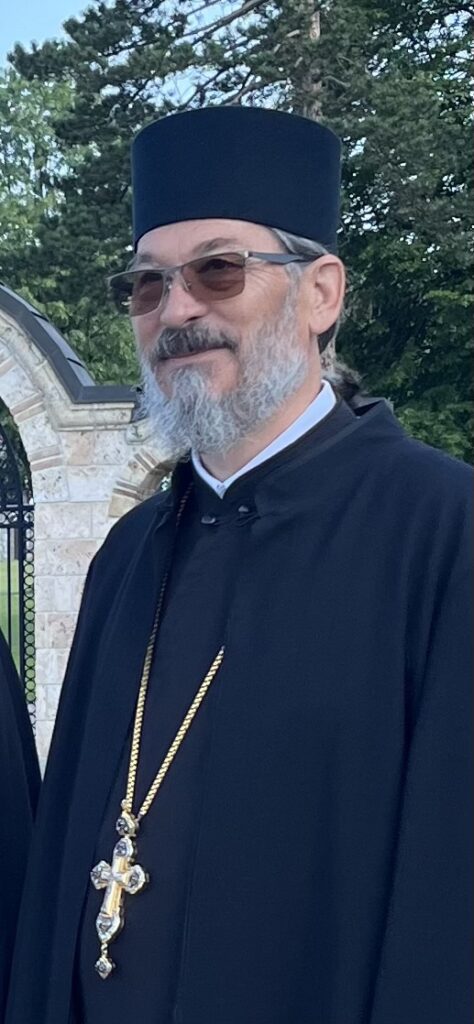
Rev. Dr Aleksandar Milojkov
PHOTOGRAPHY: pixabay