
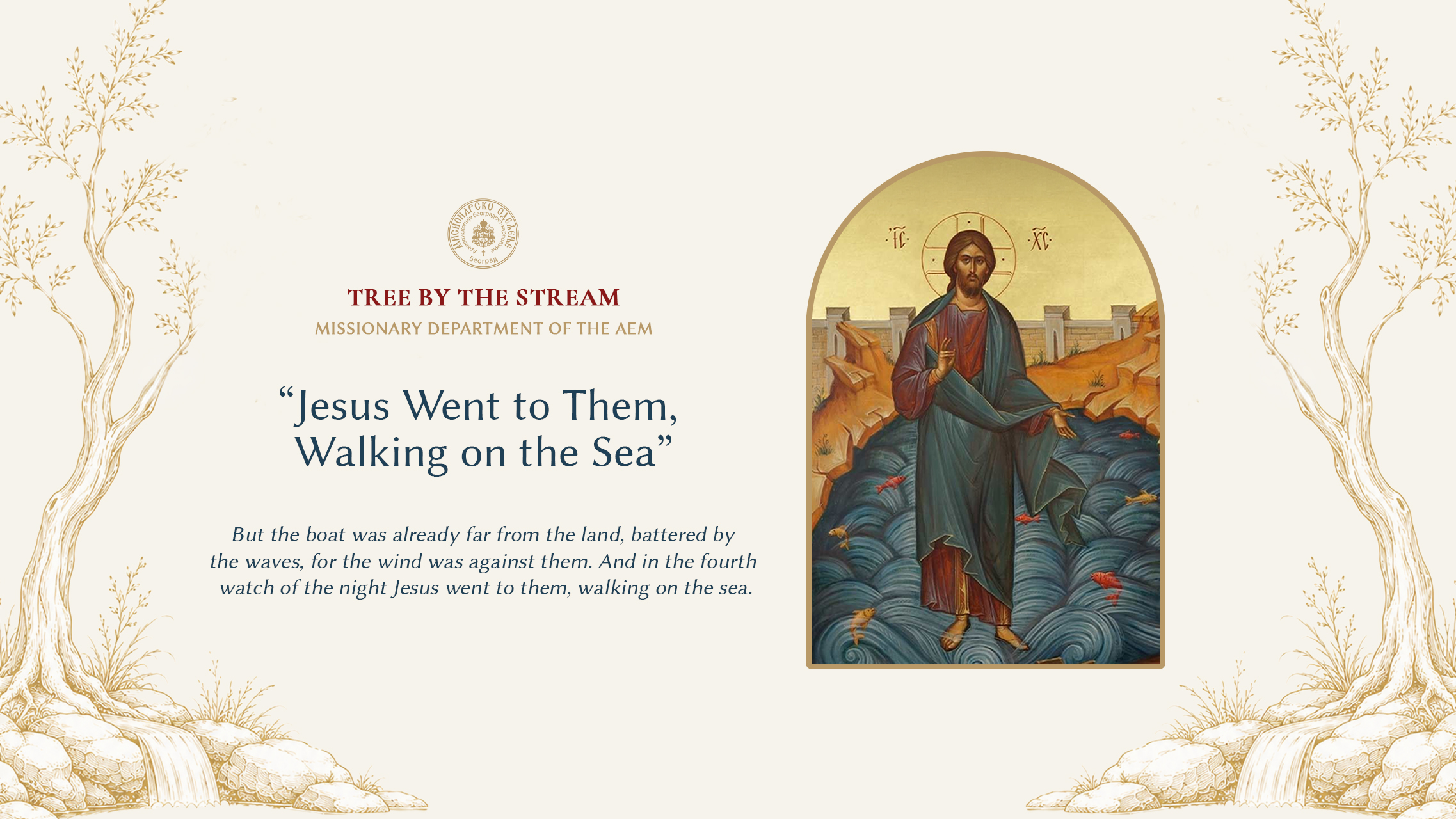
We begin this homily with verses 24–25 of chapter 14:
But the boat was already in the middle of the sea, being tossed by the waves, for the wind was contrary. And in the fourth watch of the night Jesus went to them, walking on the sea.
Blessed Augustine sees in this event a profound mystery of the life of the Church on earth: those who are faithful to God must remain within the Church, however great the trials may be, in order to attain eternal salvation:
“At that time, the boat in which the disciples were travelling—that is, the Church—was shaken and tossed among the stormy waves; and the contrary wind did not cease, that is, her adversary, the devil, hindered the calming of the wind. Yet greater is He who intercedes for us, for amid the disturbances of life He grants us security, coming to us and strengthening us, lest in the midst of turmoil we be cast out of the boat into the sea. For although the boat is exposed to dangers, it nevertheless remains the boat. It alone carries the disciples and receives Christ. It is indeed endangered upon the waters, but without it all would perish. Therefore, remain in the boat and pray to God. And behold, when all counsel proves useless, when the helmsman is helpless, when tightening the sails brings greater danger than benefit, when human assistance and strength have come to an end, then only one thing remains for those who sail: to cry out to God. Will He who cares that sailors arrive safely in harbour abandon the Church and fail to bring her into peace and tranquillity?”
Saint John Chrysostom sees in this event a resemblance to the episode described in the eighth chapter of the Gospel according to Matthew, when the disciples were caught in a storm, though Christ was then with them and asleep in the boat:
“Christ, therefore, went up the mountain to pray; meanwhile, the disciples again struggled with the waves and suffered upon the sea as before. Yet at that earlier time, during the storm, Christ was with them in the boat, whereas now they were alone. The Lord gradually and little by little leads them towards greater things, teaching them to endure all things courageously. Therefore, when they were first exposed to danger, He was with them, even though He slept, in order to calm them by His very presence. Now, however, leading them towards greater endurance, He acts differently: He withdraws from them and allows the storm to overtake them in the middle of the sea, so that they had no hope of deliverance. He permits them to struggle with the waves throughout the entire night, wishing, I believe, to shake their insensitive hearts. Such an event was meant to produce fear, aroused both by the storm and by the darkness of the night. In addition to contrition of heart, the Lord also leads them towards a more intense desire to be with Him and to remember Him continually. This is why Jesus did not appear to them immediately, but, as the Evangelist says: in the fourth watch of the night Jesus went to them, walking on the sea. By this He taught them not to seek a swift deliverance from the difficulties surrounding them, but to endure courageously whatever might happen.”
Saint Gregory Palamas emphasizes that the Lord Jesus Christ acted in the same manner with the Israelites during their flight from Egypt. Saint Gregory also explains why the Lord chooses this manner of instruction:
“You may see that He acted in the same way with that ancient people, that is, with Israel. When the sea was about to be miraculously divided before them and a path of salvation opened for them, they found themselves in extreme danger, pressed by inevitable destruction and surrounded by enemies. Now, in the time of His presence, when He delivers those possessed by demons, their liberation is preceded by great turmoil. In this way, His benefactions were not only wondrous, but also remained long in the memory of those to whom they were given. Jesus appears to them as they were undoubtedly calling upon the God of all creation amid that storm, showing that He is God over all and that He extends a helping hand to those who call upon Him.”
The final thought of Saint Gregory is a consolling confirmation of the spiritual experience of us who believe.
Saint Nikolaj of Ohrid draws attention to the preciousness of trusting in God even when we find ourselves in a difficult, almost hopeless situation:
“Ah, what a beautiful lesson this is for the righteous person: not to despair on the path along which God directs him; to believe that the One who sent him also cares for him and knows his afflictions, even if He does not immediately come to his aid, in order to test the faith of the righteous, just as gold is tested in fire. When the disciples were in despair, already in the final hour of despair, Christ suddenly appeared to them, walking upon the waves. This was in the fourth watch of the night, that is, just before dawn. For the Jews, like the Romans who ruled over them, divided the night into four watches. Each watch lasted three hours. The Lord appeared to the disciples in the fourth watch of the night, that is, in the fourth or final quarter of the night, just before dawn.”
Saint Hilary of Poitiers draws attention to the hidden meaning of this division of the night into periods known as watches. He writes:
“In the fourth watch of the night the fullness of His care is revealed. The first watch represented the time of the Law; the second, the time of the Prophets; the third, the time of His Incarnation; and the fourth, the time of His return in the splendour of glory. At that time, however, Jesus will find the Church weakened, seized by the spirit of antichrist and by the passions of this age. He will come to Christians who are afflicted and without consolation. And since, as must be expected from the antichrist, the faithful will be subjected to every possible trial, even at the time of the Lord’s coming they will be frightened by false visions and deceptive images appearing before their eyes. Yet the gracious Lord will then say: It is I, and He will dispel their fear. Through faith in His Second Coming, He will drive away the fear of the boat’s inevitable sinking.”
Another saint of our Church, Chromatius of Aquileia, writes that the watches represent the period from the creation of the world to the moment of the Incarnation and the saving work that the Lord accomplished for us on the Cross. Chromatius interprets it in this way:
“The first watch of the night—that is, of the present world—lasted from Adam to Noah; the second from Noah to Moses, through whom the Law was given. The third watch extended from Moses until the coming of the Lord and Saviour. During these three watches, before His Incarnation, the Lord guarded His saints through the ever-watchful angels from the snares of the enemy, that is, the devil and his angels, who from the beginning of the world plotted against the salvation of the righteous. In the first watch, protection was given to Abel, Seth, Enosh, Methuselah, and Noah. In the second watch, to Abraham, Melchizedek, Isaac, Jacob, and Joseph. In the third watch, to Moses, Aaron, Joshua son of Nun, and afterwards to the other righteous ones and prophets. The fourth watch announces the time in which the Son of God was born in the flesh and accepted suffering; the time in which He promises His disciples and the Church that, after His Resurrection, He will watch over them forever: I am with you always, even to the end of the age (Matthew 28:20).”
The great Father of the desert, Venerable Nilus of Sinai, writes that this event very much concerns our personal spiritual life and our own spiritual struggles:
“Behold: not in the first, not in the second, and not in the third, but in the fourth watch of the passing night does the Lord come to those who suffer from storm, waves, and immeasurable fear. When He decides to approach your boat and enter it, there will immediately arise for you silence, peace, joy, and gladness. Only do not allow the wondrous expectation within you to grow cold, and without yielding, lift your gaze towards Christ. When temptations arise and while they endure, do not extinguish good hope within yourself, but continue to hope.”
We now come to verses 26–27:
And when the disciples saw Him walking on the sea, they were troubled, saying, “It is a ghost!” And they cried out for fear. But immediately Jesus spoke to them, saying, “Be of good cheer! It is I; do not be afraid.”
Saint Bishop Nikolaj of Ohrid draws attention to a spiritual law that is deeply consoling for us: the Lord Jesus does not abandon His faithful ones in difficult situations, in situations of great fear and despair, but quickly comes to their aid. Here are his elevated words:
“Whether day had already begun to dawn, or whether there was moonlight, or whether the Lord Himself shone in the darkness with the light of Tabor—we cannot know. The essential point is that He became visible to the disciples. Seeing Him upon the waves of the sea, the disciples were filled with indescribable fear. This new fear was greater than their fear of the storm and of impending destruction. They did not know this power of their Lord, this degree of authority over nature. He had not revealed it to them until then. They had seen only that He commanded the sea and the winds, but they did not know that He could walk upon the water as upon dry land.
And Christ performed this new miracle precisely in order to strengthen their faith. It is a ghost! the disciples thought, and they cried out in great fear. It is some apparition. Or perhaps Satan himself in the form of their Teacher. Behold, their Teacher was wrestling with Satan and his army in this world! They knew this; they had seen it. And now, they may have thought, Satan has seized the opportunity, while they—His friends—are alone and in great danger, in order to destroy them. What thoughts did not pass through their minds! Surely all those thoughts that would even today pass through the minds of those of little faith when they find themselves in danger on the path of God.
But Jesus immediately spoke to them, saying: Do not be afraid; it is I; do not fear! Do you see how the Lord does not keep His own people for long in the most difficult trial? He knew their fear, their terrible fear of the apparition, and therefore hastened to save them from that fear: immediately He said to them: Do not be afraid. Immediately! And do you see how He encourages them, restoring to them, as it were, the breath of life which they had almost lost through fear: Do not be afraid; do not fear! He repeats the same encouragement: Do not be afraid; it is I; do not fear.
O sweet voice! O life-giving word! At that voice demons fled, illnesses withdrew, and the dead rose. What am I saying? By that voice heaven and earth came into being, the sun and the stars, angels and human beings. That voice is the source of every good thing, of all life, health, wisdom, and joy. Do not be afraid; it is I! Not everyone can hear these words, but the righteous hear them—those who suffer for the Lord. Not everyone hears Christ in every suffering. For how will the one who suffers because of his own sins and injustice hear Him? Only the one who suffers for faith in Him will hear Him (1 Peter 4:13–16). And behold, the disciples suffered because of their faith in Christ, namely, so that their faith in Christ might be strengthened.”
Adapted for the contemporary reader based on the interpretations of the Holy Fathers by Stanoje Stanković.