Each year, on September 1/14, we liturgically commemorate the Venerable Simeon the Stylite, and on that day, we also celebrate the Beginning of the Indiction, or the Church New Year. On the first day of September—at the start of the new ecclesiastical year—we are reminded during our liturgical gatherings of the words with which our Lord and Saviour Jesus Christ announced the arrival of the „acceptable year of the Lord“ (Luke 4:19) into the world. The Lord came among us and proclaimed the Kingdom of Heaven to the poor in spirit; He bestowed healing upon the contrite of heart; He freed the repentant from their sins; He opened the eyes and minds of the faithful so that, with spiritual vision, we might behold the incarnate and risen King and God—Christ—lest our feet falter towards sinful deeds (cf. Ps. 15:8); He brought us life—and life „more abundantly“ (John 10:10).
What is the Indiction? Historians know that the indiction is the ordinal number of a year within a regularly recurring fifteen-year cycle (the so-called „indiction“), spanning the time from one indiction (census/tax assessment) to the next. The indiction cycles themselves are not numbered; rather, they are used to correlate dates with other dating systems. Originally, the *indictio* (Latin for „proclamation“) referred to an announcement regarding mandatory food supplies for the government. The origins of the *indiction* cycle remain unclear (possibly Egyptian), but as early as the reign of the persecuting emperor Diocletian (284–305)—who radically reformed the system of government—property in the Roman Empire was re-evaluated every 15 years to determine tax amounts. The need for the population to know the current tax year led to the practice of reckoning time by *indictions*. This system was officially introduced by Emperor Constantine the Great (in 312/313). Initially, the *indiction* began on September 23—the birthday of the first Roman emperor, Octavian Augustus—but in 462, for practical reasons, the start of the year was shifted to September 1. Dating years by *indiction* became mandatory in 537, becoming widespread in both civil and ecclesiastical proceedings. It was used by the supreme authority of the Roman Empire until its dissolution in 1806 and it remains in use in certain calendar systems. For applied chronology, dating by *indiction* is of great importance.
The Fathers of the First Ecumenical Council in Nicaea (325 AD) decreed that the ecclesiastical year should begin on September 1st. For the Jewish people—God’s chosen people of the Old Testament—September marked the beginning of the new civil year; it was a time when the harvest was gathered and sacrifices were offered to God. September also commemorates the victory of Emperor Constantine the Great over Maxentius. For a long time throughout the Christian world, the civil year coincided with the ecclesiastical year, with both reckoned from September 1st. Later, the start of the civil year was shifted to January 1st—first in Europe, and subsequently in Russia during the reign of Peter the Great.
The feast of the *Nachalo Indikta* (the Beginning of the Indiction) is mentioned as early as the 10th-century Menologion of Basil, which records that the Lord Jesus Christ bestowed this holy feast upon us Christians, and that by celebrating it fervently, we offer Him our thanksgiving. This testimony points to the antiquity of the feast’s observance. Some liturgical scholars hypothesize that the custom of celebrating this feast was established as early as the 4th or 5th century. However, the earliest relevant evidence regarding the liturgical celebration of the *Nachalo Indikta* appears only in the 8th century, in the writings of Saint Theodore the Studite. In the liturgical hymns of this feast, fervent prayers are offered to God, asking Him to bless the crown of the new year of His goodness. As we celebrate the beginning of the Church New Year—instituted by the Lord who created days and nights, time and years (as the feast’s kontakion proclaims)—we pray that He sanctify and bless the new annual cycle, granting the earth’s fruitfulness and favourable weather, while also blessing and preserving us all. The service for this feast is also imbued with thanksgiving to the Lord for all the good things He has bestowed upon us.
In celebrating the beginning of the Indiction—the start of a new year of the Lord’s goodness—we are reminded of the importance of time in our lives. We are immersed in it, like a body in a swift-flowing river. Time is irreversible; it cannot be turned back. Time is unstoppable; with every fraction of a second, it rushes ever forward. Our entire life is immersed in time and dependent upon it. Only the Lord stands above time—above this flow—in His infinite Kingdom of light. To God, „a thousand years are like a single day, and a single day like a thousand years.“ We must accept the time granted to us as a great and priceless gift. Every river eventually flows into the sea, and every life eventually passes into eternity and continues, but time ceases where the Kingdom of God begins.
God grants man the opportunity to start anew many times throughout life, and each cycle can mark a new stage in our personal growth. This desire for renewal makes every New Year a significant event in the life of every Christian; thus, the Church celebrates the New Year by sanctifying it through prayer. In the spirit of the liturgical celebration of the Church’s New Year, we are reminded of the importance of sacred worship and the prayer by which we sanctify time. The Fathers called worship „life in the Holy Spirit,“ for the knowledge of God is realized in prayer, and through worship, we learn to pray and learn of eternal life—which is, in itself, the knowledge of God. Through Orthodox worship, we learn to glorify God. Every time we enter the church, we attend a great school of prayer. A new year begins, and we enter a new grade in this spiritual school, where the Church—through its feasts, hymns, and readings from Holy Scripture—will teach us about the Kingdom of Heaven, instructing us on how to acquire the skills necessary for the spiritual life and how to root out the habits that hinder it. Orthodoxy is life in the Holy Spirit. We have been given a colossal treasure: though we are sinful people, unworthy of the Kingdom of God and lacking a single bright spot upon our souls, we can nonetheless—by God’s grace—stand in heaven. Every time we enter the church and participate in the divine service, we stand in heaven: „Standing in the temple of Thy glory, it seems to us as though we are standing in heaven.“ This is a profound, sacred truth; ever since Christ came to earth and founded the Church, this heaven has descended upon the Apostles through the Holy Spirit. The Lord established the Church so that, through it, we might ascend to heaven. Therefore, the more we immerse our minds, hearts, and entire beings in the life of the Church and its grace-filled order, the more we partake in heavenly life—and the more we share in Christ and eternity.
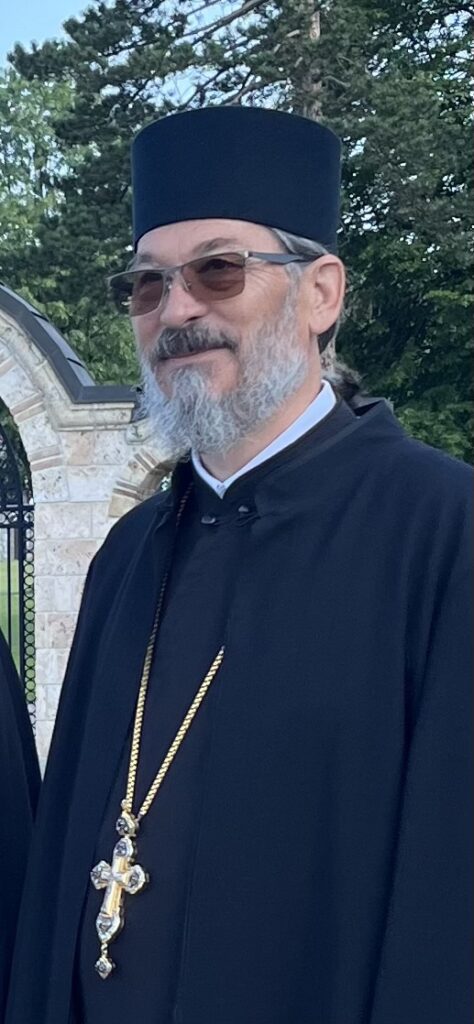
WRITTEN BY: Catechist Branislav Ilić, editor of the portal “Kinonia”
*The text was published on the portal Kinonia in the section “From the Editor’s Pen”, Septembar 13, 2026.