My task in this introductory address is to shed light on the concept of „Koinonia“ —to explain what the term signifies—from a theological and, above all, liturgical perspective and context. The portal’s name was not chosen at random; the name itself embodies the portal’s entire mission. „Kinonia“ (the spelling used as a Serbo-Greek variant when referring to the portal) is translated as community, fellowship, participation, or communion, and it derives from the Greek adjective „koinos“, meaning „common“ or „shared.“
If we trace the term back to antiquity, we see that in Classical Greek it denotes a community, society, partnership, friendship, or participation in something shared. It can be described primarily as a social term, as it was most frequently used in the contexts of politics, trade, civic life, or friendship. In the New Testament, however—specifically in the language of the Holy Apostle Paul—the term acquires an entirely new dimension; it takes on a new, transfigured meaning. The Apostle Paul employs it not only to describe the relationship among the early Christians but also the relationship between man and the Lord Himself. We observe this usage in the First and Second Epistles to the Corinthians, where he speaks of God calling people into fellowship with His Son, Jesus Christ. In 2 Corinthians: The grace of our Lord Jesus Christ, the love of God the Father, and the communion („koinonia“) of the Holy Spirit be with you all. Thus, this term shifts from a social category to an ontological category.
To understand the theological depth of the term „koinonia“, we must return to its source—the Holy Trinity. The Father, the Son, and the Holy Spirit have existed from eternity in perfect unity of love and mutual indwelling—what our theology calls „perichoresis“. God is not a solitary monad within Himself; He is a communion. It is precisely this Trinitarian communion that serves as the model for every other communion within the Church—most notably, the communion between man and God. Our understanding of the Church itself stems from this Trinitarian vision: the Church is not merely an institution—as our parishioners often view it—nor is it an organizational structure or a gathering of like-minded individuals; rather, in its deepest identity, it is a communion („koinonia“). It is a communion of the faithful with one another, and a communion of the faithful with the Lord.
In the Acts of the Apostles, within the description of that early Jerusalem community, we read that the faithful steadfastly devoted themselves to the fellowship, to the breaking of bread, and to prayers. It is crucial to note that this fellowship is linked to the breaking of bread—that is, to the Eucharist and Holy Communion. If the Church is „koinonia“ by its very essence, then this „koinonia“ (communion) is realized concretely in the liturgical gathering—specifically, in the Holy Eucharist. The Apostle Paul formulates this using technical theological language: „The cup of blessing which we bless, is it not the communion („koinonia“) of the blood of Christ? The bread which we break, is it not the communion („koinonia“) of the body of Christ? For we, though many, are one bread and one body; for we all partake of that one bread.“ Thus, we see here that „koinonia“ operates in two inseparable directions: vertical and horizontal. Vertically, it is the communion of the faithful with Christ; horizontally, it is the communion of the faithful with one another, stemming from that same participation in the Eucharist.
Now we come to the Divine Liturgy and the moment of „koinonia“ within it. The first moment of „koinonia“ in the Divine Liturgy is the gathering. We know that the Liturgy is not celebrated in isolation somewhere in the desert; rather, it presupposes the gathered people of God—assembled in one place around a single table and led by the bishop—as Saint Ignatius the God-bearer stated at the very beginning of the second century. The same saint warns Christians to shun those who separate themselves from the common assembly; for where the bishop is, there the people should be, since it is the bishop who presides over and preserves the unity of the Church. Therefore, the gathering is the first moment of „koinonia“ in the Liturgy. People arrive from various directions and places, with diverse personalities; yet they do not come to the Liturgy merely as individuals who happened to find themselves in the same location—they come as members of a single community. It is there that the initial step is taken: a person emerges from their self-enclosure and enters the realm of community. That is the first aspect.
The second aspect of „koinonia“ (communion) in the Liturgy is communal prayer. In the Liturgy, there is no such thing as the priest’s prayer versus the people’s prayer as separate realities; rather, there is one shared prayer of the Church. The celebrant intones, and the people respond; they call one another to prayer. All liturgical litanies are recited in the first-person plural, and no prayer within the Liturgy is individualistic or merely personal in structure; instead, it is the prayer of the community.
We observe certain phenomena during the Holy Liturgy—often seen in many places—where people hold prayer ropes and recite the Jesus Prayer, or hold prayer books and read their own personal prayer rules. This represents individualism within the Liturgy.
The third aspect of „koinonia“ in the Liturgy involves the diptychs and the commemoration of the living and the departed—both during the Proskomedia and at specific moments prescribed within the Holy Liturgy. This demonstrates that „koinonia“ transcends the boundaries of time and space; for the Holy Liturgy encompasses not only those physically present but also those absent for various reasons—and, even more profoundly, those who have fallen asleep in the Lord are present through prayer. Thus, the entire Church—both heavenly and earthly—is gathered together.
The fourth aspect of „koinonia“ in the Liturgy is the hearing of the Word of God. During the Liturgy, the Church gathers around the Word of God; the readings from the Apostle and the Gospel are not merely ordinary readings, but the very word Christ speaks to His Church. It is therefore important to emphasize that the Liturgy fosters not only a communion in prayer but also a communion in faith, for „koinonia“ is impossible without truth. We now arrive at the next aspect: the confession of the one faith—specifically, the confession of the Creed. When we confess the Creed together during the Liturgy, we are not simply reciting it as individuals; rather, we are confessing the faith of the Church and the faith of the Fathers. This represents a vital form of „koinonia“, as it is not a community where everyone holds their own version of Christianity; thus, the Creed is not merely a dogmatic text but, above all, a liturgical act through which we demonstrate that we belong to one Church and believe in one Christ.
The next aspect of „koinonia“ in the Liturgy is reconciliation and the kiss of peace. This is the moment in the Liturgy when the deacon says: „Let us love one another, that with one mind we may confess.“ The priests then kiss one another, saying: „Christ is among us—He is and shall be.“ Deacons kiss one another before the doors, and—from the 11th to the 14th century—all the faithful present in the church also kissed one another, speaking those same words. Sometime in the 14th century, that practice disappeared. Thus, in the Liturgy, community is realized not only because we are united, but also because we are reconciled with one another. „Koinonia“ is not merely a matter of belonging; it is a matter of our relationship with one another. It is not enough simply to say that we are one; we must strive as much as we can to live as one. That is why „koinonia“ is always a call to forgiveness, to love, and to service. One obstacle to receiving Communion can be a state of discord with another person. Discord is not a magical prohibition against Communion. If a person is consciously at odds with someone—if they do not forgive and refuse reconciliation—all of this stands in direct contradiction to the Sacrament of Communion. Saint John Chrysostom clearly states: „Let no one who has an enemy approach the table to receive the Body and Blood of Christ.“ Now it is clear to us why the act of the kiss of peace is so important.
The next moment of „koinonia“ in the Liturgy is the offering. „Koinonia“ is realized in the offering. Christians of the early times… …upon coming to the Divine Liturgy, they would bring bread, wine, and water. They brought gifts—that is, aid—for widows, orphans, and the destitute; these were distributed after the Divine Liturgy. Over time, deacons would select the finest loaves and the best wine from these offerings; the priests, during the Procession, would walk through the entire church, gather these gifts, bring them into the altar, and then perform the Proskomedia. It is important to emphasize that the believer does not keep their individual gift for themselves; rather, what is „mine“ is brought into the assembly and becomes „ours.“ The bread and wine I brought become the Eucharistic offering of the Church. At the Divine Liturgy, we offer not only gifts but also ourselves—our lives, our time, our sacrifices, our love, and so forth. „Koinonia“ is not merely a community where we receive something, but also one where we give and offer something. True community is impossible without a gift, without sacrifice, and without love that is given.
The eighth aspect is the Eucharist as the pinnacle of „koinonia“, for the Eucharist is the centre of ecclesial communion. The Holy Apostle Paul says: „There is one bread; we who are many are one body, for we all partake of the one bread.“ This is one of the finest expressions of „koinonia“ — one bread and one body—not because we are all identical, but because we are united. „Koinonia“ A community is not merely a group of people standing side by side; it is a community of people who become one in Christ.
Thanksgiving and life shared in common after the Divine Liturgy constitute the final moment of „koinonia“, for „koinonia“ does not end with the offering and Holy Communion but continues through thanksgiving. After Communion, the Church does not say, „Now everything is finished“; rather, it sends us back into life, and we must continue to live in such a way that „koinonia“ spills over into our entire existence—into marriage, relationships, friendships, and aid to the needy—as attested to by the Acts of the Apostles. We can observe this specific form of „koinonia“ among the Serbian people during the era of Ottoman rule. That period of Ottoman domination was extremely difficult for our people, yet liturgical worship remained one of the few settings where the people could gather as a community. To affirm their shared faith, the liturgical calendar preserved the memory of Serbian rulers and archbishops and kept the remembrance of ancestors alive; through these gatherings, it was demonstrated that the Church is a living community. The people survived the era of Ottoman rule only because liturgical worship survived, and for worship to survive, there was a need for scribes—individuals who would spend months copying a single book in a humble cell by candlelight. The dedicated labour of those people is an expression of „koinonia“.
Koinonia is not a sociological or moral concept; rather, it is a theological reality that springs from the Trinitarian life of God, is realized historically within the Church, and attains its fullness and culmination in the Eucharistic assembly—where we, too, partake in Communion, becoming one body in Christ. Koinonia is not mere socializing, a sense of belonging, friendship, or emotional warmth; above all, it is a participation in Christ.
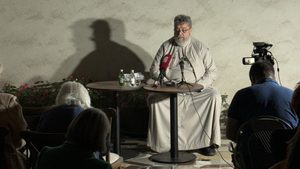
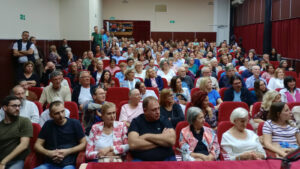
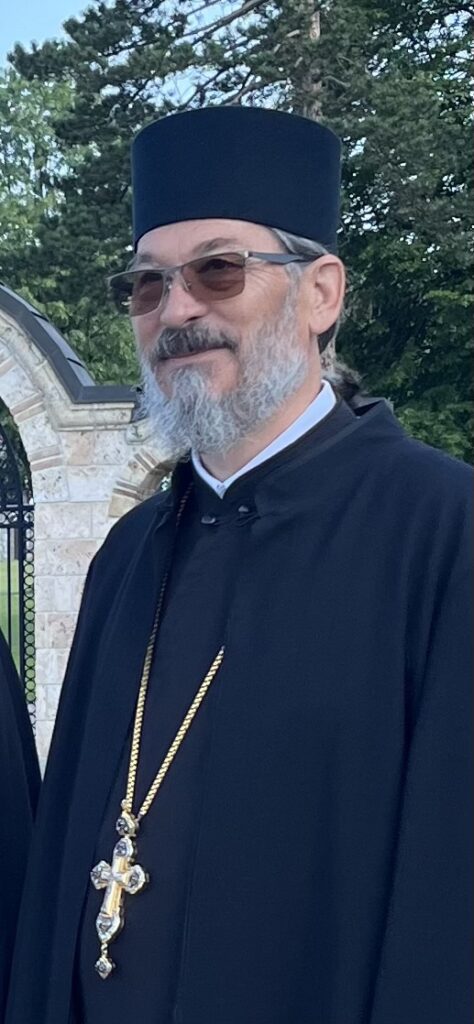
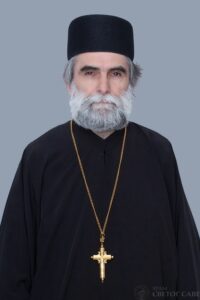
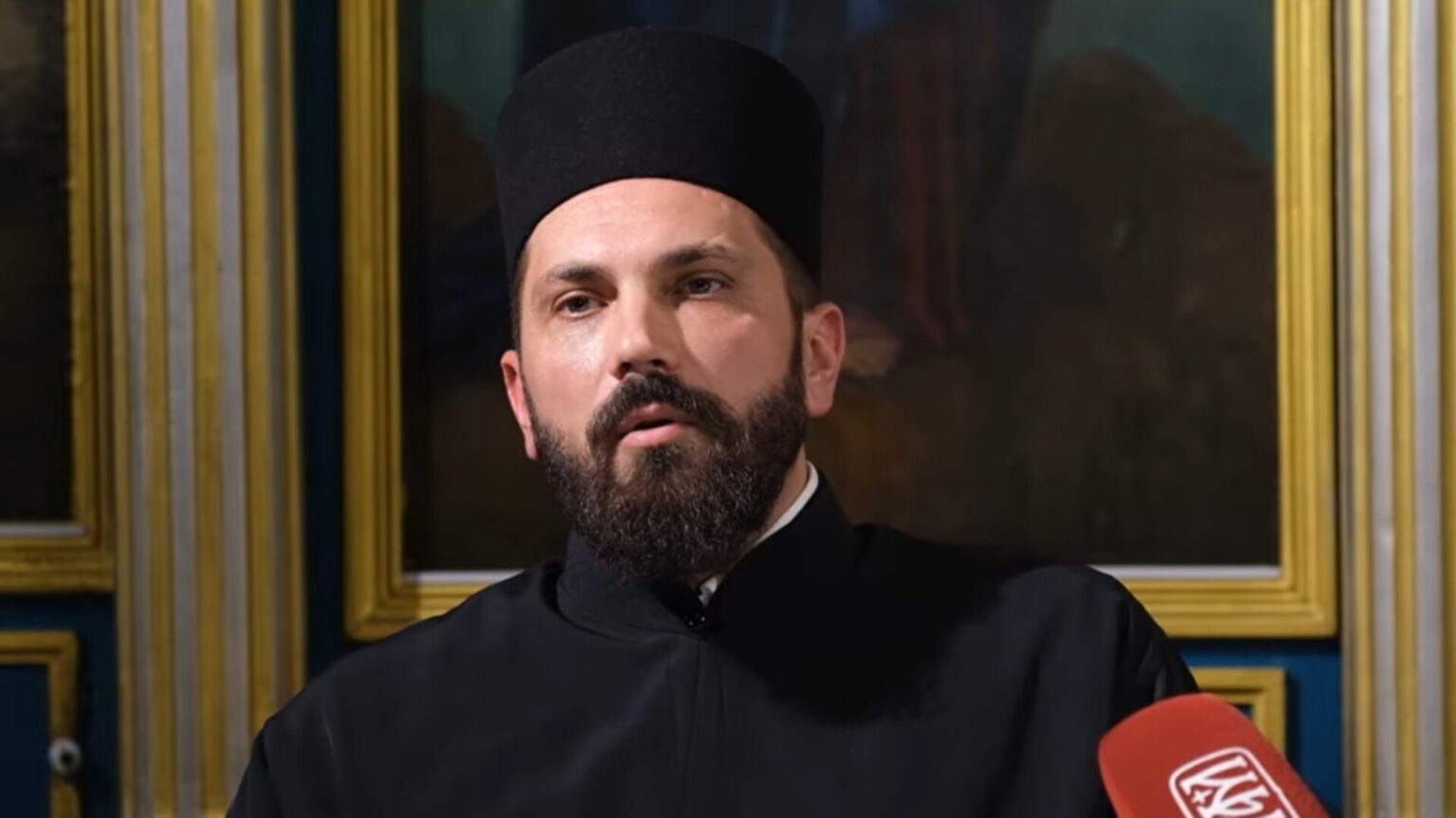
Address by Archpriest Dr. Slobodan Jakovljević, parish priest of Čačak, at the discussion panel „Koinonia – A Call to Community,“ held on September 14, 2026, to mark the second anniversary of the „Koinonia“ portal.
Source: Kinonia Portal
Photo: Hram Television Archive