
Before us are the final four verses of the fifteenth chapter:
And He took the seven loaves and the fish, and gave thanks, broke them, and gave them to His disciples; and the disciples gave them to the multitude. So they all ate and were filled, and they took up seven large baskets full of the fragments that were left. Now those who ate were four thousand men, besides women and children. And He sent away the multitude, got into the boat, and came to the region of Magdala.
Saint John Chrysostom continues to speak of the wisdom of the Apostles, as revealed in their actions: “Observe also the Apostles’ love of wisdom and how little concern they had for the needs of the body, being accustomed to give little thought to food. Although they were in the wilderness and had remained there for three days, they had only seven loaves… Since no miracle disposed the people to follow Jesus as greatly as the miracle of the multiplication of the loaves—for they did not merely wish to follow Jesus, but wanted to make Him king—Christ, avoiding even the appearance of a desire for power, withdrew after performing this miracle. He did not depart on foot, but entered a boat so that the people could not follow Him.”
Saint Hilary of Poitiers draws attention to the fact that, in the second multiplication of the loaves, the precise number of fish is not mentioned, and he explains its significance: “The unspecified quantity of fish signifies the diversity and distribution of the gifts and graces by which the faith of the Gentiles is nourished. The seven baskets that were filled indicate the abundance and superabundance of the light of the Spirit through the seven gifts: whatever the Holy Spirit bestows is given in abundance. A gift, when we have been filled with it, becomes richer and more abundant. The fact that four thousand people were gathered here represents the infinite multitude of people from all four corners of the world. With a view to the future, this indicated that every number of people would be filled in all the thousands of places where thousands of the faithful hasten to receive the gift of heavenly food. Thus, the people are sent away once they have been filled. And since the Lord abides with us throughout all the days of our lives, the multitude of believers from among the Gentiles enters the boat—that is, the Church.”
Saint Theophan the Recluse writes that the Lord Jesus is able to work miracles for us at every moment, but does not wish to do so because this would not be beneficial to us or to our spiritual development: “For a second time, through the miraculous feeding, the Lord provided for the people who followed Him, thereby demonstrating that He is always ready to bestow His gifts abundantly upon those who believe. He could have done this on every occasion, but He did not wish to do so, lest He accustom people to disregard the ordinary way of life, which He Himself had established, ordered, and sustained. Such is also God’s providence in general. The principal and all-embracing work of providence was accomplished in the beginning, at the creation of all things. Having ordered everything and set it in motion, God did not bind Himself by anything, but retained the freedom to provide extraordinary assistance whenever necessary. He acts as the master of a household, establishing order and sustaining it without being bound by it. He governs it with authority and according to His wise discretion as its master. The opponents of the faith do not understand God’s providence. In their own minds, they extend its boundaries and then, when they do not see their assumptions realised in practice, deny its very existence. The kind of providence they demand does not, indeed, exist; yet the providence established by the Lord God Himself undoubtedly does.” From this teaching, we see that the Lord is always ready to help us, but that He will do so only when we truly need His help and when it is for our benefit.
Concerning the very end of the fifteenth chapter, Saint Ambrose of Milan writes about the hidden spiritual mysteries contained in the events of the multiplication of the loaves: “The difference lies not only in the number of people, but also in the place where they received the food. Some reclined on the grass, while others were upon the ground; five thousand were on the grass, and four thousand upon the ground. Resting upon the ground is more difficult than reclining on the grass; those who are governed by bodily sensations find pleasure in what is soft and comfortable, and therefore recline on the grass, for all flesh is grass (Isa. 40:6). The others lower themselves to the earth, which brings forth wheat, wine, and the olive, and they receive the food of grace. Some recline, while others sit, and the latter enjoy greater repose. The former have two fish, whereas among the latter no one counts the fish. For this reason, many consider the loaves to represent the seven gifts of the grace of the Holy Spirit, and the fish to represent the two Testaments. It would be correct to understand the four thousand gathered from the four corners of the world as representing the Church; they receive food more abundant in grace, in accordance with what is written: many shall come from the east and the west, and from the north and the south… The multitude is filled with food, while the Apostles minister to them—herein lies a mystical meaning. Being filled signifies the banishment of hunger forever, for the person who has tasted the bread of Christ shall never hunger.”
We now begin the interpretation of the sixteenth chapter, and the first four verses are before us:
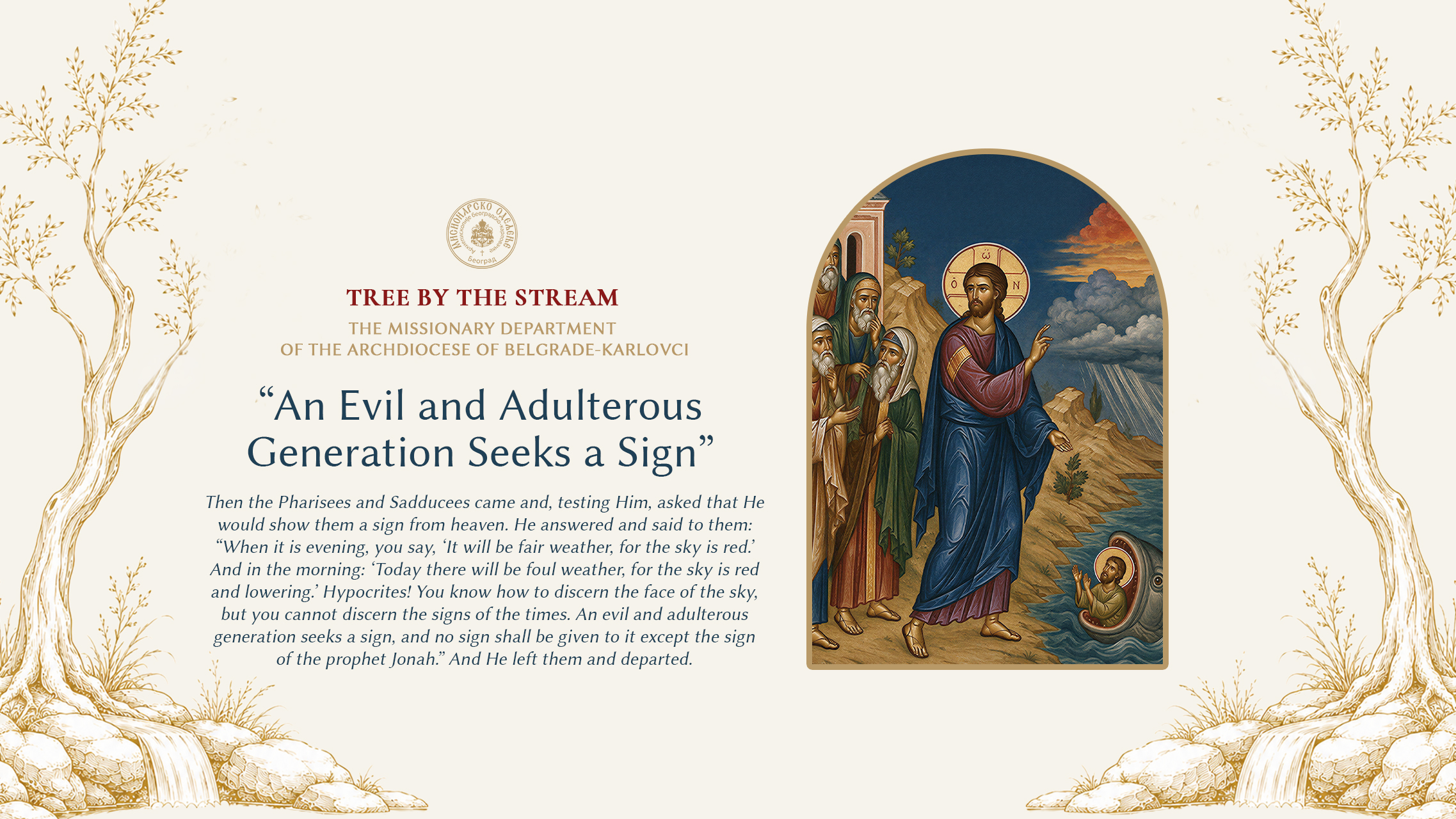
Then the Pharisees and Sadducees came and, testing Him, asked that He would show them a sign from heaven. He answered and said to them: “When it is evening, you say, ‘It will be fair weather, for the sky is red.’ And in the morning: ‘Today there will be foul weather, for the sky is red and lowering.’ Hypocrites! You know how to discern the face of the sky, but you cannot discern the signs of the times. An evil and adulterous generation seeks a sign, and no sign shall be given to it except the sign of the prophet Jonah.” And He left them and departed.
Saint John Chrysostom reveals the full extent of the cunning and insensibility of these people, explaining what the Pharisees and Sadducees were essentially asking of Christ: “Although such a question ought to have provoked anger and indignation, the loving and merciful Lord does not become angry, but rather pities and grieves over them as people suffering from an incurable illness, who, even after so many demonstrations of His power, continue to put Him to the test. The Pharisees and Sadducees questioned Jesus not in order to believe, but to ensnare Him. Had they approached Him with a desire to believe, Jesus would have shown them a sign. … However, since they sought a sign not in order to believe, the Saviour calls them hypocrites, because they said one thing while thinking another. Had they believed, they would not even have asked for a sign. The fact that they did not believe is also evident from their failure, after being rebuked and exposed, to persist in their request or to say: ‘We do not know and wish to learn.’ What sign did they seek from heaven? The halting of the sun or the moon, the bringing down of lightning, a change in the atmosphere, or something similar. What does Christ answer them? You know how to discern the face of the sky, but you cannot discern the signs of the times. Do you see His meekness and condescension? Jesus does not answer as He did previously, No sign shall be given to it (Matt. 12:39), but also states the reason for not giving one, although the Pharisees had not asked in order to learn. What is that reason? Just as in the sky, Jesus says, one sign foretells foul weather and another fair weather—and no one who sees the sign of foul weather will expect fair weather, nor a storm during fair weather—so must you also reason concerning Me. The time of My present coming is one thing, and the time of My future coming another. Signs upon the earth are needed now, while signs in heaven will be reserved for the future. Now I have come as a Physician, but then I shall come as Judge; now I have come to seek those who have gone astray, but then I shall come to require an account. … Why should I show great signs when you lack faith even for the lesser ones? I call them lesser according to their outward appearance, for in their inner power they are far greater than the former. For what can be compared with the forgiveness of sins, the raising of the dead, the casting out of demons, the healing of the body—in a word, the renewal of all things? Behold how insensible the hearts of the Jews are. Upon hearing that they would receive no sign except the sign of the prophet Jonah, they asked Jesus nothing, although, knowing about Jonah and everything that had happened to him, and now hearing Christ speak of it once again, they ought to have asked and understood what Jesus’ words meant. From this it is evident that they sought a sign without any desire to be instructed. Therefore, Jesus leaves them and departs.” From this action of our Lord, we too may draw a lesson whenever we find ourselves in a situation in which someone asks questions about our faith out of idle curiosity, because they are bored, or with concealed mockery. When we perceive and recognise this, we ought not to cast pearls.
Blessed Theophylact, in connection with this verse, writes about an important law of the ascetic life—something that everyone who earnestly wishes to fulfil the commandments should remember: “Although the Pharisees and Sadducees held different doctrines, they nevertheless acted in concert against Christ. They sought a sign from heaven, such as the halting of the sun or the moon, because they believed that signs performed upon the earth came from demonic powers and Beelzebub. In their foolishness, they forgot that even Moses had performed many signs upon the earth in Egypt, while the fire from heaven that consumed Job’s flocks came from the devil. Thus, not all signs that come from heaven are from God, nor is everything that occurs upon the earth the work of demons.”
Saint Theophan the Recluse reveals the spiritual blindness of Jesus’ enemies, for they sought a sign while the greatest Sign from God was standing directly before them: “The Pharisees and Sadducees asked the Lord to show them a sign (Matt. 16:5), yet they failed to notice that the Sign was before their very eyes. The Lord Himself was the Sign. His teaching and deeds clearly revealed who He was, so that no other testimony was necessary. The works that I do… bear witness of Me, He said to the Jews (John 10:25). … Why did this happen to them? Because they lived an outward life and did not enter within themselves. Without inner recollection, attentiveness, and self-examination, the works of God can neither be perceived nor understood. This continues to the present day. Christianity stands before everyone’s eyes as a true sign of God. Yet those who look upon it do not see; they waver in their faith and fall away. Their eyes lose the ability to perceive the divine seal upon it. They are ready to seek special signs from heaven, like the Jews. Nevertheless, no sign is given, because those who seek it do so in order to test, and not in order to set out upon the path of Christ. You need only set foot upon that path, and from the very first step you will perceive its divine character—that is, you will see that it leads to God and brings God nearer to you. The Lord said to the Jews: No sign shall be given except the sign of the prophet Jonah (Matt. 16:4). The Lord also foresaw the unbelievers of the present day and prepared an answer for them in advance: Then the sign of the Son of Man will appear in heaven, and then all the tribes of the earth will mourn(Matt. 24:30).” We should bear this reflection of Saint Theophan in mind when, for example, we wish to preach at work or while visiting relatives. We see that people are not unbelievers solely because no one has explained the faith to them or spoken to them about it. As we can see, there are also deeper reasons concealed within the heart of a person who does not wish to believe.
Saint Ignatius Brianchaninov writes about the spiritual condition of the Pharisees and Sadducees: “In demanding a sign from heaven from the Lord, the Pharisees and Sadducees sought miracles resembling those of the Antichrist. The fact that they sought such a miracle explains the Lord’s response to their request. … All who demanded a sign were called an evil generation because of their mutual spiritual affinity in wickedness; they were called an adulterous generation because, in spirit, they had entered into communion with Satan, having severed their communion with God. They were called a wicked generation because, although aware of the miracles of the God-Man, they pretended not to be aware of them; while disparaging and blaspheming the miracles of God, they sought a miracle that corresponded to their own wretched disposition and spirit. The request for a sign from heaven was not so much a plea for a miracle as it was a mockery of the miracles of the God-Man and an expression of a distorted understanding of miracles. The sign of the prophet Jonah, according to the explanation of the Saviour Himself, signified the signs that accompanied the death and Resurrection of the Lord Jesus. It was then that God’s sign from heaven was given! Then the sun, beholding the crucified Lord, was darkened at midday; a profound darkness descended and lasted for three hours; the veil of the Temple in Jerusalem was torn in two of its own accord, from top to bottom; an earthquake occurred, the rocks were split, and the tombs were opened; many holy people were raised and appeared to many in the holy city. At the very Resurrection of the Lord, another earthquake occurred; a light-bearing angel descended from heaven to the Lord’s tomb as a witness to the Resurrection, striking terror into the guards who had been stationed at the tomb by those very people who had sought a sign from heaven. The guards informed the Jewish Sanhedrin of the Lord’s Resurrection. Yet the Sanhedrin, having received a sign from heaven, displayed the same contempt and hatred that it had shown towards all the previous miracles of the God-Man, bribed the guards, and, together with them, endeavoured to conceal the miracle of God beneath the darkness of falsehood.”
Adapted for the contemporary reader based on patristic interpretations by Stanoje Stanković