
The text was published on the Kinonia portal in the column “From the Editor’s Pen,” on April 5, 2026.
Six days before Lazarus Saturday and Palm Sunday, the liturgical life of our Church encourages us to follow Christ after He announces the death of His friend Lazarus and begins His journey towards Bethany and Jerusalem. The focus of our attention is on Lazarus—his illness, his death, the sorrow of his relatives, and Christ’s response to all of this. Thus, the final week passes in spiritual reflection on Christ’s impending encounter with death—first in the person of His friend Lazarus, and then in His own death upon the Cross.
“The hour of Christ,” of which He so often spoke, is drawing near, and His entire earthly ministry was directed towards it. The raising of Lazarus occurred in order to confirm the general resurrection of all. It is profoundly moving to celebrate each day of this week this encounter between life and death, which is gradually approaching. “When Jesus saw Mary weeping, and the Jews who had come with her also weeping, He was deeply moved in spirit and troubled… Jesus wept” (John 11:33–35). According to our liturgical terminology, Lazarus Saturday and Palm Sunday are the “beginning of the Cross.”
Why did Jesus weep at the tomb of Lazarus?
Saint Amphilochius, Bishop of Iconium, a close friend of Saint Basil the Great and of the Cappadocian Fathers, begins his interpretation of the event of the raising of Lazarus with the following words: “Bring to us once more John the Evangelist. It is good to examine the first-fruits of the resurrection.” Continuing his interpretation, he stands before the event that the Evangelist John especially emphasizes—namely, the tears of Jesus. And Saint Amphilochius asks: “Why are tears necessary, if You are about to raise him?”
Why, then, did Jesus weep?
“Jesus wept because He had wisely ordained all things.” He wept before the tomb in order to reveal the thoughts of all those who followed Him—that is, the extent of their doubts about Him. “See how much He loved him? He who raised the dead and gave sight to the blind—could He not have prevented this death, if He truly loved him so much?”
To such thoughts of the people who had come to Bethany to console Martha and Mary for the death of their brother, Christ’s answer, expressed through the mouth of the aforementioned Spirit-bearing Father of the Church, is striking: “I allowed death to consume him so that you might clearly know that I have authority over life and death.”
According to certain God-bearing interpreters of this passage from Holy Scripture, Christ wept because He did not deny His likeness to human beings, yet His human nature is united with the divine. He is perfect God and perfect man. He stands before the all-devouring beast of death and the dread it instills in humanity. According to the words of Saint John of Damascus: “He is perfect God, having become perfectly mortal, the whole of divinity united with humanity.” Saint Andrew, Bishop of Crete, adds his own insight in the canon chanted on the eve of the Saturday of Righteous Lazarus: “O Lord, You wept for Lazarus to show that You have become incarnate”; “He shed tears for His friend by economy, in order to manifest the body He received from us”; “You wept as a man, yet You raised Lazarus as God”; “He weeps because of the fall of humanity from Paradise, which we suffered through sin,” concludes Saint Andrew of Crete. Christ weeps because He recalls Lazarus from the reality of true life. Lazarus had succeeded in entering gloriously into the reality of true life as one who was righteous, pious, and a friend of Christ. Having found refuge in the harbour of Paradise, he is called back into the storms of life. He who had struggled and been crowned with a crown of victory is summoned once again into life’s struggles. Christ has given us an example and at the same time has defined the proper measure—how much we should grieve and weep for the departed. No one remains indifferent before the fearful mystery of death. According to Saint John of Damascus: “The mystery of death is most terrible.”
The Church does not forbid tears for our departed brethren, nor does it condemn such sorrow. The wise Sirach writes: “Weep for the dead, for they have lost the light; and weep more for the foolish, for they lack understanding. Weep but little for the dead, for they are at rest; but the life of the foolish is worse than death” (22:11). “My child, let your tears fall for the dead; as one who suffers grievously, give voice to your grief. Lay out their bodies according to their due and do not neglect their burial. Let your weeping be bitter and express your sorrow fervently, and make your mourning worthy of them. Mourn for one or two days, lest you be reproached, and then be comforted in your grief. Excessive sorrow can lead to death, and grief of heart will exhaust your strength” (38:16–18).
To these wondrous words, the God-bearing Father of the Church, Saint John Chrysostom, adds: “Let us not become harsh or unfeeling… Moreover, Christ Himself showed us this when He wept for Lazarus… Do this also: weep, but with moderation, with dignity, and with the fear of God.”
If Christ wept at the tomb of one who had been dead for four days, how much more does He weep today over our apostasy and the presence of death and sin that dominate our souls? How many of us will have the opportunity to meet Him on the night of the Resurrection? How many of us will possess the wedding garment in order to sit at the “prepared table”? How many of us will worthily partake of His Body and His Blood for the forgiveness of our sins and for eternal life?
Therefore, through the inspired hymns of the Church in these days, we are called to direct our prayerful cries to Christ the Saviour, asking Him to grant us a fountain of tears by which we may wash our defiled souls, so that we may behold the light of His countenance. “O God, grant me tears, and as the sinful woman, deem me worthy to wet Thy feet… that I may hear Thy gracious voice: ‘Your faith has saved you; go in peace’” (from Great Compline).
When Christ was born in Bethlehem of Judea, they immediately sought Him in order to kill Him. Fourteen thousand infants were slain in the search for Him. Throughout His earthly life, Christ was persecuted. Christ, our Lord, ought to have been received with dignity in Jerusalem. When we have a dear guest, we strive to prepare everything for his arrival.
How, then, should humanity welcome its Creator?
Knowing that Christ was approaching, the people hastened to see Him, glorifying Him as God ought to be glorified. They took branches of palm trees and spread them along the road before the feet of the donkey; some removed their outer garments and cloaks and cast them down as well. Amid these cries of rejoicing, the Lord entered triumphantly into the city of Jerusalem. Christ came from the heart of the people. As at every celebration, the children were the most joyful. They ran around Christ, crying out: “Hosanna! Blessed is He who comes in the name of the Lord! God is the Lord and has revealed Himself to us!” All rejoiced at Christ’s coming, except the Jews, the scribes, and the Pharisees. Thus was fulfilled the ancient prophecy which foretold that, when God would come, the mouths of children and infants would proclaim His praise.
The entire procession solemnly moves towards Jerusalem and comes to a halt at the summit of the Mount of Olives, from which a magnificent view opens over this ancient, great, and holy city. At its centre stands the majestic Temple, and its white marble walls, its gates overlaid with gold—all of it gleams and sparkles in the rays of the rising sun.
Christ, the King of kings and Lord of lords, weeps amid the joyful and exultant crowd. Yet He does not weep for Himself; He does not weep for the suffering He will endure in only a few days. Christ enters Jerusalem in triumph, in order to ascend the Cross. But this is not the reason for His tears. He weeps for the people who surround Him. He weeps because of the blindness of their hearts. He has done everything that could be done, yet even God—however paradoxical this may sound to us today—is “powerless” against the human will, against the blindness and deafness of the human heart. Love cannot be forced, nor can faith be imposed—these can be embraced only by the human heart and mind. The Lord weeps because of our hardened insensitivity, because of our unwillingness to receive His eternal word. It is dreadful to live and yet never to “recognize the time” of God’s visitation to our hearts. Throughout the past six weeks of Great Lent, we have repeatedly heard the Church’s call to break the shell of insensibility within our hearts and, like the prodigal son, to turn to God with the words: “I have sinned, O Lord, against Thee.”
The people of Jerusalem were awaiting a great leader—a liberator and a conqueror. Yet the Lord enters the Holy City, fulfilling the Scriptures: “Tell the daughter of Zion, Behold, your King is coming to you, meek and mounted on a donkey” (Matt. 21:5). In the same way, we await Christ in our lives, forgetting His words: “Behold, I stand at the door and knock; if anyone hears My voice and opens the door, I will come in to him” (Rev. 3:20). Christ’s call is addressed to each one of us. If we look back upon our lives, we shall find many moments when the Lord was very near to us, when our hearts responded with joy to divine truth. Yet this was later forgotten, and the light of Christ was extinguished by our passions, introducing into the soul the darkness of despair, anxiety, and an oppressive sense of hopelessness.
At Vespers and Matins of the feast of Palm Sunday, we hear the sticheron: “Today the grace of the Holy Spirit has gathered us together, and taking up our cross, we all say: Blessed is He who comes in the name of the Lord, Hosanna in the highest.” The text of this sticheron does not say: “taking palms or branches of young trees”—but rather: “taking up our cross”—and then we say: “Blessed is He who comes in the name of the Lord.” To take up one’s cross means to share with Him His labours, His sorrow for humanity, His love for us, and His ultimate humility. To take up one’s cross means to imitate Him with steadfastness, trust, love, and hope that the Lord comes today to grant us salvation.
Holy Week lies before us. The Lord enters Jerusalem in order to ascend Golgotha—we are called to go with Him. Just as the apostles followed Him in trembling and fear, yet continued to follow Him, so we too shall follow Christ and live with Him through the final days of His earthly life. Today begins the path of Christ’s ascent to Golgotha. May the Lord help us to draw at least a little nearer to the struggle. of His Cross-bearing, so that we may become participants in the glory of the Resurrection.
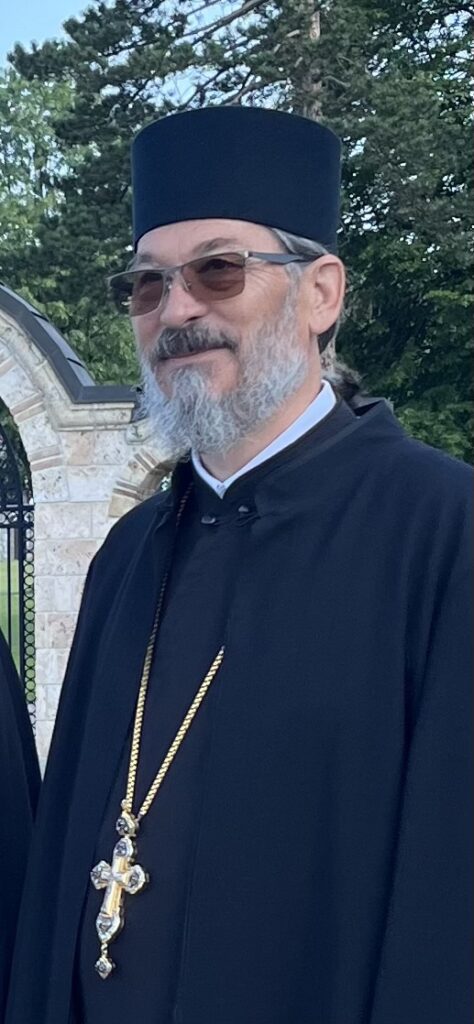
WRITTEN BY: Catechist Branislav Ilić, Editor of the Kinonija Portal