

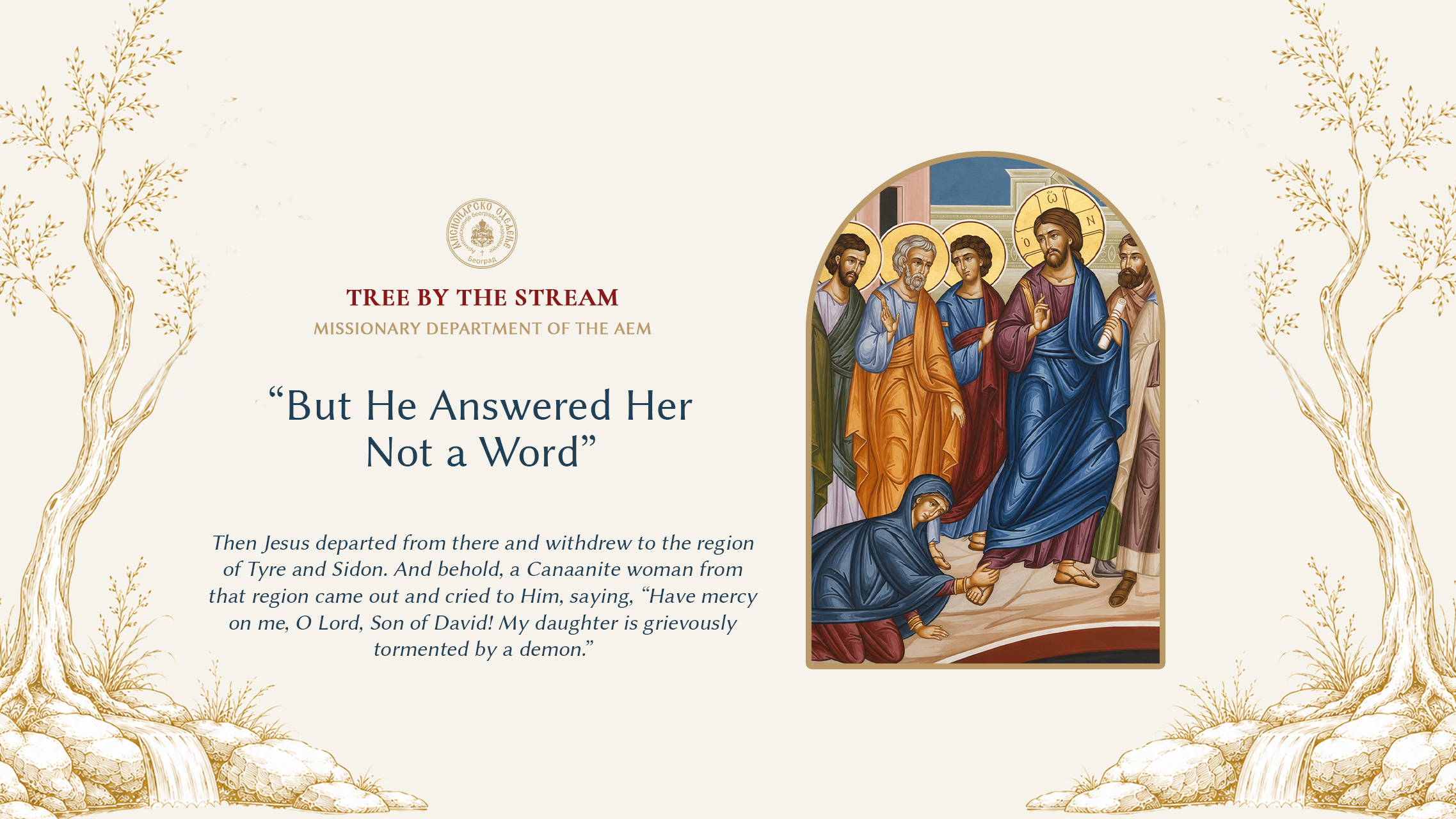
We begin our interpretation of this Gospel passage with verses 21–22:
Then Jesus departed from there and withdrew to the region of Tyre and Sidon. And behold, a Canaanite woman from that region came out and cried to Him, saying, “Have mercy on me, O Lord, Son of David! My daughter is grievously tormented by a demon.”
St. John Chrysostom reveals the deeper reason for Christ’s journey through the Gentile territories:
“The Evangelist Mark tells us that after Christ entered a house, ‘He desired that no one should know it, but He could not be hidden’ (Mk. 7:24). But why did Christ go precisely to these regions? Having already abolished the Jewish ceremonial distinction regarding foods, Christ now proceeds further by opening the door even to the Gentiles. In the same way, Peter was first commanded to set aside the dietary regulations and only afterwards was sent to Cornelius (Acts 10). If someone should ask, ‘How is it that Christ, who instructed His disciples, “Do not go into the way of the Gentiles” (Mt. 10:5), now Himself enters Gentile territory?’ we reply: first, was He Himself bound by the command that He had given to His disciples? Secondly, He did not go there for the purpose of preaching. This is confirmed by the Evangelist Mark, who states that the Lord wished to remain hidden but could not. Just as it was not yet fitting for Christ to go first to the Gentiles, neither would it have been consistent with His boundless love for mankind to turn them away when they themselves came seeking Him. If He was not to pursue those who fled from Him, then all the more He could not reject those who voluntarily sought Him. … ‘Have mercy on me,’ cries the woman, ‘I possess no good works; my life gives me no confidence to approach You. I appeal only to mercy, the common harbour of sinners. I flee to compassion, where there is no judgment and where salvation is bestowed without examination.’ Thus, as a sinner, she found the courage to draw near to Christ. Observe also the wisdom of this woman. She does not entreat James, nor implore John, nor appeal to Peter. … ‘I have no need of an intermediary. Taking my own repentance as my advocate, I approach the very Source Himself. It is for this very reason that Christ came and assumed human nature, so that I might speak directly with Him.’ In heaven, the cherubim tremble, yet on earth a sinful woman converses with the Lord! ‘Have mercy on me’—a simple phrase, yet within it lies an inexhaustible ocean of salvation. In heaven there is awe; on earth there is boldness!”
St. Nikolai of Ohrid continues this thought and presents a third reason for the Lord’s journey into Gentile territory:
“From where did Jesus depart? From Galilee, from the land of the people of Israel, the descendants of the blessed Shem. And where did He go? To the regions inhabited by the Canaanites, the descendants of the accursed Ham. Thus the Lord departed from those who had been blessed and came among those who had been cursed. Why? Because those who had been blessed forgot God and became accursed, while some of those who had been under the curse acknowledged God and came to share in His blessing. After rebuking the scribes and Pharisees for their outward observance of external customs while transgressing God’s commandments concerning mercy and the honouring of parents, the Lord took His disciples and crossed into Gentile territory. … Through their leaders, the Jewish people rejected the Saviour. Yet God, who is infinitely wise in accomplishing His saving plan, did not allow the work of salvation to be hindered, much less frustrated, by Israel’s rejection of Christ. Therefore, the Saviour crossed the borders of the Jewish nation and went among the other peoples. Faithful to His covenant, the Lord first sent His disciples to the people of Israel; yet after His Resurrection, He commissioned them to preach to all nations. Finally, there was a third reason for this journey: the Lord desired once more to put His chosen and blessed people to shame by the faith of the Gentiles, so that through this they might be brought to repentance and restored to God.”
St. Hilary of Poitiers offers an intriguing reflection on the Canaanite woman herself, suggesting that she most likely belonged to the community of proselytes—Gentiles who had embraced the faith of Israel and come to know the God of the Old Testament, Yahweh. He also explains the symbolic meaning of her demon-possessed daughter:
“In order to understand the inner motivation of the Canaanite woman and the significance of what took place, it is necessary to reflect carefully upon the force of her words. It is certain that within Israel there existed a community of proselytes, people who had abandoned paganism and embraced the observance of the Old Testament Law. They had renounced their former way of life and united themselves with the religion of another people as though it were their own. The Canaanites had once inhabited the land that later became Judea. Some perished in war, others were scattered throughout neighbouring regions, and still others were carried away into captivity as a conquered people. They retained their ethnic identity, yet no longer possessed a homeland. This people gradually mingled with the Jews, although they were originally of Gentile descent. Since part of the believing community consisted of those who had come from among the Gentiles, it is highly probable that this Canaanite woman had likewise left her homeland, preferring to live as a proselyte—that is, she had passed from paganism to the neighbouring people of God. She pleaded on behalf of her daughter, who symbolizes all the Gentile nations. Because she had come to know the Lord through the Old Testament revelation, she addressed Him as the Son of David. The woman herself, having confessed Christ as Lord and Son of David, stood in no need of healing. Rather, she sought help for her daughter—that is, for all the Gentiles who remained possessed by unclean spirits.”
Verse 23:
But He answered her not a word. And His disciples came and urged Him, saying, “Send her away, for she cries out after us.”
St. John Chrysostom draws attention to the Lord Jesus’ response, which has surprised and puzzled many readers of the Gospel:
“What is the meaning of this new and extraordinary manner of Christ? He guides the Jews despite their ingratitude; He calls to Himself those who speak against Him; He does not abandon those who test Him. Yet this Canaanite woman, who comes to Him of her own accord, who implores Him with such faith, who knows neither the Law nor the Prophets and yet displays such remarkable piety, He does not even deem worthy of a reply. Who would not be troubled by Christ upon witnessing conduct so seemingly contrary to everything that had been reported about Him? It was said that He travelled through towns and villages in order to heal the sick, and yet here He appears to reject a woman who has voluntarily approached Him. Whose heart would not be moved by such suffering and by the humility with which she interceded for her grievously afflicted daughter? She did not presume herself worthy of receiving His favour, nor did she come demanding what was due to her. She begged only for mercy, speaking solely of her own misery, and yet she was not granted even a single response. … I believe that the disciples themselves were deeply touched by the woman’s distress. They were troubled and filled with compassion. Yet even in such a state they did not dare say directly to Christ, ‘Show mercy to her.’ Instead, ‘His disciples came and urged Him, saying, “Send her away, for she cries out after us.”’ So it is with us as well: when we wish to persuade someone, we often do not say exactly what we truly desire.”
St. Nikolai of Ohrid explains the purpose of Christ’s seemingly unexpected response:
“Why does the Lord answer in this manner? First, in order to demonstrate God’s faithfulness to His covenant; and second, in order to awaken His disciples to the realization that the Gentiles, too, are children of the living God and are likewise in need of help and salvation. Through this afflicted woman, whose faith was so great, He also gives His disciples the opportunity to challenge the narrow Jewish notion that God cares only for the Jews, or that He is somehow exclusively the God of Israel. The Lord deliberately speaks in the same way that the Jews themselves commonly spoke, so that His disciples might reflect and come to understand for themselves that the prevailing belief of their nation was mistaken—and all the more mistaken because that very nation had fallen away from God, rejected Christ the Lord, and cast Him aside. The Lord Jesus does not instruct His disciples only through words, but also through the living events of His earthly ministry. In this instance, instead of a verbal lesson, He allows the encounter with the Gentile woman to become an unforgettable teaching for His followers. It was precisely for this reason that He crossed the borders of the Jewish land and entered Gentile territory: to instruct His disciples through this remarkable event.”
Verse 24:
But He answered and said, “I was sent only to the lost sheep of the house of Israel.”
St. Innocent of Kherson explains the meaning of these words, which may initially surprise the reader:
“Why did Jesus Christ limit His preaching to the Jews? Because the primary purpose of His earthly ministry was not first of all to enlighten the whole world directly, but to prepare those who would become its enlighteners. For this purpose, it was unnecessary for Him to devote Himself equally to every nation. He did, indeed, minister to others, but only incidentally; it was His disciples who were later commanded to proclaim the Gospel to all peoples, both Jews and Gentiles. Christ also acted in this manner because the Jews had been uniquely prepared for His coming through the prophecies and promises of the Old Testament.”
St. Hilary of Poitiers once again directs our attention to the deeper spiritual meaning of this verse, seeing the Canaanite woman as a figure of the Church:
“The Lord remains patiently silent, leaving the privilege of salvation first to Israel. His compassionate disciples intercede on the woman’s behalf, and He, knowing the mystery of His Father’s will, answers that He has been sent to the lost sheep of the house of Israel. At this point it becomes entirely clear that the daughter of the Canaanite woman represents an image of the Church, as the woman persistently seeks what has, for the moment, been assigned to others. It is not that salvation was not also intended for the Gentiles, but that the Lord came first to His own and among His own. … The Gentiles, however, would afterwards receive salvation through the preaching of the apostles.”
The Next Two Verses:
Then she came and worshiped Him, saying, “Lord, help me!” But He answered and said, “It is not good to take the children’s bread and throw it to the little dogs.”
St. Gregory Palamas reveals the extraordinary greatness of the Canaanite woman’s virtue and offers practical guidance for our own spiritual lives:
“While still at a distance, she cried out, imploring the Lord to have mercy upon her. Yet she gained nothing, for He did not even turn towards her. Then she came nearer, fell at His feet, and again begged for His help, but once more He responded with what appeared to be a severe refusal. Even then, this courageous and resolute soul did not lose heart. Instead, she humbled herself completely. Hearing herself compared not only to an irrational animal but even to one regarded as wild and unclean—her cries sounding more like barking than speech worthy of being heard—she nevertheless accepted these words, willingly humbled herself, and yet did not cease to entreat Christ. Let this great teacher instruct us how we ought to persevere in prayer, how we should cultivate patience, humility, and a contrite spirit. Even if we are unworthy, even if we are turned away because we have been defiled by sin, let us learn not to depart from God, but to persevere in sincere supplication and humility. Then God will grant us what we seek.”
Blessed Jerome of Stridon continues by describing each of the virtues manifested by the Canaanite woman:
“In the person of the Canaanite woman we behold the remarkable faith, patience, and humility of the Church. Her faith is evident in her unwavering confidence that her daughter can be healed. Her patience is revealed in her perseverance in prayer despite being repeatedly turned away. Her humility is shown in that she compares herself not merely to dogs, but even to little dogs. The Gentiles were called dogs because of their idolatry; having devoted themselves to the worship of the dead and to the consumption of blood, they had become spiritually corrupted. Observe also how the Canaanite woman progressively deepens her confession of Christ: at first she addresses Him as the Son of David, then as Lord, and finally she worships Him as God.”
Adapted for the contemporary reader based on the interpretations of the Holy Fathers by Stanoje Stanković.