
We continue with the interpretation of the third verse of the fifth chapter.
Saint John Chrysostom, in interpreting the term used by the Lord, raises the question of whether it might have been better for Him to use the word “humble” instead of “poor.” Would the beatitude not have sounded more fitting as “Blessed are the humble in spirit”? Here is how Chrysostom explains this: “Why did He not say: the humble, but rather: the poor? Because the latter word is more expressive than the former. Here He calls poor those who fear and tremble at the commandments of God. It is such people that, through the prophet Isaiah, God calls His favored ones, saying: ‘But to this one will I look: to the one who is poor and contrite in spirit, and who trembles at My word’ (Isaiah 66:2). Humility has many degrees: some are moderately humble, others extremely so. This second kind of humility is praised by the blessed prophet, who, in describing not merely a humble heart but a deeply contrite one, says: ‘A broken and contrite heart—these, O God, You will not despise’ (Psalm 51:17).” Chrysostom further explains why the Lord began His Sermon on the Mount precisely with this beatitude, stating: “All the greatest evils that afflict the whole world have come from pride… Since pride is the pinnacle of evil, the root and source of every godlessness, the Savior offers a remedy that corresponds to the illness, establishing this first law as a firm and unshakable foundation. Upon this foundation, all else may be built without danger… Even if a person excels in fasting, prayer, almsgiving, chastity, or any other virtue, all of it collapses and perishes without humility.”
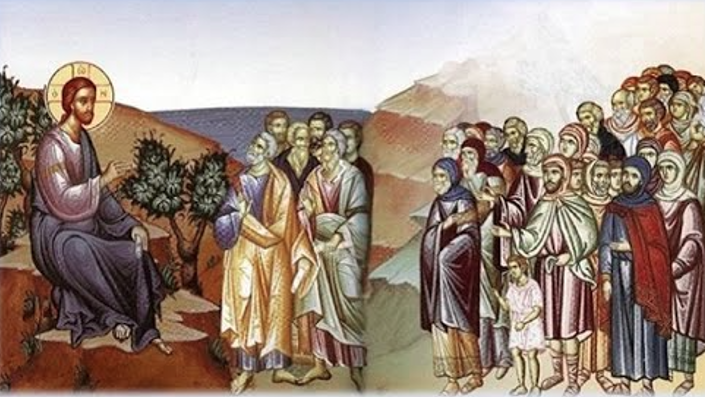
We now continue with verse 4, which describes the second beatitude:
Blessed are those who mourn, for they shall be comforted.
This verse illustrates one of the instances where a careless reading of the Scriptures may lead one astray, or even lead to the mistaken assumption that Orthodoxy is only for those who find in faith an excuse for their complexes, neuroses, or depressions. Saint John Chrysostom states that, in this verse, Christ offers something that directly contradicts the mindset of the world, for everyone considers those who laugh to be blessed, while those who mourn are seen as deeply unfortunate. He adds a very interesting point—that even in people who mourn the death of a loved one (a child, parent, or spouse), during that time, other passions are extinguished. From this alone, one may perceive the benefit of such grief—how much greater, then, is the benefit of godly sorrow, that is, true repentance. Thus, the Holy Fathers clearly distinguish between two kinds of sorrow and provide us with a clear criterion by which we may tell them apart. Saint Justin of Ćelije explains the verse as follows: “Blessed are those who mourn—but not all who mourn. For there are many kinds of weeping, but they may all be reduced to two categories: one is evangelical, salvific weeping, and the other is futile, destructive weeping. Every kind of sorrow that arises from something evangelical and leads towards God and the things of God is salvific, evangelical, and blessed; whereas every sorrow that arises from something unevangelical and draws one away from God and the things of God is futile, destructive, and bitter. Blessed is every kind of weeping that in any way brings a person into spiritual communion with the One and Only Blessed One—our Lord Christ; and bitter is every kind of weeping that distances a person from the Only Blessed One, for it represents a kind of curse upon human nature.”
Saint Luke of Crimea further illuminates the divine mystery contained in this verse, writing: “Does God bless all tears? Are all tears promised comfort? No, not at all. There are tears of malice, hatred, and wounded pride. Many tears are shed because human longing for worldly goods remains unsatisfied, because our deepest desires are humiliated, or because the life plans we ourselves have made—but not God—have been shattered. All these tears are abhorrent to God. Most often, people weep because of bodily and emotional suffering: the gravely ill weep from unbearable pain, people weep out of deep emotional anguish. The unfortunate and the weak weep, orphans and widows weep, the powerless who are crushed by the strong weep. God will receive and wipe away such tears. These are the tears of those to whom the Lord promised comfort in the second beatitude. But there is also another kind of tears—tears of pure people with deeply sensitive consciences, tears shed for themselves, for their deeds, tears shed out of awareness of their own sinfulness, their profound unworthiness before God, tears of repentance and contrition. These are the tears most pleasing to God.”
Saint Nikolaj of Ohrid teaches that weeping in this life is inevitable, but that we are presented with a choice: “Man, before you lies only the choice between weeping and weeping, and never between weeping and not weeping. Either you will weep hopelessly before the blind and deaf nirvana, or you will weep before the Living Comforter. If you weep before the Living Comforter, you will receive consolation.”
The Holy Fathers speak in many places about weeping—that is, about what the Apostle Paul calls godly sorrow (2 Corinthians 7:10). As you already know, the greatest Fathers and ascetics of the Orthodox Church considered weeping to be one of the most important virtues that a person striving for the Kingdom of Heaven should acquire. Here is how Saint John the Prophet writes about weeping, defining precisely how one may acquire it: “Weeping does not arise from tears, but tears from weeping. If one, while among the brethren, cuts off his own will and pays no attention to the sins of others, he will gain weeping. Through this his thoughts are gathered, and in being gathered, they give rise in the heart to sorrow (that is, godly weeping), and sorrow gives rise to tears.” Thus, we can see how this virtue of weeping—inner mourning for God—is beneficial to us and can in time bear the fruit of true joy in the Lord. According to Saint John of the Ladder, this virtue should in no way be displayed outwardly so that others may see the sorrow for God. Before moving on to the next beatitude, I would like to read to you his reflection on this matter: “Beloved, we have not been called here for a wedding feast. He Who called us here has indeed summoned us to weep over ourselves.”
Let us continue now with the reading of the fifth verse: Blessed are the meek, for they shall inherit the earth.
In this verse lies another stumbling block for many who strive to live a life in the Church. It is often unclear to us when a person should be meek, when it is appropriate to be angry, whether it is even permissible to be angry, and under what circumstances. Here is the explanation of this virtue by Saint Justin of Ćelije, who writes: “What is meekness? Meekness is: to receive everything that befalls us with a prayerful disposition, as something that must be so, according to God’s all-wise providence concerning us. For the All-Caring One, who said: But the very hairs of your head are all numbered (Luke 12:7), constantly cares for all that is ours: both the greatest and the smallest.” The great saint of our local Church continues: “Blessed meekness can be acquired only if a man does everything to allow the meek Lord Jesus to rule over his soul. And above all, if he fills his soul with humility. Once humility rules the soul, then comes meekness, her spiritual sister. These two create in a person the awareness and conviction that he himself—and only he—is to blame for all his sins and misfortunes. Therefore, when he becomes angry, he becomes angry at himself, and towards others, he is filled with meekness.”
Blessed Theophylact of Ohrid, for his part, provides a very important clarification concerning a question that often confuses us today—whether meekness automatically implies the absence of anger in any situation. Blessed Theophylact writes: “The meek are not those who never get angry, for such people are lacking in reason, but those who have the capacity for anger and restrain it, becoming angry only when it is necessary.” Therefore, a meek Christian does not represent a weak-willed or passive being, easily taken advantage of. Anger is given to us as a power that should be used rightly. The Holy Fathers explain how to do this. Saint Justin of Ćelije writes: “Indeed, in the heart of the meek there is always anger toward sin and evil, but not toward sinners. He loves sinners, but condemns their sins. The climax of evangelical meekness’s anger is shown toward those who deliberately and consciously equate themselves with their sins. Then even the God of meekness drives out the money changers from the temple with a whip. And when it becomes angry, evangelical meekness possesses its own God-manly measure. This is the word of the most zealous Christ-bearer: Be angry, and do not sin. Do not let the sun go down on your wrath (Ephesians 4:26).”
As for the earth which the meek shall inherit, the Holy Fathers explain that this refers also to the material earth. Thus, Saint Nikolaj of Ohrid cites as tangible evidence of this word of Christ the vast expanse of Russian land, and he writes that no nation is as meek as the Russians. Of course, no nation on earth is perfect, yet the Russians possess this distinctive trait, and the Lord has granted them such great land because of it. Moreover, the Holy Fathers also say that the “earth” here refers to the spiritual land—that is, Heaven. Thus, Saint Gregory of Nyssa writes: “The meek shall, without doubt, inherit that land, fruitful in wondrous fruits, adorned with the Tree of Life, watered by the streams of spiritual gifts, upon which grows the true Vine, whose Vinedresser is the Father of the Lord Jesus (John 15:1).”
Saint John of Kronstadt explains something very important—that the virtues are actually natural to our nature: “How senseless and unnatural malice and wrath are. How, on the contrary, meekness is akin to our nature. Just look at the face of a meek person: how beautiful, serene, calm, untroubled, and attractive it is! What a spiritual fragrance the meek person spreads in souls; even the irascible one learns meekness by looking at him.”
Adapted and for the modern reader based on the Patristic commentaries: Stanoje Stanković