
We begin with the patristic interpretation of the thirteenth chapter, the chapter in which Christ’s parables are described, whose principal subject and essence is the Kingdom of Heaven. Why does the Lord Jesus Christ choose precisely this manner of proclaiming the eternal Kingdom to people? It was not possible to preach directly to the common people, who were eager to hear the words of Jesus, yet at the same time were under the strong influence of many prejudices concerning the kingdom of the coming Messiah. It was not possible, within the three years during which the Lord was on earth, to eradicate all these misconceptions and replace them with the true teaching; this is evident from the amount of time required for the spiritual formation even of the closest and chosen apostles. The Fathers say that parables are like the finest fabric, skillfully woven and beautifully composed, so that in one respect the truth is veiled until the proper moment, lest it blind weak eyes, and in another respect it awakens attention towards what is hidden beneath the mysterious meaning of Jesus’ parables. It was precisely this that drew people to the Lord Jesus, that they might receive answers. The Lord chose to clothe exalted spiritual truths in examples drawn from visible nature or from human life, because in this way these parables became clearer, remained more deeply in memory, were more frequently recalled, and more vividly affected the human heart. … It should also be said that, alongside all this, there exists another purpose of Jesus’ parables, different from the first—that is, to conceal the truth from those who are unworthy and from those who are unable to properly discern and receive it. Here are the words of the blessed Jerome: “The multitude of the people does not possess equal capacity for discernment, and each person has a will that differs from others. Therefore Jesus speaks to them in parables, so that, in accordance with these differences of will, the people might receive different instruction.”
The first two verses of the thirteenth chapter:
On that day Jesus went out of the house and sat by the sea. And great multitudes were gathered together to Him, so that He entered into a boat and sat; and all the people stood on the shore.
John Chrysostom writes: “Having performed many miracles, Jesus again desires to benefit people by His teaching. He sat by the shore in order to fish for and draw to Himself those who were on land. He did not sit by the sea by chance, as the Evangelist indicates by mentioning this circumstance; the Lord wished to place Himself in such a position that no one would be behind Him, but that all might be before His eyes.” Saint John here draws attention to the practicality of the Saviour, to His experience in preaching and in making use of all available means so that the proclamation might be as effective as possible and reach as many people as possible. At that time, the Lord used His position so that His preaching might be heard more clearly; today, the missionaries of the Church use the internet, YouTube, radio, and books with the very same aim.
The blessed Jerome, in his interpretation, shows how attentive the Lord was, how constantly He thought of people, and how He did not wish to neglect anyone. These are his words: “The people could not enter Jesus’ house; they could not be where the apostles listened to the mysteries. Therefore the gentle and merciful Lord goes out of the house and sits by the sea of this life, so that the great multitude of people who were not deemed worthy to hear Him within the house might draw near to Him and hear Him on the shore. He sat in a small boat, while the multitude stood on the shore. Jesus is in the midst of the waves and is subjected to the striking of the sea now from one side, now from the other. Yet in His majesty He is not subjected to danger, and He commands the boat to draw near to the shore. The people stand upon the shore, on firm ground, so that they might hear what is spoken without being exposed to dangers and temptations which they are not able to endure.”
Hilary of Poitiers, for his part, points also to the hidden meaning of these verses: “In the words that the Lord sat in the boat while the people stood on the shore, there is a concealed sense. Jesus was preparing to speak in parables, and by these words He signifies those who are outside the Church and who have no understanding of the word of God. For the boat represents the Church, in which the word of life is present and proclaimed, while those who are outside it remain like sand—empty and unfruitful—and are unable to comprehend this word of life.”
Here are the verses in which the first parable of the thirteenth chapter is described—the Parable of the Sower:
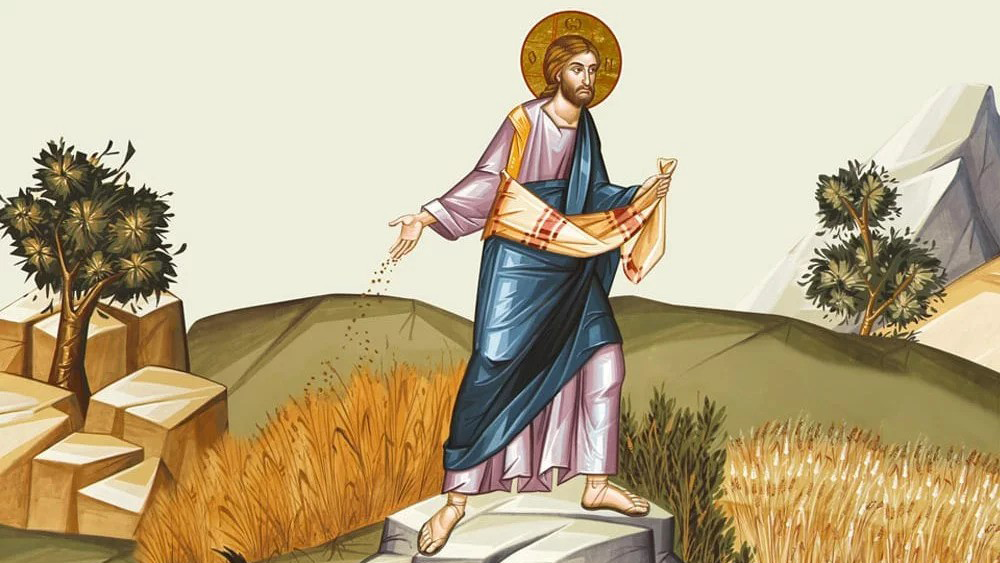
And He spoke many things to them in parables, saying: “Behold, a sower went out to sow. And as he sowed, some seeds fell by the wayside, and the birds came and devoured them. Others fell on rocky ground, where they had not much soil, and immediately they sprang up, because the soil was not deep. But when the sun rose, they were scorched, and because they had no root, they withered away. Others fell among thorns, and the thorns grew up and choked them. Others fell on good soil and brought forth fruit, some a hundredfold, some sixty, some thirty. He who has ears to hear, let him hear!”
John Chrysostom explains why the manner of preaching of the Lord Jesus here differs from His Sermon on the Mount: “He spoke many things to them in parables. The Lord did not act in this way in the Sermon on the Mount; there He did not present His discourse in so many parables. This is because there He was addressing a simple and unlearned people, whereas here there were also scribes and Pharisees. Observe here which parable the Lord first speaks and how Matthew sets them forth in order. Which is the first? The one that had to be told first and that was most capable of awakening the listener’s attention. Intending to speak in a veiled manner, Jesus first arouses the minds of His hearers through a parable. Therefore another Evangelist says that Christ reproached the apostles for not understanding: ‘Do you not understand this parable?’ (Mark 4:13). Yet Jesus speaks in parables not only for this reason, but also to make His word more vivid, to implant it more deeply in memory, and to present the subject more clearly. The prophets also acted in this way. What, then, is this parable? ‘A sower went out to sow.’ From where did He who is everywhere present and fills all things go out? Or how did He go out? The Lord did not become nearer to us in place, but in disposition and providential care for us when He clothed Himself in the flesh. Since our sins prevented our approach to Him and did not allow us to ascend, Jesus Himself descends to us. And why did He go out? To destroy the land filled with thorns? To punish the husbandmen? No. He went out to cultivate the soil thoroughly and to sow upon it the word of piety. Here, by the seed Christ understands His teaching, by the field the souls of men, and by the sower Himself. And what is the fruit of this seed? Three quarters perish, and only one remains. ‘And as he sowed, some seeds fell by the wayside, and the birds came and devoured them.’ Christ did not say that He cast them away, but that the seed fell. … One quarter remained, yet even this did not yield the same fruit; there too there is great variation. From these words it is evident that Christ offered His teaching to all, without distinction. Just as the sower does not distinguish between the fields before him, but simply casts the seed without discrimination, so also Jesus makes no distinction between rich and poor, wise and unlearned, careless and diligent, courageous and timid; to all He preached, fulfilling His work, although He knew beforehand what the fruits would be, so that He might say: ‘What more was there to do for My vineyard that I have not done for it?’ (Isa. 5:4).
The prophets speak of the people as a vineyard: “I will sing for my beloved a song of my beloved concerning his vineyard”; “You brought a vine out of Egypt” (Isa. 5:1; Ps. 80:8). But Christ speaks of the people as seed. What does He show by this? That the people will readily and easily submit and will quickly bear fruit. When you hear the words, “The sower went out to sow,” do not consider this a mere repetition, for a sower often goes out for other tasks as well: to plough the land, to destroy weeds, to uproot thorns, or to do something similar. But Christ went out for the purpose of sowing. Tell me, why did the greater part of the seed perish? This did not occur because of the one who sowed, but because of the soil that received the seed—that is, because of the soul that was inattentive. And why does Jesus not say that one seed was received by the careless and thus ruined; that another was received by the rich and choked; that a third was received by the weak and neglected? The Lord does not wish to rebuke them harshly, but leaves the hearers to their own conscience. Moreover, this did not happen only with the seed, but also with the net: in the net, too, much that was useless was found. Christ speaks this parable in order to strengthen and instruct His disciples, that they may not lose heart even though the majority of those who hear will not accept the word. The same occurred with the Lord Himself; although He knew beforehand that this would be the case, He did not cease to sow.
Yet you may ask: is it reasonable to sow among thorns, upon rocks, or by the wayside? Indeed, if this referred to seed and soil, it would not be reasonable; but when it concerns souls and teaching, it is most commendable. If a farmer were to act in such a way, he would rightly deserve reproach, for a rock cannot become soil, nor can a path cease to be a path; yet it is not so with rational beings. Even a rock can change and become fertile soil; and a path need not remain open to every passerby and trampled underfoot, but can become a fruitful field; thorns can be uprooted, and seeds may grow without hindrance. If such a transformation were impossible, Christ would not have sown. If this transformation did not occur in all, the cause lies not in the sower, but in those who were unwilling to change. Christ fulfilled His work; if they neglected His teaching, then He who showed such great love for mankind is not to blame.
Observe also that there is not only one path to destruction, but many, differing greatly from one another. Those who are like the path are the lazy and careless; the rocky ground represents only the weakest. … Therefore, lest anything similar should happen to us, let us diligently attend to the teaching and keep it constantly in mind. Even if the devil seeks to snatch it away, it depends on us whether we permit it. If the seeds perish, it is not because of drought; for it is not said that they perished because of the heat, but because they had no root. And if the word is choked, this does not occur because of the thorns, but because of those who allowed them to grow. If you so desire, it is possible not to allow the thorns to grow and to use wealth as it ought to be used. Therefore Christ did not say “the world,” but “the care of this world”; nor did He say “wealth,” but “the deceitfulness of riches” (v. 22). Thus, let us not accuse things themselves, but rather a corrupted will. It is possible to be rich and not be deceived, and to live in this world without being consumed by its cares. …
Thus, after speaking of the various kinds of destruction, Jesus concludes by speaking also of the good soil, lest He lead people to despair, but rather to offer them hope for repentance and to show that it is possible to transform oneself from rock and thorns into good soil. But if the soil is good and the sower is the same, why does one seed yield a hundredfold, another sixty, and another thirty? Here again, the difference depends on the quality of the soil, for even in good soil there can be great variation. You now see that the fault lies neither in the farmer nor in the seed, but in the soil that receives it. The difference depends not on human nature, but on the will. And here the great love of God for mankind is revealed in that the Lord does not require the same measure of virtue from all, but receives the first, does not reject the second, and gives place even to the third. Jesus says this so that His followers may not think that mere hearing is sufficient for salvation. Why, you may ask, does the Lord not speak of other vices, such as bodily desire or vanity? By saying “the care of this world” and “the deceitfulness of riches,” Jesus encompasses all, since vanity and every other vice belong to the care of this world and the deception of riches… Speaking of the path and the rock, He wished to show that it is not enough to free oneself from the love of riches, but that one must also cultivate other virtues. What profit is there if you are not attached to wealth, yet are weak and inclined to sloth? What profit is there if you are not slothful, yet listen carelessly to the word of God? A single virtue is not sufficient for our salvation; rather, first of all, attentive hearing of the word of God and its constant remembrance are necessary; then courage is required; further, the contempt of riches; and finally, freedom from attachment to anything that belongs to this world.
Based on patristic interpretations, and adapted for the contemporary reader by Stanoje Stanković.