
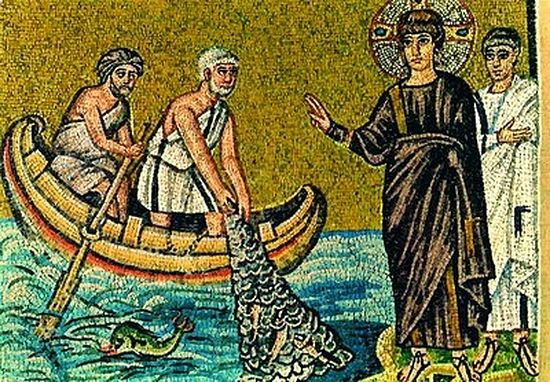
And Jesus, walking by the Sea of Galilee, saw two brothers: Simon, who is called Peter, and Andrew his brother, casting a net into the sea, for they were fishermen. And He said to them, “Follow Me, and I will make you fishers of men.”
When one reads the Gospels and comes across this account of the calling of the apostles, a certain dilemma may arise, as the Evangelists describe the event somewhat differently. In the Gospel of Luke, chapter five, the calling of the apostles is preceded by the miraculous catch of fish and the famous words of the Apostle Peter: “When Simon Peter saw it, he fell down at Jesus’ knees, saying, ‘Depart from me, for I am a sinful man, O Lord!’” (Luke 5:8). Thus, if one compares the accounts found in Luke 5 and Matthew 4, it is possible to form different impressions. Luke emphasizes that they immediately left everything and followed Jesus after the miraculous catch, while Matthew and Mark state that the apostles were called while in their boats mending their nets. The explanation lies in the fact that these are not two different events, but rather that Luke provides a more detailed description, while Matthew and Mark focus on the very fact of the calling itself, without elaborating on the surrounding circumstances.
It is also important to note that, upon closer reading of the Gospels, it becomes clear that there were two temporally distinct callings of the apostles by the Lord. The synoptic Evangelists—Matthew, Mark, and Luke—describe the second calling, while the Evangelist John records the first, which occurred after the testimony of John the Baptist concerning the Lord. Saint Nicholas of Ohrid explains this very clearly and beautifully:
“The Evangelist John writes that Andrew was the first to join the Lord, and this took place in Judea. Andrew had previously been a disciple of John the Baptist, and when John pointed to Christ as greater than himself, Andrew left his first teacher and followed Christ. Shortly thereafter, Andrew found his brother Simon and said to him: ‘We have found the Messiah,’ which means Christ; and he brought him to Jesus. Even at that moment, Simon was named by Christ as Peter, or the rock—the solid rock of faith (John 1:35–42). Does this not contradict what the Evangelist Matthew recounts in today’s Gospel, namely that Christ called these two brothers at the Sea of Galilee? According to John’s Gospel, Andrew follows Christ first, and then Peter; while according to Matthew’s account, it appears that both were called simultaneously, with Peter mentioned before Andrew. Is this not an obvious contradiction? No; not in the slightest. Rather, as Saint John Chrysostom explains, these are clearly two distinct events: one that occurred in Judea during the time of the Baptist’s freedom, and another later in Galilee, after the Baptist had been imprisoned and the Lord Jesus had settled in Capernaum, on the shore of the Sea of Galilee. John describes the earlier meeting of Christ with Peter and Andrew, and Matthew describes the later one. This is evident from the fact that Matthew refers to Simon as ‘called Peter,’ which implies that Simon had previously been named Peter by the Lord. That earlier, first meeting between Peter and Christ took place in Judea, when Andrew brought his brother to the Lord. John describes this meeting with the words: ‘And he (Andrew) brought him to Jesus. And Jesus, looking at him, said: You are Simon, the son of Jonah. You shall be called Cephas (which is translated: A Stone).’ Knowing this, the Evangelist Matthew is now describing a subsequent meeting of the sons of Jonah with the Lord, which is why he writes: ‘Simon, called Peter.’ Peter is mentioned before Andrew due to his more ardent temperament and because he stood out more prominently from the beginning. That John and Matthew describe two different events, and not one and the same, is evident to anyone who reads both accounts carefully. While Matthew describes the decisive calling of Peter and Andrew to apostolic service—‘Follow Me’—John is describing more of an encounter and acquaintance of these brothers with Christ, prompted by the words of the Forerunner: ‘Behold the Lamb of God!’ It is clear that after this initial meeting, they parted from Christ and, by another route or at another time, went to Galilee, where the Lord found them again engaged in their fishing.”
Another question that may arise when reading these verses is whether the sacrifice of the apostles was truly that great. After all, someone might think: what could poor fishermen, who were so destitute that they had to mend their nets, possibly lose by leaving everything behind and following the Lord? Saint Gregory the Dialogist, Pope of Rome, provides an excellent explanation and directs us to where our attention should lie: “Yet perhaps someone, in the secrecy of their thoughts, might say: ‘They were merely fishermen who possessed almost nothing. What or how much did they truly leave behind at the Lord’s word?’ The point, beloved brethren, is that we should consider above all the inner disposition rather than the amount one possesses.”
Saint Isidore of Pelusium draws attention to an intriguing detail that might easily escape our notice—that it was no coincidence that the Lord chose brothers as His first disciples. Here is how Saint Isidore explains it: “Two brothers were deemed worthy of the first calling among Jesus’ disciples. In this way, the All-Wise Savior, from the very beginning, demonstrated that it was His will to unite all His disciples into a bond of brotherly fellowship.”
Saint Ephraim the Syrian also highlights the fulfillment of Old Testament prophecies in the calling of the apostles and the reason why the Lord Jesus chose precisely fishermen—poor, outcast, and humble men. Saint Ephraim writes: “Fishermen came and became fishers of men, as it is written: ‘Behold, I will send for many fishers,’ says the Lord, ‘and they shall fish them; and afterward I will send for many hunters, and they shall hunt them from every mountain and from every hill, and out of the holes of the rocks’ (Jer. 16:16). For had the Lord sent the wise, it might be said that they ensnared men through persuasion or cunning. And if He had sent the wealthy, people would have claimed that they deceived the crowds with abundance or gained power with money. And if He had sent the mighty, people would have said that they subdued the people by awe or through force. Yet the apostles possessed none of these things, as the Lord made clear through Simon. For he was fearful, as he was frightened by the words of a maidservant (Saint Ephraim refers here to the night of Peter’s denial). Peter was poor, unable even to pay his own tax, which was half a stater, as he himself says: ‘Silver and gold I have none’ (Acts 3:6). He was of humble origin, for when he denied the Lord, he could not even come up with a reason to disguise himself. Thus, fishermen appeared and triumphed over the mighty, the rich, and the wise.”
Saint Chromatius of Aquileia also reflects on the prophecy of Jeremiah: “Behold, I will send for many fishers,” says the Lord, “and they shall fish them; and afterward I will send for many hunters…” (Jer. 16:16). This holy father explains that the prophet does not mention fishermen and hunters without purpose. He writes: “The apostles showed themselves to be true sons of Abraham, for just like him, upon hearing the voice of God, they set out to follow the Savior… The Lord chose fishermen who traded their earthly labor for a higher one—who turned from earthly fishing to the heavenly, so that they might catch the human race for salvation from the deep abyss of error, like fish, as the Lord Himself said: ‘Follow Me, and I will make you fishers of men.’ That is why the apostles, as we know, were called not only fishermen but also hunters—fishermen, because with the net of the Gospel they caught the faithful throughout the world; and hunters, because they sought out those who wandered in the forest of this world’s delusions and lived by bestial customs, catching them for salvation with a heavenly hunt.”
Saint Theophan the Recluse offers a particular explanation of this event. Here is what he writes about the inner movement of the souls of Peter and Andrew, about what compelled them to leave everything and follow the Lord: “Why did the apostles follow so quickly and willingly? Because they perceived something better. Such is the law of our soul: having known and tasted something better, it turns away from the lesser and abandons it. This is what the Lord later illustrated in the parables of the treasure hidden in a field and the pearl of great price. The treasure and the pearl represent faith in the Lord and communion with Him through the power of faith. We receive it already at the time of baptism. But why do we value this treasure so little, and why do we trade it for vanities? Because during our upbringing, no one instills in us the taste of that treasure, and thus it remains foreign to our hearts. Our heart does not know what is better. It knows only what is less or more evil, and on that basis it forms its worldview. This is why some respond and follow when the Lord calls, while others—though called—flee from Him.” It is hardly surprising that this great saint advocated for the foundation of a Christian psychology when one sees the depth of his understanding of the human soul.
Adapted for the contemporary reader based on patristic commentaries: Stanoje Stanković