The Antichrist
In order to discuss Satanism, it is first necessary, quite naturally, to understand who Satan is, what his characteristics are, and how he operates. Once we understand who Satan is, we will simultaneously understand the reasons for the existence of Satanism and its objectives. Only then can we proceed to examine the various forms in which Satanism manifests itself.
In Milan Vujaklija’s Dictionary of Foreign Words and Expressions, the term Antichrist is defined as an opponent or enemy of Christ or Christianity, and, in its figurative sense, as a godless man, the devil, or Satan. Although this definition is both appropriate and acceptable from the Orthodox Christian perspective, it should be added that the Greek prefix anti- may also be translated as “instead of,” and not merely as “against.” Thus, St. Justin Popović, in his Dogmatics of the Orthodox Church, writes concerning the Antichrist: “In every respect he will be an irreconcilable adversary of Christ, striving with all his might to suppress Christ everywhere and to replace Him with himself” (emphasis added, D.M.).
In the Second Epistle to the Thessalonians, the Holy Apostle Paul describes Satan as “the man of lawlessness, the son of perdition,” “who opposes and exalts himself above everything that is called God or is worshiped, so that he sits as God in the temple of God, proclaiming himself to be God” (2 Thess. 2:4).
The designation Antichrist (Greek: ὁ ἀντίχριστος) appears in Holy Scripture exclusively in the Epistles of the Holy Apostle and Evangelist John, where it is found on five occasions.
In the First Catholic Epistle of St. John the Theologian, in the eighteenth verse of the second chapter, we read: “…and as you have heard that the Antichrist is coming, even now many antichrists have come; by this we know that it is the last hour” (καὶ καθὼς ἠκούσατε ὅτι ἀντίχριστος ἔρχεται, καὶ νῦν ἀντίχριστοι πολλοὶ γεγόνασιν· ὅθεν γινώσκομεν ὅτι ἐσχάτη ὥρα ἐστίν) (1 John 2:18).
Further on, in the same chapter, we read: “Who is the liar but he who denies that Jesus is the Christ? This is the Antichrist, who denies the Father and the Son” (Τίς ἐστιν ὁ ψεύστης εἰ μὴ ὁ ἀρνούμενος ὅτι Ἰησοῦς οὐκ ἔστιν ὁ Χριστός; οὗτός ἐστιν ὁ ἀντίχριστος, ὁ ἀρνούμενος τὸν πατέρα καὶ τὸν υἱόν) (1 John 2:22).
The Antichrist is likewise mentioned in the fourth chapter: “And every spirit that does not confess that Jesus Christ has come in the flesh is not of God. This is the spirit of the Antichrist, of which you have heard that it is coming, and now it is already in the world” (1 John 4:3).
Finally, the term appears in the Second Epistle of St. John: “For many deceivers have gone out into the world, those who do not confess Jesus Christ as having come in the flesh. Such a one is the deceiver and the Antichrist” (Ὅτι πολλοὶ πλάνοι εἰσῆλθον εἰς τὸν κόσμον, οἱ μὴ ὁμολογοῦντες Ἰησοῦν Χριστὸν ἐρχόμενον ἐν σαρκί· οὗτός ἐστιν ὁ πλάνος καὶ ὁ ἀντίχριστος) (2 John 1:7).
From the foregoing passages, we see that St. John the Theologian speaks of the Antichrist not only in the singular but also in the plural, referring explicitly to many antichrists. Why is this so? Who are these antichrists? St. Justin Popović, in his Dogmatics of the Orthodox Church, explains that all these antichrists are, in fact, merely forerunners of the principal Antichrist—“the Antichrist in the proper sense of the word, who will appear before the end of the world for the final and decisive battle against the Church of Christ.” It is therefore essential to distinguish between the principal Antichrist, whose appearance is expected at the end of time, and the multitude of lesser antichrists who precede him and who are already active in the world.
The existence of many antichrists (that is, satanic or demonic agents) who precede the principal Antichrist is of particular importance for the subject of this study. Indeed, it is precisely their existence that explains the phenomenon of Satanism in its various manifestations. In this respect, it would be more accurate to speak of Satanisms in the plural rather than of Satanism in the singular. For as many antichrists as there are, so too are there various forms of Satanism, each representing a particular manifestation of the activity of an individual antichrist. Nevertheless, all of these manifestations pursue the same objective, since they are ultimately directed by one and the same Satan, the leader of the fallen angels, who dwells in Hades.
With regard to the terms devil and Satan, both are found in the Book of Revelation: “And the great dragon was cast out, that ancient serpent, who is called the Devil and Satan…” (Καὶ ἐβλήθη ὁ δράκων, ὁ ὄφις ὁ μέγας ὁ ἀρχαῖος, ὁ καλούμενος Διάβολος καὶ ὁ Σατανᾶς…) (Rev. 12:9).
The English word devil derives ultimately from the Greek Διάβολος (Diabolos), a term most commonly translated as “slanderer” or “accuser.” Besides the Book of Revelation, it appears throughout the New Testament, for example in the Gospel according to Matthew, particularly in the account of Christ’s temptation in the wilderness (Matt. 4:5, 4:8, 4:11), as well as elsewhere in that Gospel. It is likewise found in the Gospels according to Luke (e.g., Luke 4:2, 4:3, 4:5), and John (e.g., John 8:44; 13:2), in the Acts of the Apostles (Acts 10:38; 13:10), and in several Apostolic Epistles, including those to the Ephesians, Timothy, and Titus.
The term Satan, although it also appears in the New Testament (ὁ Σατανᾶς), is borrowed from the Hebrew שָׂטָן (śāṭān), found in the Tanakh, the sacred Scriptures of Judaism, where it denotes an “adversary” or “opponent.” In the New Testament it occurs in all four Gospels (e.g., Matt. 4:10; Mark 1:13; Luke 10:18; John 13:27), in the Acts of the Apostles (Acts 5:3; 26:18), and in several Epistles of the Holy Apostle Paul, including Romans, First and Second Corinthians, and First and Second Thessalonians.
In addition to these three principal designations, both the Old and New Testaments contain numerous other appellations for Satan. These include Day Star or Lucifer (ὁ Ἑωσφόρος) (Isa. 14:12), the tempter (Matt. 4:3), the evil one (translated as the wicked one in Church Slavonic versions of the Lord’s Prayer) (Matt. 6:13; Luke 11:4), Beelzebul and the prince of demons (Matt. 12:24), the evil one (Matt. 13:19), Belial (2 Cor. 6:15), a murderer and the father of lies (John 8:44), the ruler of this world (John 14:30), and many others.
The serpent likewise serves as a synonym for the Evil One, since it was in the form of a serpent that Satan deceived Eve and persuaded her to eat the fruit from the tree of the knowledge of good and evil (Gen. 3:1–6). As the Book of Revelation declares: “And the great dragon was cast out, that ancient serpent, who is called the Devil and Satan, who deceives the whole world; he was cast to the earth, and his angels were cast out with him” (Rev. 12:9).
Finally, it is important to note that even among Christians the euphemistic designation the Unmentionable has unfortunately become widespread. According to magical thinking, the mere utterance of Satan’s name was believed to invoke him or make him present. Consequently, people avoided mentioning his name directly, giving rise to the expression the Unmentionable.
St. John of Damascus, in his Exact Exposition of the Orthodox Faith, teaches that Satan was originally an angel who was not created evil by nature. Rather, he was created good and for a good purpose, but through pride he rebelled against the God who had created him, desiring to oppose Him. Having voluntarily fallen away from the good, he entered into evil and, by his own free choice, became darkness instead of light. Concerning the demons, St. John explains that they are the multitude of angels who were under Satan’s authority and who likewise followed him in his rebellion and fell together with him. Since Satan is a fallen angel, it follows that he is, by nature, a spirit—that is, an incorporeal, spiritual being.
The Holy Prophet Isaiah describes this fall in the following words:
“How you are fallen from heaven, O Day Star, son of the morning! How you are cut down to the ground, you who laid the nations low! For you said in your heart: ‘I will ascend into heaven, I will exalt my throne above the stars of God; I will sit on the mount of assembly in the farthest north; I will ascend above the heights of the clouds; I will make myself like the Most High.’ Yet you shall be brought down to Sheol, to the depths of the pit.” (Isa. 14:12–15)
Pride, therefore, was the cause of Satan’s fall from God, and it remains the defining characteristic of every antichrist. The Wisdom of Jesus the Son of Sirach teaches that “the beginning of sin is pride” (Sir. 10:15), while “the beginning of pride is when one departs from the Lord, and one’s heart turns away from the Creator” (Sir. 10:14). According to St. Nicodemus the Hagiorite, pride “transforms a man into another demon and another Lucifer (the Day Star), who through pride became darkness instead of light.”
Other characteristics of Satan are described in Holy Tradition, the Holy Scriptures, and the writings of the Holy Fathers. Among those who addressed this subject are St. Hippolytus of Rome in his Treatise on Christ and Antichrist; St. Irenaeus of Lyons in his teaching on the Kingdom of the Saints and the Kingdom of the Antichrist; and St. Cyril of Jerusalem in his Fifteenth Catechetical Lecture, among others.
The Lord Himself refers to demons as the angels of the devil in the Gospel: “Depart from Me, you cursed, into the everlasting fire prepared for the devil and his angels” (Matt. 25:41).
Who, then, are the demons? According to Orthodox theology, demons are “personal, independent beings who have voluntarily and irrevocably established and perfected themselves in evil.” In the Gospels, besides the term demons (e.g., Matt. 7:22; Mark 1:34; Luke 4:41), they are also designated as unclean spirits (e.g., Matt. 10:1; Mark 1:27; Luke 4:36), evil spirits or spiritual forces of evil (e.g., Eph. 6:12; Luke 7:21), the angels of Satan (e.g., Matt. 25:41), and by other similar expressions.
In numerous passages of the Gospels, we read how the Saviour casts demons out of those possessed, addressing them as distinct, conscious, and personal beings (e.g., Mark 5:2–13; Luke 4:34–35).
St. Ignatius (Brianchaninov) writes concerning Satan and the demons:
“From the Lives of the Saints, just as the Book of Revelation also testifies, it is evident that the leader of the fallen angels, Satan, dwells in Hades, while upon the earth demons carry out their activity under the authority of their princes—that is, the fallen angels of the higher angelic ranks. The demons descend into Hades in order to receive instructions and commands from Satan, to report to him concerning their actions, and to inform him of everything that takes place upon the earth.”
In his Dogmatics of the Orthodox Church, St. Justin Popović writes primarily about the principal Antichrist. Nevertheless, the greater part of what he says concerning him may also be applied, by analogy, to the many antichrists who precede his coming, and it is this description that will serve as the basis for our analysis.
St. Justin teaches that the Antichrist will be a human being composed of both soul and body and, as such, the fullest embodiment of human-satanic evil. According to him, the Antichrist will indeed be the incarnation of evil, but not the incarnation of the devil himself, for the devil cannot become incarnate as a human being. As St. John of Damascus explains:
“The devil himself does not become man in the manner of the Lord’s Incarnation—far from it—but is born as a man through fornication and receives every satanic operation.”
Likewise, St. Hippolytus of Rome writes:
“The Lord appeared in the form of a man (cf. Rev. 16:2; Phil. 2:7); in the form of a man the Antichrist also shall come.”
From this we may conclude that the many antichrists who precede the principal Antichrist are likewise human beings. The essential distinction between them and the final Antichrist lies in the degree to which evil is present within them, as well as in the intensity of their hatred and opposition towards the God-man, Jesus Christ. In other words, whereas the principal Antichrist represents absolute and unrestricted evil, the many antichrists who precede him embody a comparatively lesser, though still profoundly destructive, manifestation of evil.
St. Justin Popović further describes the principal Antichrist in the following terms:
“In every respect he will be the opposite of Christ. Christ is incarnate goodness and truth; he will strive to become incarnate evil and falsehood. Christ is absolute goodness; he will strive to become absolute evil. Christ gave the world the Gospel; he will endeavour to give the world an anti-gospel. He will display the fiercest opposition to God and to Christ that human nature, aided and incited by Satan, is capable of directing against God and His Christ.”
St. Cyril of Jerusalem explains why many antichrists appear before the coming of the principal Antichrist. According to him, these numerous antichrists are forerunners who “prepare the way for the Antichrist, making his hunt easier when he comes” (emphasis added, D.M.). This, at the same time, constitutes the essential purpose of Satanism: to prepare the way for the principal Antichrist in his pursuit of human souls and their ultimate destruction.
In a similar vein, St. Hippolytus of Rome observes:
“Just as the Lord sent the Apostles to all nations, so also will the Antichrist send forth his false apostles.”
St. Justin Popović likewise writes concerning the demons:
“From bitter experience they know that under no circumstances can they overcome the Lord Christ. Their greatest delight, however, is to turn people away from Christ, to prevent them from approaching Him, and to scandalize them concerning Christ, for they know that by doing so they cast human beings into every kind of downfall, and above all into the greatest of all falls—apostasy. Once a man falls away from Christ, he is separated from the only sure foundation against death, sin, and evil. Then the devil tosses him about with every storm of sin, passion, and temptation, until at last he sweeps him away into his own kingdom—hell.”
St. Justin further explains that the Antichrist has countless forerunners who began to appear in the earliest days of Christianity in the form of opponents, haters, and persecutors of Christ. Throughout the history of Christianity, these forerunners have continued to arise with the same objective: to displace the Lord Jesus Christ, to destroy His work, to undermine His Church, and thereby to prevent the salvation of mankind through the one and only Saviour of the human race.
Just as God “desires all men to be saved and to come to the knowledge of the truth” (1 Tim. 2:4), so the Antichrist, together with his many forerunners—the antichrists—seeks to turn as many people as possible away from Christ, who is “the way, the truth, and the life” (John 14:6), and to bring both their bodies and their souls to destruction in hell (Matt. 10:28). Speaking of the devil, the God-man Christ declares: “He was a murderer from the beginning” (John 8:44).
In the Life of the Holy Martyr Juliana, the devil, compelled by the power of the Creator, confesses:
“I am the one who long ago wickedly persuaded Eve in Paradise to transgress God’s commandment. I incited Cain to murder his brother Abel. I taught Nebuchadnezzar to erect the golden idol on the Plain of Dura. I deceived the Israelites into worshipping idols. I deprived the wise Solomon of reason by inflaming him with passion for women. I advised Herod to slaughter the infants, and Judas to betray his Master and afterwards to hang himself. I stirred up the Jews to stone Stephen, and Nero to crucify Peter upside down and to behead Paul with the sword.”
One of Satan’s fundamental and defining characteristics is cunning. As the Holy Apostle Paul writes, “the serpent deceived Eve by his cunning” (2 Cor. 11:3). In order to make his deception effective, Satan even disguises himself as “an angel of light” (2 Cor. 11:14), as the Apostle likewise teaches and warns.
St. Justin Popović describes the devil’s cunning in the following way:
“The entire strategy of Satan consists in making sin appear as attractive as possible to human beings by means of the most refined cosmetic disguise that a mind perfected in evil can devise, thereby ensnaring men and winning them over to apostasy from Christ. (…) He will possess the genius to disguise evil beneath the appearance of good, to skillfully coat the poison of death with the false honey of immortality, to artistically conceal the ugliness of sin behind counterfeit miracles and signs, and to make sinful pleasures appear irresistibly attractive, so that he will deceive multitudes and destroy their souls.”
Naturally, all of this applies equally to Satan’s forerunners—the many antichrists and false apostles—who, according to St. Justin, continually marshal every form of evil against the divine gifts of Christ in this world, embellishing and disguising them so as to make them attractive to human beings.
St. Ignatius (Brianchaninov) likewise teaches that Satan will deliberately present himself as something he is not in order to deceive as many people as possible:
“The Antichrist will present himself as meek, merciful, filled with love, and adorned with every virtue. Those who regard fallen human nature as the true standard of righteousness will recognize him as such and submit themselves to him because of this apparent exalted virtue.”
The God-man Christ Himself draws our attention to this reality, declaring that Satan “does not stand in the truth, because there is no truth in him,” and that “when he speaks a lie, he speaks from his own nature, for he is a liar and the father of lies” (John 8:44).
Christ likewise warns that “false Christs and false prophets will arise” and will perform “great signs and wonders so as to deceive, if possible, even the elect” (Matt. 24:24). One such forerunner of the Antichrist was Simon Magus, who “practiced magic and astonished the people of Samaria,” so that “both small and great gave heed to him” because they were amazed by his supernatural feats (Acts 8:9–11). There can be little doubt that in our own age there will likewise arise antichrists—precursors of the final Antichrist—who will captivate the attention of the people through various extraordinary signs and wonders.
Who, then, are “the elect” of whom the Lord speaks in this passage? In its most immediate sense, the term refers to all those who have been baptized into the One, Holy, Catholic, and Apostolic Church and who, in receiving the Holy Mystery of Baptism, have renounced Satan.
It is worth recalling the rite of Holy Baptism itself. During the celebration of the sacrament, the priest asks the catechumen—or, in the case of an infant, the godparent speaking on the child’s behalf—the following questions three times:
“Do you renounce Satan, and all his works, and all his angels, and all his service, and all his pride?”
The catechumen, or the godparent on behalf of the child, replies:
“I do renounce him.”
The priest then asks:
“Have you renounced Satan?”
The response is:
“I have renounced him.”
Following this renunciation comes union with Christ. Turning towards the East, the priest asks:
“Do you unite yourself to Christ?”
The catechumen, or the godparent on the child’s behalf, answers:
“I do unite myself to Christ.”
The priest continues:
“Have you united yourself to Christ?”
The response is:
“I have united myself to Christ.”
Finally, he asks:
“Do you believe in Him?”
To which the answer is:
“I believe in Him as King and God.”
Accordingly, the purpose of the Antichrist is to lead the baptized, through various means—including deception—to accept him in place of Christ and thereby to renounce Christ Himself.
St. Ignatius (Brianchaninov), writing about Satan’s subtlety and deception, observes:
“The Antichrist will be received with enthusiasm by those who have fallen away from Christianity. Yet, as the Holy Fathers observe, what is most deserving of attention and tears is that even the elect themselves will hesitate concerning the person of the Antichrist, for he will know how to conceal from human eyes the satanic evil that dwells within him with extraordinary skill.”
St. Ignatius further teaches that the Antichrist will entice humanity by offering the highest forms of earthly prosperity, honour, wealth, luxury, and sensual pleasure in order to draw people away from Christ and towards himself.
“Those who seek earthly things will accept the Antichrist and will call him their lord.”
There is little doubt that the many antichrists who precede him likewise exploit the various passions that dominate fallen humanity—gluttony, lust, avarice, vanity, pride, and others—in order to ensnare human beings.
An important question naturally arises from the foregoing discussion: Why does Satan rely upon deception? Why does he make evil appear attractive to human beings? St. Justin Popović provides the answer. Satan employs deception because “he possesses neither the authority nor the power to impose sin upon man. Rather, man freely chooses sin by the exercise of his own free will, together with the countless evils that sin contains and inevitably brings in its wake.”
From the foregoing discussion, it is evident that, alongside the heavenly hierarchy, there also exists a hierarchy of fallen spirits—“the spiritual hosts of wickedness in the heavenly places” (Eph. 6:12). This is likewise affirmed by the Holy Apostle Paul when he speaks of “principalities,” “powers,” and “authorities” (Eph. 6:12; Col. 2:15). At the head of this hierarchy of evil spirits stands Satan, followed by the fallen angels of the higher ranks, and finally by the demons. Appearing in human form are the principal Antichrist, who is the embodiment of absolute evil and whose coming is still awaited, together with the many antichrists, his forerunners, who are continually present throughout the world.
What must also be borne in mind is that not only the devil and his angels, but also the principal Antichrist and his forerunners—the many antichrists—are clearly distinct from sinful human beings who have been ensnared by the devil “to do his will” (2 Tim. 2:26). In what respect do those who sin under the influence of unclean spirits differ from the antichrists? The distinction lies in the fact that God may yet grant sinful people “repentance leading to the knowledge of the truth” (2 Tim. 2:25). The antichrists, however—such as Simon Magus; the self-proclaimed Satanist Stanisław Przybyszewski, author of The Synagogue of Satan; the occultist Aleister Crowley; Anton Szandor LaVey (born Howard Stanton Levey), founder of the Church of Satan and author of The Satanic Bible; or David Spangler, one of the founders of the New Age movement—have, like the evil spirits themselves, become so thoroughly immersed in evil that repentance and moral restoration are no longer possible for them. According to St. Justin Martyr and Philosopher, the unclean spirits are unchangeably evil, while, in the words of St. Justin Popović, the devil, having consciously, rationally, and persistently identified himself with evil, possesses a will that is incapable of repentance. Likewise, the antichrists are unchangeably evil: they neither seek repentance nor are they capable of attaining it.
Satanism
The Encyclopaedia Britannica defines Satanism as “the worship or veneration of Satan, a figure in Christian belief also known as the Devil or Lucifer.” This definition, however, is inadequate from the Orthodox theological perspective, because service to Satan need not always be conscious, intentional, or direct. It does not necessarily take the form of explicit worship or veneration of Satan, but may also exist as unconscious, unintentional, and indirect service to the devil.
This distinction leads to the classification of Satanism into Satanism in the narrow sense (visible or overt Satanism) and Satanism in the broader sense (concealed or latent Satanism).
From an organizational perspective, whether one is speaking of Satanism in the narrow or the broader sense, a further distinction may be drawn between organized (collective) Satanism and individual Satanism.
Although the term Satanism, as reflected in the definition provided by the Encyclopaedia Britannica, is generally understood to refer exclusively to Satanism in the narrow sense, it is both inaccurate and unacceptable to exclude the second category. Concealed or latent Satanism may prove considerably more dangerous and may attract far greater numbers of people precisely because it presents itself in a hidden, attractive, and deceptive form—just as Satan himself “transforms himself into an angel of light” (2 Cor. 11:14).
Dimitrije Marković
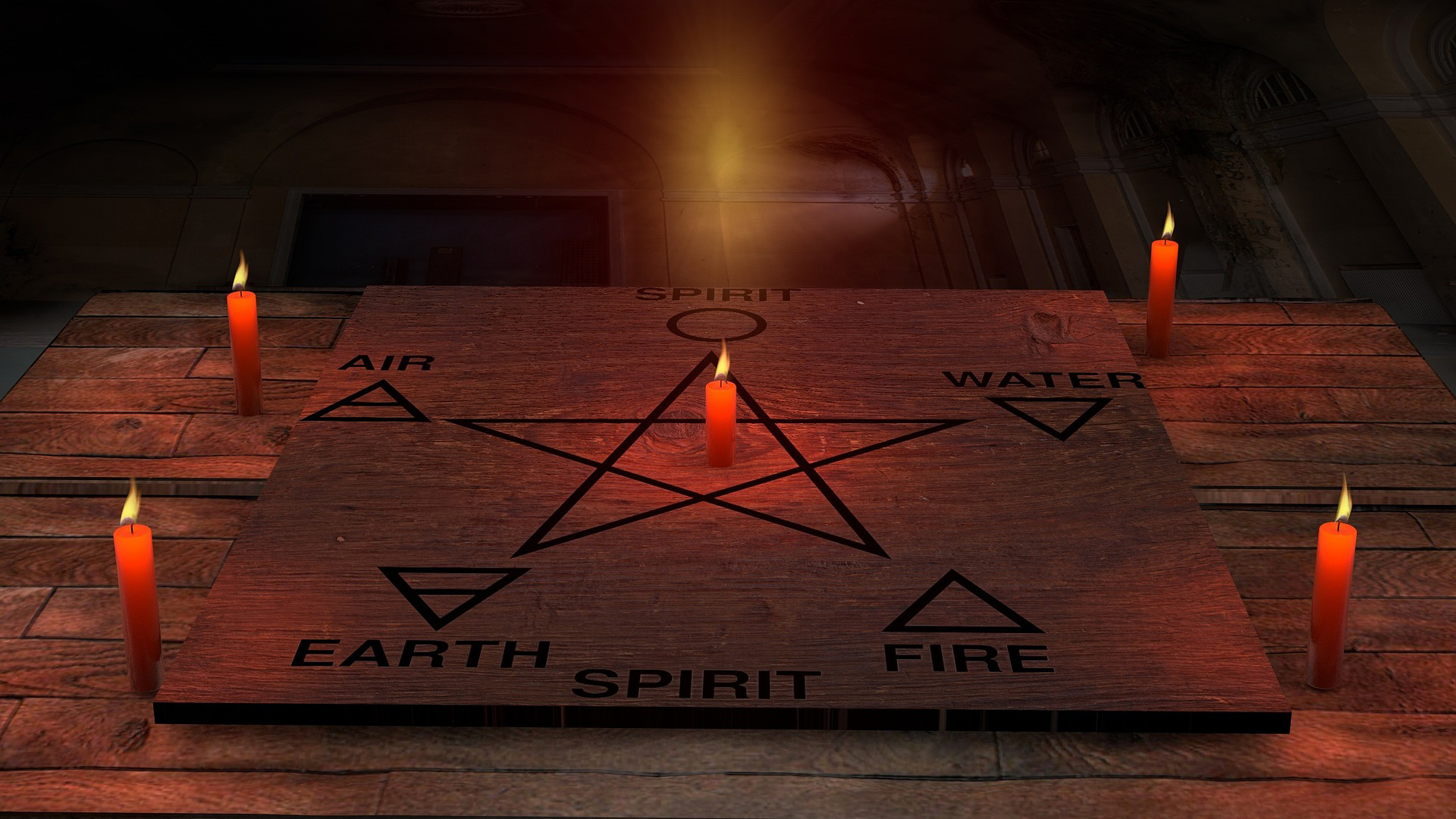
Cover photo: pixabay