We continue our interpretation of verses 10–11 of the fifteenth chapter of the Gospel according to Matthew.
St. Theophan the Recluse emphasizes the importance of fasting, noting that those who seek excuses for neglecting the fast frequently appeal to these very verses, arguing that food does not defile a person. St. Theophan writes:
“The Lord did not say this because He regarded fasting as unnecessary or because it was not pleasing to Him. On the contrary, He Himself fasted, taught His apostles to fast, and established periods of fasting in His holy Church. He spoke these words so that, while fasting, we would not limit ourselves merely to reducing the quantity of food or practicing abstinence from certain foods, but would also strive to fast inwardly, refusing to yield to the desires and passions of the soul. This is the essential point. In this sense, fasting is the most powerful spiritual remedy. The foundation of the passions lies within the body; when the body is disciplined and weakened through fasting, the passions themselves are undermined and their power diminished. To resist the passions without fasting would be nothing short of miraculous—it would be like standing in the midst of flames without being burned. How can one whose body is continually indulged with abundant food, excessive sleep, and physical comfort cultivate spiritual aspirations or interests? Such a person can no more rise above earthly concerns and contemplate invisible realities than an aged bird can lift itself from the ground.”
St. John Chrysostom explains that the Lord seeks the undivided attention of the people because He is about to impart a teaching of the utmost importance:
“Observe how the Lord introduces this new teaching: ‘Calling the multitude to Him, He said, “Hear and understand!”’ He does not simply proclaim this law but, with gentleness and wisdom, draws the people to receive His words. Christ chooses the appropriate moment: He begins to reveal this teaching only after He has exposed the Pharisees, prevailed over them, and condemned them by the testimony of the prophet. At that point, the people were more prepared to receive His words. Moreover, He not only summons them but also awakens their attention: ‘Understand,’ He says—that is, reflect carefully and give your full attention. The teaching I am about to give you is worthy of such consideration. If the Pharisees improperly altered the Law in order to preserve their own traditions, and you nevertheless listened to them, how much more ought you to listen to Me, who now instruct you in the highest wisdom. Yet the Lord does not say that the distinction between clean and unclean foods is meaningless, nor does He declare that Moses instituted it in vain or merely as a concession. Rather, He speaks by way of instruction, drawing His argument from the very nature of the matter itself. … Upon hearing these words, the Pharisees offered no objection. They did not say, ‘What are You saying? Did not God Himself establish so many commandments concerning distinctions in food, and yet You now proclaim such a teaching?’ Christ had silenced them completely—not only by exposing their error, but also by revealing their corruption and laying bare their hidden intentions and secret thoughts. Therefore, they withdrew in silence. Observe also that the Lord nowhere openly attacks the question of food itself. For this reason, He does not say, ‘Food does not defile a person,’ but rather, ‘What enters the mouth does not defile a person,’ a statement that could equally be understood as referring to the washing of hands. Although Christ was indeed speaking about food, His words could also be interpreted as addressing ritual handwashing. The distinction between clean and unclean foods was observed with such strictness that even after the Resurrection Peter declared, ‘By no means, Lord! For I have never eaten anything common or unclean’ (Acts 10:14). … Therefore, Christ intentionally refrains from stating directly that ‘food does not defile a person’; instead, He expresses Himself as though He were discussing the washing of hands, so that the Pharisees would have no grounds upon which to object.”
Blessed Theophylact explains what it is that truly defiles a person and what is of greatest importance for our spiritual life:
“What defiles the inner man are improper and sinful words. By these words Christ wishes to show that the Pharisees themselves are defiled because they speak out of envy. Observe His wisdom: He does not publicly establish the practice of eating with unwashed hands, nor does He explicitly forbid it. Instead, He teaches us something far more important—that we must not allow evil words to proceed from our hearts.”
St. Philaret of Moscow explains the meaning of Isaiah’s words:
“What does it mean to draw near to God with one’s lips while remaining far from Him in one’s heart? It means to utter prayers with one’s own lips, or to hear prayers spoken by others, without uniting them with the attention of the heart and spiritual fervour—in other words, to pray without love. The vanity of such prayer is easily understood through simple reflection. What does a child who has only begun to reason do when asking his father or mother for something he desires? Does he not accompany his request with every expression of love and affection that he knows? Should we then consider ourselves less wise than little children when we imagine that our cold, inattentive, and loveless petitions will obtain anything from our Heavenly Father, who looks above all upon the human heart? Shall we say that God is more merciful than earthly parents and therefore will grant good things to those who ask Him? Indeed, He is; yet He is also more perfectly just, and therefore He cannot bestow His gifts upon those who are unworthy. Precisely because of His goodness, He cannot grant His blessings to those who ask unworthily, lest they themselves profane those very gifts. But what else does the spiritual law teach? It reveals that not only the fulfillment of prayer, but even prayer itself, cannot be genuine and pure apart from true and pure love. Likewise, ‘the Spirit also helps us in our weaknesses. For we do not know what we should pray for as we ought, but the Spirit Himself makes intercession for us with groanings which cannot be uttered. Now He who searches the hearts knows what the mind of the Spirit is, because He makes intercession for the saints according to the will of God’ (Rom. 8:26–27). Lest anyone hearing these words should wonder how such sublime intercession may be attained, the Apostle immediately adds: ‘And we know that all things work together for good to those who love God’ (Rom. 8:28). Love for God transforms everything into a means of our salvation and blessedness; without love, nothing attains that end. A lamp cannot give light without oil, nor can prayer illuminate the soul without love. Incense cannot ascend without fire, and likewise prayer cannot rise to God unless it is kindled by love.”
Verses 12–13:
Then His disciples came and said to Him, “Do You know that the Pharisees were offended when they heard this saying?” But He answered and said, “Every plant which My heavenly Father has not planted will be uprooted.”
St. John Chrysostom perceptively observes that, by speaking about the Pharisees, the apostles were in fact seeking an answer to a question that had troubled them personally:
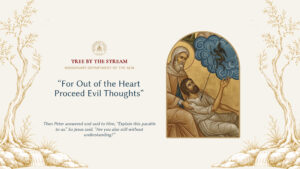
“The disciples said this not so much because they were concerned about the Pharisees, but because they themselves were perplexed. Since they did not dare to express their own uncertainty openly, they sought clarification by referring to the reaction of others. That they themselves were indeed troubled becomes evident from the fact that the zealous Peter, who was always the first to speak, approached the Lord and said, ‘Explain this parable to us.’ Revealing the disturbance of his own soul, yet not daring to confess openly, ‘I myself am offended,’ Peter asks for an explanation so that he might be delivered from his uncertainty. It was for this reason that he was subsequently rebuked.”
Blessed Jerome offers a profound response to the question of free will and predestination, a theological issue that naturally arises from a deeper reflection on these verses:
“In Holy Scripture, even what appears to be straightforward is often filled with profound questions. ‘Every plant,’ says Christ, ‘which My heavenly Father has not planted will be uprooted.’ At first glance, this would seem to imply that even those plants of which the Apostle speaks—‘I planted, Apollos watered, but God gave the growth’ (1 Cor. 3:6)—will likewise be uprooted. Yet this apparent difficulty is resolved by what the Apostle immediately adds: ‘God gave the growth.’ Elsewhere he also writes: ‘You are God’s field, God’s building,’ and again, ‘We are God’s fellow workers’ (1 Cor. 3:9). If the apostles are fellow workers with God, then whenever Paul plants and Apollos waters, God Himself is planting and watering together with His co-workers. This passage is misused by those who advocate the doctrine of different human natures, arguing: ‘If every tree not planted by the Father will be uprooted, then the tree planted by the Father cannot possibly be uprooted.’ Let such people hear instead the words of the Prophet Jeremiah: ‘I had planted you a choice vine, wholly of pure seed. How then have you turned degenerate and become a wild vine?’ (Jer. 2:21). It is indeed true that God plants, and no one can uproot what He has planted. Yet because the growth of the tree unfolds through the exercise of human free will, no one can uproot it unless the tree itself, by its own consent, allows this to happen.”
From these words we clearly see that God does not predetermine anyone’s destiny. Human beings are not powerless instruments of fate; rather, they truly participate in shaping their own lives and eternal destiny because they possess a gift that God never takes away—the gift of free will.
St. Chromatius of Aquileia points out that a tree may also grow apart from the will of God, and that this is evident in the emergence and development of various heretical doctrines and teachings that deny God. Nevertheless, the final outcome of all such teachings, which are inspired by the devil, is certain: they will ultimately be uprooted by God. Chromatius writes:
“The scribes and Pharisees transgressed the Law of God and introduced regulations of their own that were not from God at all, while demanding that these human ordinances be observed as though they were divine commandments. It is therefore entirely just that they should be uprooted by the Lord, for they imposed teachings of their own making. Thus the Lord says: ‘Every plant which My heavenly Father has not planted will be uprooted.’ Indeed, the growth of such a tree was not of God but of men. Every corrupt tree—not only that of the scribes and Pharisees, but also that of all heretics—will likewise be uprooted by the Lord. Though such a tree may for a time spread its branches of unbelief, it can never establish true roots, for it originates not from God but from the devil. Therefore, it must ultimately be uprooted and cast into the eternal fire, since it bears no fruits of faith or salvation.”
Verse 14:
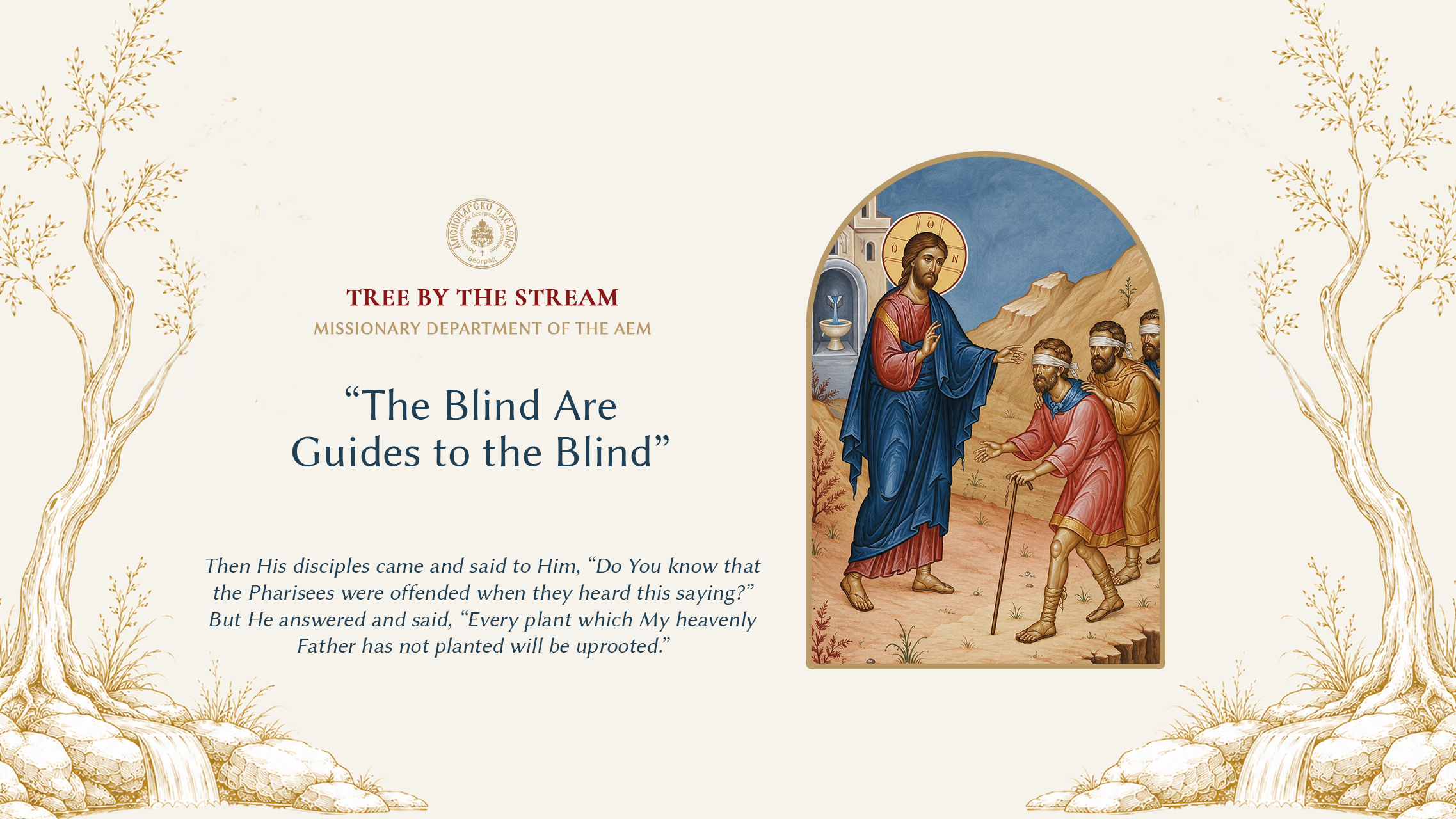
“Leave them alone. They are blind guides of the blind. And if the blind leads the blind, both will fall into a pit.”
Blessed Theophylact explains the importance of discerning when we should continue striving to lead someone to the truth and when the time has come to leave that person to his own choice. He also addresses the question of whether Christ’s warning against causing others to stumble applies in such cases:
“Since the Pharisees had reached a hopeless and incurable state, the Lord says, ‘Leave them alone.’ From this we learn that we suffer no spiritual harm if those who willingly choose to take offense, and who have rendered themselves spiritually incurable, are scandalized by us. The Lord calls them ‘blind guides of the blind’ in order to turn the people away from following them.”
Chromatius of Aquileia likewise teaches that heretics belong among these blind guides:
“The Lord continues by saying: ‘Leave them alone; they are blind guides of the blind. And if the blind leads the blind, both will fall into a pit.’ These words refer first to the scribes and Pharisees, who had been blinded by the error of their unbelief. Not only were they themselves unable to recognize the light of truth by refusing to believe in Christ, but they also dragged others with them into the pit of destruction. These words apply equally to heretics. By rejecting Christ as ‘true Light from true Light, true God from true God,’ they too have become spiritually blind. Carrying false doctrine, they have made themselves leaders and teachers of the unfortunate souls who choose to follow them.”
Adapted for the contemporary reader based on the interpretations of the Holy Fathers by Stanoje Stanković.