
The Lord manifests His love for us humans in various ways. In the Gospel parable of the talents, we see how our heavenly Father pours out certain talents on each person in the form of various gifts. At the time when the Lord tells this story to his disciples, a talent was a measure of money. It is very difficult to convert the value of one talent into the value of today’s currency, because one talent was worth six thousand dinars, and one dinar was the wage for a day’s work. Therefore, one talent was worth six thousand working days. That is a large amount of money. The Lord Jesus Christ uses examples from everyday life in order to present the truths of the future Kingdom of God in a way that is vivid and understandable to us.
Through the Gospel parable of the multiplication of talents, the Lord shows us that a person who wants to use his life for good must cherish what God has given him, multiplying his talents. His life’s work will yield a hundredfold return as a reward, especially in eternal life, and for many it will be so in this life as well, in terms of the acquisition of inner spiritual wealth and strength that cannot be taken away. At the same time, this story indicates that a person who, for whatever reason, refuses to accept God’s gift, acts wrongly and leads himself to ruin.
In the inter-ambon prayer of the Liturgy of St. John Chrysostom, we hear: „Every good gift and every perfect gift comes down from the Father of lights.“ Indeed, God, creating man, embeds in him special gifts that make him a unique being. These gifts (talents) are woven into our being and through them we develop what makes us unique personalities. Each of us possesses within himself a treasure trove of talents, gifts that everyone needs to recognize and discover through their own efforts. Man is an active and dynamic being, who was made to create and love, to share with others his inner and outer riches, because only in the encounter with another person, with our neighbour, do we get the opportunity to keep learning and discovering anew that we are children of God. The Apostle Paul calls us to bear witness to love for one another, because true Christ-like love defines the quality of life and our relationship not only with other people, but also with God.
In this life, nothing happens by chance; there are no random events, and certainly no random encounters. If we compare life to a beautiful meadow filled with diverse and colourful flowers, it will become clear to us that every day of our life we meet many people who possess certain talents. One is a good singer, someone else a successful artist, or an inspired orator… There is beauty in this diversity. The Christian ethos teaches us that this diversity does not divide, but rather unites people and calls us to love each other regardless of our differences. The Lord said to his disciples: “By this all will know that you are my disciples, if you have love for one another” (John 13:35). During the Holy Liturgy, the soul of one person rejoices, and the soul of another person feels compassion, each person experiences prayer in his own way, but all of us during the Liturgy feel love. By this all will know, — says Christ, — that you are my disciples, if you have love for one another.
A few days ago, I received with such love and joy the news that a person close to me was rewarded for her creativity. In addition to the feeling of pride, joy, love and respect, this news prompted me to think more deeply, not only about multiplying the gifts given to us by God, but also about the need to truly rejoice in the success of our friends.
Friendship is a great gift from God. Every sincere friendship is based on love, mutual respect and a willingness to sacrifice. One of the God-bearing Fathers said that a friend is my other “self”, that is, that having a friend means having another self. If we understand and practice friendship in this way, then joy over the success of our friend will be something that is natural.
The award that a person dear to me received represents only one of the pebbles in the mosaic of her giftedness. In her life and work I see someone who has been blessed by God with many gifts. They are manifested in her refined sense of aesthetics, her gift for the written and spoken word, her sharp mind, the dignified way in which she keeps transforming daily the most important truths of our faith into works of love in relation to people who have the joy and honour of being in her presence. In her case, I see more clearly than in any other how the multiplication of talents produces great spiritual fruits. The sweetness of these fruits touches not only her, but also all those who recognize this spiritual wealth.
The Lord expects us to cling to what is good with all our hearts, to spend the time of this life loving, with friends whom God’s love has given us. “In brotherly love be kind to one another; in honour esteem one another more highly than yourselves” (Rom. 12:10), are the words of the God-wise Apostle Paul. The Apostle does not require of us mere brotherly love, which can also be cold, but a higher form of love – marked with tenderness. This kind of true love filled the heart of the Venerable Seraphim of Sarov, the saint who greeted all people with words full of tenderness: “My joy.”
Rejoicing in the success of those we love and whose presence enriches our lives, we also thank God for all His gifts, praying that He may grant us the spiritual and physical strength to persevere in the struggle to multiply the gifts that His love has given us.
At the end of this humble reflection, instead of congratulating her on her well-deserved award, I offer prayers to the Lord for her whose name means beauty and kindness. Lord, preserve her in her kindness. Increase in her faith, hope and love. Grant her the strength to be a hard-working bee in Your spiritual meadow all the days of her life, and to continue to sweeten the hearts of those who meet her with spiritual honey. And to us, Lord, grant us the strength to persevere on the path of salvation, walking with love and witnessing to the love that is the “bond of perfection” (Col. 3:14).
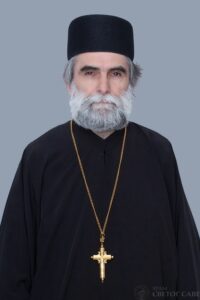
WRITTEN BY: Catechist Branislav Ilić, editor of the “Kinonia” portal
*The text was published on the Kinonia portal in the “Our Recommendation” section on July 9, 2026.