We now come to verses 20–21:
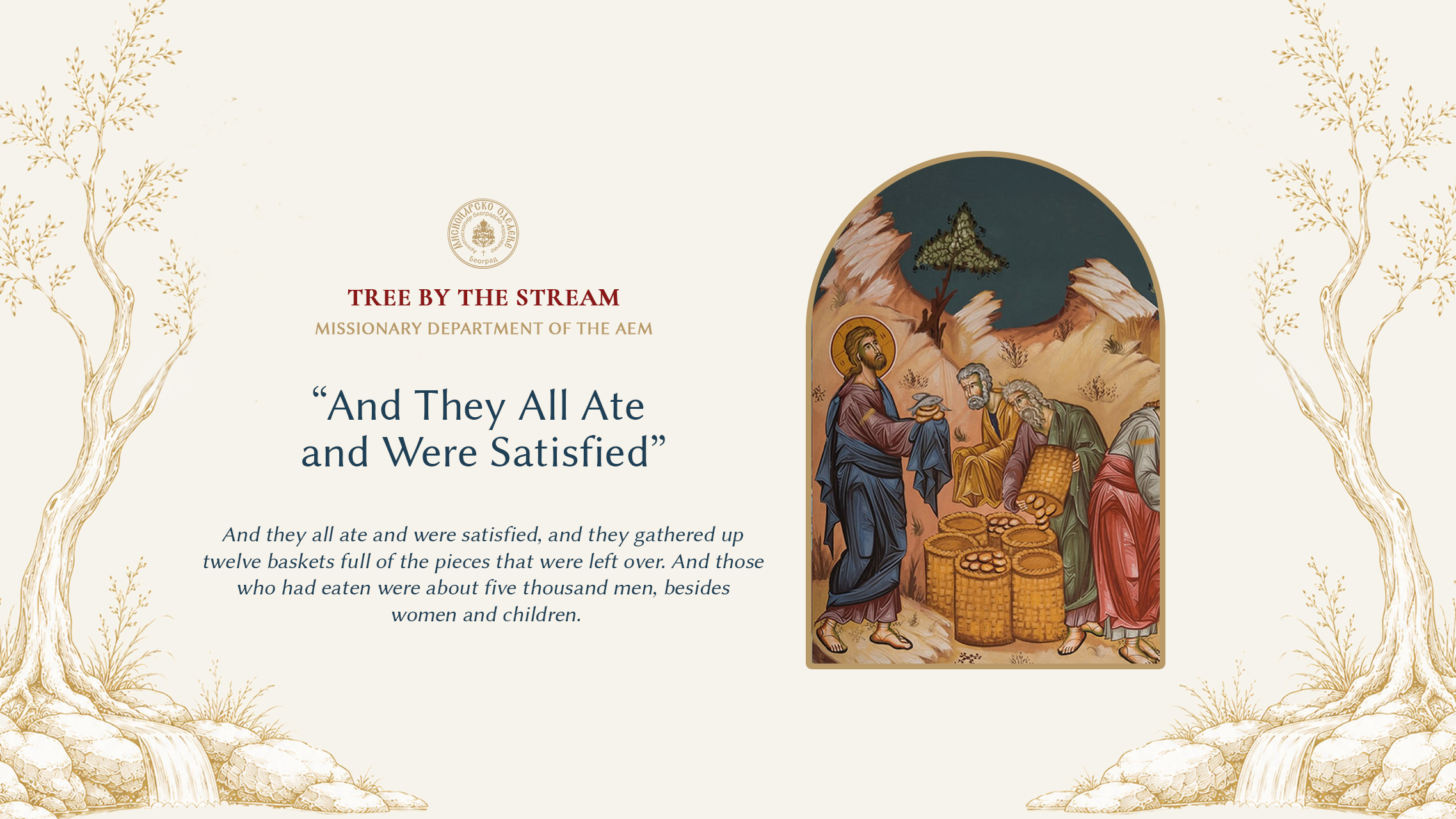
So they all ate and were satisfied, and they took up twelve baskets full of the fragments that remained. Now those who had eaten were about five thousand men, besides women and children.
Saint Ambrose of Milan writes here about the most essential aspect of our salvation—the Holy Eucharist—and explains how the miracle of the multiplication of the loaves foreshadowed that which constitutes the very heart of the Church and of our life within her:
“The people are fed, while the Apostles minister to them—herein lies the mystical meaning of this event. Their satisfaction signifies the complete removal of hunger forever, for whoever partakes of Christ’s bread shall never hunger again. The ministry of the Apostles foreshadows their future distribution of the Body and Blood of the Lord. The divine miracle consists in the fact that five loaves proved abundantly sufficient for five thousand people. Clearly, it was not a small quantity of food that satisfied the multitude; rather, the loaves themselves were multiplied. Had you been present, you would have witnessed how the portions of bread mysteriously increased in the hands of those distributing them and how new pieces appeared of themselves.
Will anyone who reflects upon this continue to marvel at the perpetual flow of rivers or be astonished by the unceasing movement of the winds? All these things occurred so that we might perceive the invisible through the visible. In this miracle it is clearly revealed that Jesus is the cause of all things and the Creator of the entire material order, which does not exist independently, as certain philosophers have imagined, but has been created. Consider what a marvel this is: no matter how much water is drawn from rivers, there is no sign of diminution; no matter how much is taken from a spring, it is as though another hand continually replenishes what has been removed.
Likewise, the bread that Jesus broke—and in its mystical sense this bread is the Word of God and the preaching of Christ—is multiplied in the very act of being broken. Through but a few words Jesus provided abundant nourishment for the whole multitude. He has given us the bread of divine instruction, and it continues to multiply as it touches our lips. In a visible manner this bread is mysteriously multiplied as it is broken, distributed, and received, without suffering the slightest diminution. Therefore, do not doubt that this bread is multiplied—in the hands of the priest and upon the lips of those who receive it—for everywhere there is testimony confirming this divine work and strengthening our faith. Understand, if you are able, how wondrous these events truly are.”
Saint Nikolaj reflects upon the greatness of this miracle and its overwhelming power, emphasizing that even Christ’s most hardened opponents did not dare deny it:
“And they all ate and were satisfied, and they took up twelve baskets full of the fragments that remained. Now those who had eaten were about five thousand men, besides women and children. Behold a miracle above all miracles and a glory surpassing all glory! Even if each of those five thousand men—without counting the women and children—had received only a single morsel, like the blessed bread (antidoron) distributed in church, five loaves would scarcely have sufficed. Yet here they all ate until they were satisfied, and twelve baskets full of fragments remained.
Had this been an illusion, Scripture would not have said that they were satisfied. One might perhaps deceive a person’s eyes into thinking he is eating, but no illusion can satisfy genuine hunger. And if this had been deception, from where came the twelve baskets filled with leftovers? No—only those hardened by sin could call such a work an illusion. It was reality, just as the living God is reality.
Observe also that during this miracle no one dared to object or attempt the kind of foolish explanations that the Pharisees frequently offered concerning Christ’s other miracles. Far from opposing Him, when the people saw the sign that Jesus had performed, they said: ‘This is truly the Prophet who is to come into the world.’ Indeed, they even sought to seize Him and make Him king. Such was the tremendous impression produced upon the multitude by this truly mighty work of Christ. When has any deceiver ever been proclaimed king? This was reality and truth, and the people, overwhelmed by that reality and truth, wished by force to make Christ their king. This would indeed have happened had Christ not withdrawn and thus prevented the fulfilment of their intention.”
Blessed Theophylact offers an allegorical interpretation of the miraculous multiplication of the loaves in the following words:
“The ‘five thousand men’ represent the five human senses, gravely wounded by sin and healed through the five loaves. Since the five senses had become diseased, as many remedies were required as there were wounds. The two fish signify the words of the fishermen—the Apostles: one is the Gospel, and the other the Apostolic preaching.
Some interpret the five loaves as the five books of Moses: Genesis, Exodus, Leviticus, Numbers, and Deuteronomy. The twelve baskets were gathered and carried away by the Apostles because what we ordinary people are unable to consume—that is, fully to comprehend—the Apostles preserved for us, having themselves received and understood it. The expression ‘besides women and children’ signifies that every Christian, whether man, woman, or child, is called not to remain spiritually childish, weak, or immature, but rather to become courageous and perfect in every virtue.”
Finally, let us consider the reflection of Saint John of Kronstadt:
“Five small loaves and two fish were sufficient to satisfy five thousand hungry and exhausted men, not counting the women and children, who were undoubtedly numerous. O Christian, recognize in your sweetest Lord Jesus Christ the Almighty Creator of the universe, for whom it was no great task to bring into existence from nothing the vast, radiant, and harmonious order of creation. How much easier, then, was it for Him to nourish the frail material bodies of human beings! Indeed, He could have sustained their life and strength by His almighty word alone, since the entire universe is upheld by that same omnipotent Word.
Yet it pleased Him to feed them by means of the very nourishment He had provided in the beginning—that is, the fruits of the earth—as food suited to man’s earthly nature. How I would have wished to witness the breaking of those loaves! For how long did they continue breaking them? How did more than five thousand portions come forth from those five loaves? And how was it that, after everything had been distributed, there remained more fragments than the original loaves themselves? The Holy Mystery of the Body and Blood of Christ likewise presents for us an image of this miraculous feeding of the multitude.”
Verses 22–23
Immediately Jesus made His disciples get into the boat and go before Him to the other side, while He dismissed the crowds. And after He had dismissed the crowds, He went up on the mountain by Himself to pray. When evening came, He was there alone.
Saint Gregory Palamas explains that, through His actions, the Lord teaches us how we ought to conduct ourselves in both dimensions of the spiritual life: when we are among others and when we are alone before God. He writes:
“Someone may ask why the Lord compelled His disciples to enter the boat. One might say that He also ordered external circumstances in such a way as to hasten the accomplishment of the very works for which He had come into the world. Indeed, I would be perplexed had He not compelled the disciples to enter the boat. Wishing to present Himself through His deeds as the perfect example of every virtue, Jesus first demonstrated how one ought to relate to the people so that they might benefit both spiritually and physically. It then remained for Him to show how one ought to commune with God, lifting one’s mind towards Him, free from every earthly attachment. Solitude, the wilderness, and the silence that reigns there are especially conducive to this. Since the time had come to reveal the goodness of solitude, silence, prayer, and withdrawal from the world, it was fitting that He ascend the mountain and pray there alone.
The disciples longed always to remain with Him and found it difficult to be separated from Him. How, then, could He have ascended the mountain alone had He not first compelled them to enter the boat and cross to the other side?
From this event another truth likewise becomes evident. Just as Christ healed, instructed, and miraculously fed the multitude before dismissing them and ascending the mountain, while compelling His disciples to entrust themselves to the sea and its waves, so also through His Incarnation He healed our nature, instructed us, nourished us with Himself, departed bodily from us in His Ascension, and then sent His disciples into the whole world. This is equivalent to saying that He sent them into the sea of the nations, bitter and stormy because of its countless trials, with the Gospel as their vessel and the evangelical Church accompanying them amidst those tribulations.
Nor did He merely send them—He compelled them to go. Whoever recalls the account given by John, the beloved Theologian, and understands the circumstances surrounding the martyrdom of Stephen and the persecution that followed, will understand what I mean. The disciples did not wish to leave Jerusalem; yet persecution compelled them to scatter throughout the world, and thus they fulfilled their apostolic mission.”
Nearly all Orthodox nations—including the Russians, Serbs, Greeks, and Romanians—were likewise compelled to undergo large-scale migrations as a consequence of the wars and persecutions of the twentieth century. When one considers the remarkable flourishing of Orthodox missionary activity that followed and the opportunity thereby afforded for many peoples to encounter Orthodoxy through living alongside Christians who had been forced to leave their homelands, it becomes evident that the Lord, in His divine providence, encompassed and ordered all things for good. Even in the midst of our sufferings, the Lord remains near to us, and we are never abandoned.
Saint Nikolaj of Ohrid writes that Christ here reveals the profound importance of withdrawing from the world and intentionally finding time to be alone with God. His words are especially relevant today, for even when we find ourselves physically alone, we are rarely truly alone, continually accompanied by social media and the distractions of the digital world. The saint also offers practical instruction on the proper relationship between good works and prayer:
“Everything that the Lord Jesus did, He did for our instruction and salvation. He came into the world not only to teach us through words, but also through His deeds, through the events of His life, and through every action and movement. He ascends the mountain because the mountain offers the greatest silence. He remains alone because solitude signifies separation from this world. He prays in the darkness of the night because darkness acts as a veil over the eyes, which most often distract the mind by constantly moving from one object to another.
Christ’s prayer upon the mountain also possesses a deeper spiritual meaning. What do the dismissal of the crowds, the ascent of the mountain, solitude, and darkness signify? To dismiss the crowds means to set aside every worldly image and every memory that binds and disturbs us, so that, emptied of the world, we may ascend towards God in prayer. What does ascending the mountain mean? It signifies lifting the mind, the heart, and the soul towards the heights of God, into His presence and communion. One who is continually weighed down by the countless concerns of this world, like a multitude pressing upon him, cannot at the same time ascend to those heights where a person stands alone before the Creator.
What does solitude mean? It means the soul stripped bare, exactly as it is. A person separated from the world often experiences a terrible loneliness. Those whom disappointment with the world leads into such loneliness frequently fall into despair and even take their own lives if they fail to ascend to those heights where God is found.
What does darkness signify? It represents the complete absence of every light belonging to this world. For the solitary man of prayer, the entire visible world lies submerged in profound darkness, while gradually there dawns within him the light that comes from heaven, illuminating a new world infinitely brighter and better than this one.
These, then, are the four stages of prayer and their inner meaning.
The lesson that the Lord teaches us by His own example of prayer is therefore perfectly clear. Every prayer should be preceded by a good work, for only then does prayer bear fruit. We must first bear witness to our faith through good deeds and only afterwards confess that faith with our lips. Likewise, prayer has value only when we prepare ourselves to perform a good work and ask God to grant us His help. To pray that God might assist us in committing evil is not merely futile but blasphemous. To perform evil while praying is like sowing weeds and asking God to make wheat grow. After every good work we should fall down before God in thanksgiving because He has deemed us worthy and enabled us to accomplish it. Likewise, before every good work we should again turn to Him in prayer, asking for His grace, assistance, and cooperation, so that the task before us may be carried out honourably and righteously.”
Blessed Jerome further observes that through His actions Jesus reveals His two natures. Certain actions manifest His divine nature, while others reveal His true humanity. Jerome writes:
“Had Peter, James, and John—those who witnessed the glory of His Transfiguration—been present with Him, they perhaps would have ascended the mountain together with Him. The multitude, however, could accompany Him to the higher place only when He was teaching them by the seashore or feeding them in the wilderness.
As for the fact that He went away alone to pray, do not associate this with Him who, according to His divinity, fed five thousand men with five loaves, but rather with Him who, according to His humanity, withdrew into the wilderness after hearing of the death of John. This does not mean that we divide the Lord into two persons; rather, certain works He performs as God, while others He performs as man.”
Adapted for the contemporary reader based on the interpretations of the Holy Fathers by Stanoje Stanković.