The Holy Fathers now interpret the event of Peter walking upon the water. We come to verses 28–29:
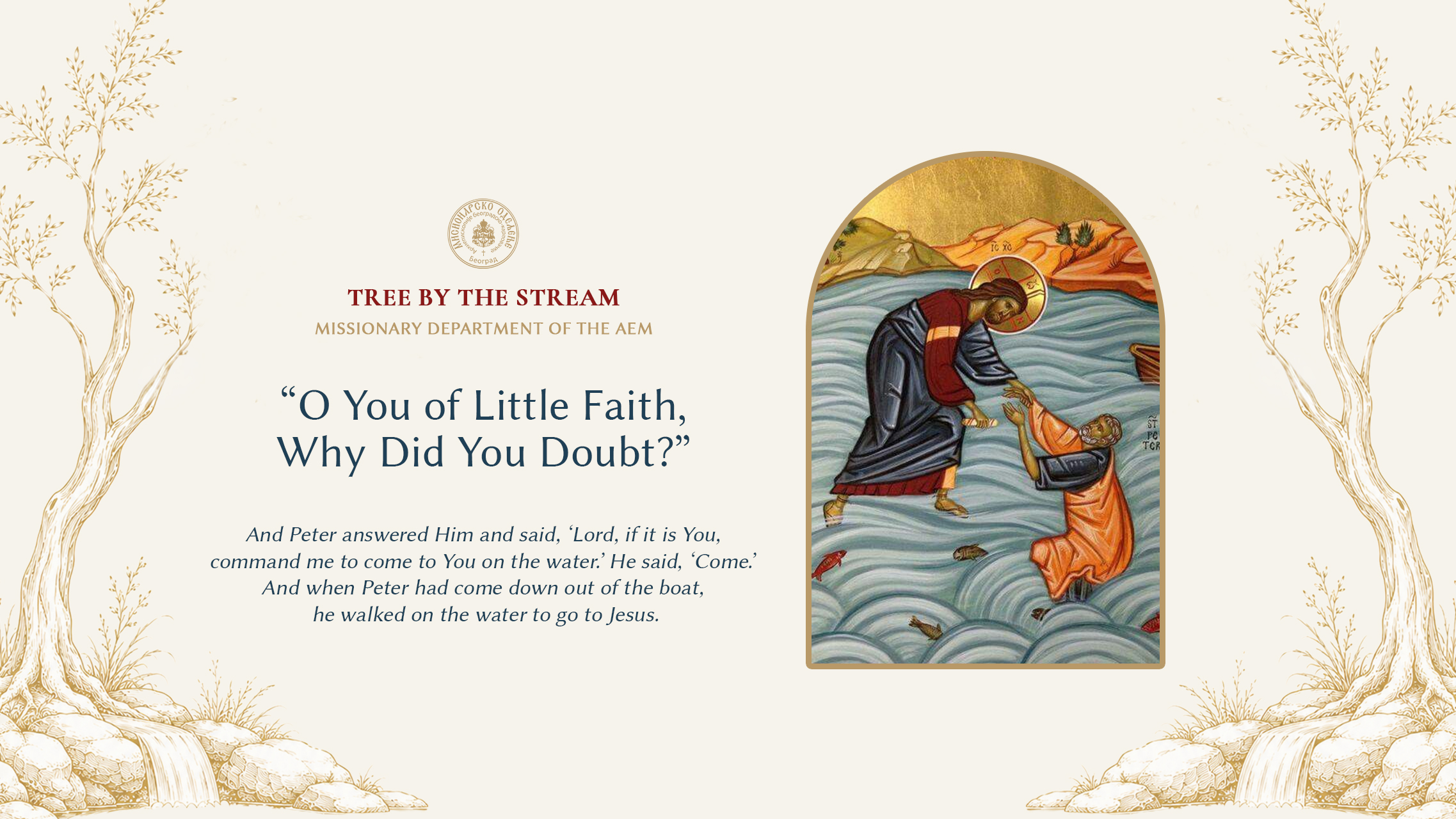
And Peter answered Him and said, “Lord, if it is You, command me to come to You on the water.” And He said, “Come.” And when Peter had come down out of the boat, he walked on the water to go to Jesus.
In these verses, the Holy Fathers draw particular attention to the person of the Apostle Peter. Saint John Chrysostom says:
“What does Peter do, always fervent, always ahead of the other disciples? Lord, he says, if it is You, command me to come to You on the water. He did not say, ‘Pray and call upon God for help,’ but rather, command me. Do you see how much zeal there is here, how much faith—although Peter often exposes himself to danger because of it? Yet this comes from love, not from boastfulness. He did not say, ‘Command me to walk upon the waves,’ but rather, command me to come to You. No one loved Jesus as much as Peter did. He proved this also after Christ’s Resurrection. Even then he did not wait to go together with the others, but hastened ahead. Yet Peter reveals not only love but also faith. He was convinced that Jesus could not only walk upon the sea Himself, but could also lead others upon it; therefore he desired to be close to Him.”
Blessed Jerome continues to consider the person of the Apostle Peter and writes:
“In every passage Peter shows himself to possess the most ardent faith. When the disciples were asked whom people believed Jesus to be, Peter confessed Him to be the Son of God. Peter opposed Jesus’ desire to go voluntarily to His Passion, and although he was mistaken, he did not sin through malice but through the movement of love, since he did not wish the death of the One whom he had shortly before confessed as the Son of God. Among the first, he ascended the mountain after the Saviour; during the Passion, Peter alone followed Him; and the sin of denial into which he fell because of sudden fear he immediately washed away with bitter tears.
After the Passion, when the Apostles were on the Lake of Gennesaret fishing and the Lord stood upon the shore, Peter, while the others approached slowly, could not endure their slowness and immediately cast himself into the water, having girded his outer garment. With this same fire of faith, as always, he now considers it possible, while the others remain silent, to do at the command of the Master what only Jesus could do by the property of His nature. Command me to come to You on the water. Command, and let the waves become firm; let the body, which by itself is heavy, become light.”
Saint Nikolaj of Ohrid here compares what happened to the Apostle Peter with what we ourselves sometimes experience: moments of spiritual fervour when it seems to us that nothing is difficult for the Lord’s sake. Yet such fervour often lasts only until the first difficulty appears. Saint Nikolaj writes:
“These words of Peter express both his joy and his doubt. Lord—his joyful heart cries out; if it is You—doubt speaks. As long as he possessed faith, Peter walked upon the water; but as soon as doubt overcame him, he began to sink. For doubt gives birth to fear.
In its inner meaning, to step out of the boat and walk upon the water toward the Lord Jesus means to separate the soul from the body, from bodily cares, and from bodily love, and to begin walking the dangerous path towards the spiritual world, towards the Saviour. Such moments occur even among ordinary believers, among those of little faith, whose joy in Christ is mixed with doubt. They often desire to separate themselves from their bodily vessel and go towards Christ, the King of the spiritual world, but soon they feel themselves sinking and return to their body as to a boat upon the waves.
Only the great spiritual men, the greatest heroes of humanity, have succeeded, through long training in steadfast faith, in setting out from the boat of their body across the stormy spiritual sea to meet Christ the King. And only they have fully experienced both the fear of that separation from the boat, the terror of storms and winds, and the indescribable joy of meeting Christ.”
We now come to the next three verses:
But when he saw that the wind was strong, he was afraid; and beginning to sink, he cried out, saying, “Lord, save me!” And immediately Jesus stretched out His hand and caught him, and said to him, “O you of little faith, why did you doubt?” And when they got into the boat, the wind ceased.
Saint Chrysostom offers a very striking explanation of why Christ permitted Peter to walk upon the water:
“Why, then, did Christ allow Peter to do this? Because if He had said to him, ‘You cannot come,’ Peter, in his fervour, would have contradicted Him even here. Therefore Christ convinces Peter by the deed itself to be more cautious in the future. Yet not even this restrains Peter. Having descended from the boat, he is overcome by the waves because he became afraid; this is what caused his wavering, and fear arose because of the wind.
The Apostle John writes: They were willing to receive Him into the boat, and immediately the boat was at the land where they were going (John 6:21). These words indicate what took place: Jesus entered the boat when the disciples had already drawn near to the shore. Thus Peter, having stepped down from the boat, goes toward Christ, rejoicing not so much that he is walking upon the water as that he is going towars Jesus. Yet having overcome what was difficult, he nearly suffered harm from what was easiest—I mean from the movement of the wind, not of the sea.
Such is human nature: often, after succeeding in great matters, it struggles with lesser ones. As Elijah suffered because of Jezebel, Moses because of the Egyptian, and David because of Bathsheba, so it happened also with Peter. At the beginning, still gripped by fear, he dared to walk upon the water; yet against the blast of the wind, even while already close to Christ, he could not remain firm. Thus it is of no benefit to be physically close to Christ if one is not close to Him in faith.
This revealed the difference between the disciples and the Master and also consoled the others. If they were indignant with the two brothers, all the more would the Apostles have been indignant with Peter, for they had not yet been counted worthy to receive the Holy Spirit. After they received the Holy Spirit, however, they became different and in all things yielded the primacy to Peter; they allowed him to speak in the assemblies, although he was less experienced in speech than others.
But why did the Lord not command the wind to cease, instead stretching out His own hand and supporting Peter? Because Peter’s faith was necessary. When there is a deficiency on our part, the divine action is also, in a certain sense, restrained. Therefore, wishing to show that it was not the blowing of the wind but Peter’s little faith that caused this change, the Lord says: O you of little faith, why did you doubt? It follows that Peter would easily have withstood the wind had his faith not grown weak. For this reason, while helping Peter, the Lord did not at once stop the blowing of the wind, wishing to show that the wind causes no harm when faith is strong.
Just as a mother bird takes upon her wings a chick that has flown prematurely from the nest and is about to fall to the ground, and then carries it back again to the nest—so also did Christ act.”
Saint Nikolaj of Ohrid writes about an experience common to all believing people. These are his words:
“Have we not ourselves, thousands of times, been sinking in the sea of the dangers of this life until some invisible hand seized us and unexpectedly drew us out, placing us beyond danger? Which of you cannot recount at least several occasions when you were unexpectedly saved from peril by an invisible hand? You all know this, and you all tell and retell these stories, even acknowledging the presence of that invisible hand which delivered you. Yet, sadly, few among you have heard, even within your own conscience, the rebuke of those invisible lips: O you of little faith, why did you doubt?”
Finally, Saint Hilary of Poitiers sees in this event a prophetic foreshadowing of what would later happen to the Apostle Peter—namely, his denial of the Lord. Hilary writes:
“The fact that, of all those in the boat, only Peter speaks and asks the Lord to command him to come upon the water reveals the strength of his resolve during the time of the Passion. When he alone walks towards the Lord, following in His footsteps and disregarding both the turbulence of the world and the raging sea, Peter possesses a strength capable even of despising death itself. Yet his fear reveals his weakness before the suffering that was to come. For although he stepped out of the boat, he began to sink. Through the frailty of the flesh and the fear of death, Peter came to the point of denying the Lord. But Peter then began to cry out and begged the Lord to save him. This cry is the sigh of repentance. Although the Lord had not yet entered into His Passion, Peter had already returned to faith and, in due time, received forgiveness for his denial.”
Adapted for the contemporary reader based on the interpretations of the Holy Fathers by Stanoje Stanković.