The Holy Fathers continue to explain Christ’s parable of the leaven.
Venerable Anthony the Great interprets the meaning of the leaven through Christ’s work of redemption and speaks about various events in His life in the following way: “I believe that the leaven represents the teaching and the faith corresponding to this teaching. The Lord calls the Church His woman whom He loved, as the holy Apostle also says. The three measures of meal are the three sons of Noah: Shem, Ham, and Japheth; from them, after the Flood, came forth all the nations that are now gathered into the Church, and the beginning of preaching for them is faith. The entire flour of the other nations—the three measures born from Noah—was mixed together with the leaven for the sake of piety. What is written here may also be understood differently: the leaven may signify the honorable and holy Body of God the Logos, which He wove for Himself within the womb of the Ever-Virgin, clothing Himself without seed in her and uniting it with soul and body. And not only this, but the wise woman is beautifully understood as the holy, living, and harmonious Word of God. For Christ is the Power of God and the Wisdom of God, as the divine Apostle said. The three measures of meal: the first measure is the entirety of human nature, the second is death, and the third is Hades, in which the Body of God was hidden after burial, growing towards Resurrection and Life. Hear also that the three measures signify Baptism, the Gospel, and the holy Mysteries. But they may also signify the Apostles, the Prophets, and the teachers. And further: the present, the past, and the future. For the incarnate Logos brought benefit not only to the living, but also raised up those who had previously been carried away by death, and granted the hope of resurrection and eternal life both to us and to our descendants, for whose sake Jesus rose from the dead, raising them together with Himself; and having Himself ascended into heaven, He transferred them, already alive, to the place where Enoch and Elijah continue to live and do not die.”
Saint Luke of Crimea draws attention to the mysterious operation of the grace of the Spirit within us, but also to the influence that Holy Scripture exerts upon our spiritual life. Saint Luke writes the following: “Further, the Lord presents two comparisons: He compares the Kingdom of God to a mustard seed, a very tiny seed from which a great shrub develops—in the first parable; and in the second, to leaven which a woman placed into three measures of flour until all was leavened. These two parables reveal the process that unfolds within human hearts; they show the manner in which the Kingdom of God begins in the hearts of men already in this present life. A tiny mustard seed is sown, and by ways unknown to us the Lord Himself causes a great shrub to grow. A little leaven is placed into flour, and the whole dough rises… In the heart of an ordinary Christian there often unfolds a process similar to the rising of dough—the dough becomes filled with bubbles of gas, rises, expands, and becomes suitable for the baking of bread. The words of Holy Scripture are often like leaven in the dough; there begins a quiet, imperceptible rising within the human heart. New grace-filled thoughts appear, new aspirations, a new understanding of life under the influence of the grace of God, which is imparted through Holy Communion. Thus man grows in spiritual life like dough into which leaven has been placed, becoming capable and prepared for passage into eternal life.” This is one of the finest explanations of how important the ascetical labour of reading and studying Holy Scripture truly is. Most likely each one of us has had occasion in life to experience the truth of Saint Luke’s words.
Before us are the following verses, 34–36:
“All these things Jesus spoke to the multitude in parables; and without a parable He did not speak to them, that it might be fulfilled which was spoken by the prophet, saying: ‘I will open My mouth in parables; I will utter things kept secret from the foundation of the world.’ Then Jesus sent the multitude away and went into the house.”
Chrysostom here shows why the Evangelist refers to the Old Testament prophet and why the Lord leaves the crowd at this point: “So that the Evangelist Matthew might show that teaching in parables was not something new, he cites the prophet who foretold this mode of instruction, and at the same time reveals to us Christ’s intention in speaking through parables. Christ did not speak in this manner in order to leave His listeners in ignorance, but to provoke them to ask questions. Therefore he adds: ‘without a parable He did not speak to them.’ Although Christ had spoken of many things without parables, now He spoke nothing without them. Yet no one asked Him anything—even though they had often questioned the prophets, such as Ezekiel and many others. Now they did not ask Him a single question, although what had been spoken was sufficient to trouble the listeners and to move them to inquiry. Even the threat of the greatest punishment expressed in the parables made no impression upon them. That is why the Lord left them and departed.”
We continue further on our spiritual journey through the Gospel according to Matthew. Before us now stands Christ’s explanation of the parable of the tares to His disciples.
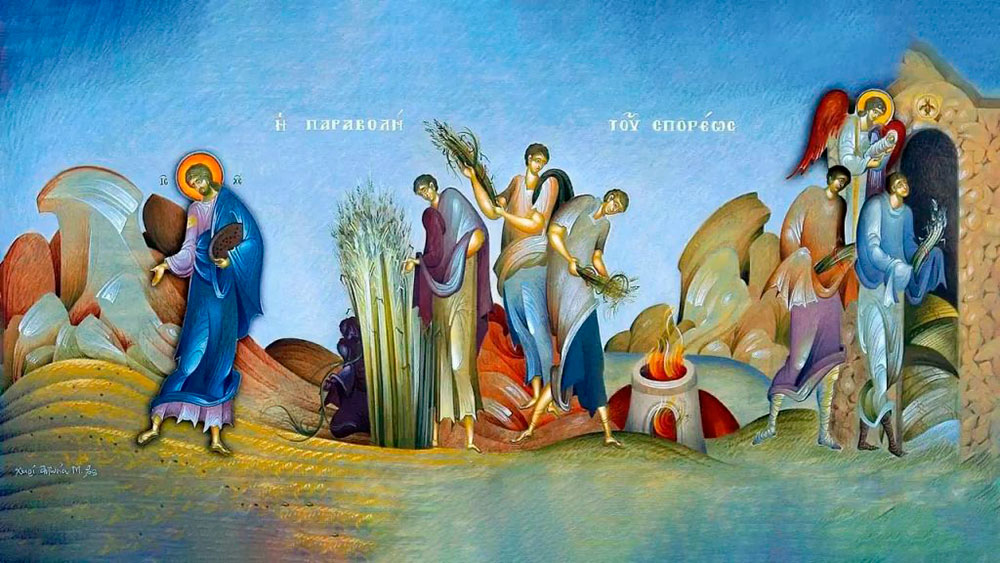
“Then Jesus sent the multitude away and went into the house. And His disciples came to Him, saying: ‘Explain to us the parable of the tares of the field.’ He answered and said to them: ‘He who sows the good seed is the Son of Man. The field is the world, the good seeds are the sons of the Kingdom, but the tares are the sons of the evil one. The enemy who sowed them is the devil, the harvest is the end of the age, and the reapers are the angels. Therefore as the tares are gathered and burned in the fire, so it will be at the end of this age. The Son of Man will send out His angels, and they will gather out of His Kingdom all things that offend, and those who practice lawlessness, and will cast them into the furnace of fire. There will be wailing and gnashing of teeth. Then the righteous will shine forth as the sun in the Kingdom of their Father. He who has ears to hear, let him hear!’”
Saint John Chrysostom here points out the complete lack of genuine interest that the scribes and Pharisees showed towards Christ’s teaching. They followed and listened to Christ not as ordinary people, but with an altogether different motive: “Then, says the Evangelist, ‘Jesus sent the multitude away and went into the house.’ And not one of the scribes followed Him. From this it is evident that they followed Christ with the sole intention of catching Him in His words. Yet because they now failed to understand what had been spoken, the Lord leaves them. ‘And His disciples came to Him, saying: Explain to us the parable of the tares of the field.’ Although they had desired to understand even before this moment, they were nevertheless afraid to ask. Whence then came this boldness in them now? They had heard: ‘Because it has been given to you to know the mysteries of the Kingdom of Heaven’ (Matt. 13:11). Therefore they ask Him privately, not out of envy towards the people, but in fulfillment of the Master’s command, who had said: ‘To them it has not been given’ (Matt. 13:11). But why do the apostles leave aside the parable of the leaven and of the mustard seed, and ask specifically about the parable of the tares? These parables were left to them as possessing great power of instruction. The apostles desire to hear the explanation of this parable because it bears close relation to the one spoken previously, and moreover it speaks of matters greater than the earlier parables. The apostles had already perceived that within the final parable there was concealed a great warning. Therefore the Lord not only refrains from rebuking them, but even supplements what He had spoken earlier. And as I have often said, parables should not be understood literally, otherwise we will fall into many absurdities—precisely this the Lord now teaches us, since in His explanation He departs from literalism. Jesus does not say who the servants are who came to the master. He allows us to understand that they were introduced into the parable only for the fullness of the message; therefore He omits that portion of the story and explains only what is most necessary and important—namely, that Christ Himself is the Judge and Lord of all things. … Consider how ineffable is His love for mankind, how ready He is to do good, and how far removed He is from punishment. When He sows, He sows personally; but when He punishes, He punishes through others, through the angels. ‘Then the righteous will shine forth as the sun in the Kingdom of their Father.’ This does not mean that they will literally shine like the sun. Yet since we know no luminary more radiant than the sun, the Lord employs examples familiar to us. Elsewhere Christ says that the harvest has already come—for example, when speaking of the Samaritans: ‘Lift up your eyes and look at the fields, for they are already white for harvest’ (Jn. 4:35). And again: ‘The harvest truly is plentiful, but the laborers are few’ (Lk. 10:2). Why then does Jesus there say that the harvest has already come, while here He says that the harvest is yet to come? Because He uses the word ‘harvest’ in different senses. Why is it also written elsewhere: ‘One sows and another reaps’ (Jn. 4:37), while here He says that He Himself is the One who sows? Because there, speaking before Jews and Samaritans, He places the apostles not in opposition to Himself but to the prophets, for Jesus also sowed through the prophets. Likewise, at times the Lord calls one and the same thing both harvest and sowing, employing these words according to different relationships. When He speaks of the obedience and responsiveness of the hearers, then, as one who has completed His work, He calls it harvest. But when He still awaits fruit from the hearing of the preaching, He calls it seed, and the end—harvest. And how is it written elsewhere in Scripture that the righteous shall be caught up first (1 Thess. 4)? It is true—they shall first be caught up at Christ’s coming. But sinners will first be delivered over to punishment, and only afterwards will the righteous ascend into the Kingdom of Heaven. The righteous belong to heaven, yet the Lord will come upon the earth, judge all people, pronounce judgment upon us, and then, like a king, rise together with His friends and lead them into the blessed inheritance. Do you see that the punishment will be twofold: they must burn in the fire and also behold themselves estranged from glory. But why, after the crowd had departed, does Christ continue to speak in parables even with the apostles? So that, having been instructed by what had previously been spoken, they might already be capable of understanding the parables. Therefore, after the parables, when Jesus asks them: ‘Have you understood all these things?’ they answer: ‘Yes, Lord!’ (Matt. 13:51). Thus the parable, among other things, also made the apostles discerning.”
Adapted for the contemporary reader based on the interpretations of the Holy Fathers by: Stanoje Stanković