I.
In his Mystagogy, St. Maximus the Confessor presents the Church as the icon of the entire cosmos, which consists of both visible and invisible realities. According to this claim, and indeed when viewed from the perspective of Holy Scripture and Tradition, the world was created to exist as Church. Consequently, it is impossible to apply a dichotomous or divisive perspective between the Church and the world, nor is it possible to separate them into “sacred” and “profane.”
In this light, and seen through the prism of pastoral theology, the paralytic in the Gospel (Mark 2:1–12) metaphorically characterizes the fallen world. Yet Christ looks upon the faith of those who brought the paralytic and regards him with love! Evidently, Christ sees this man—or rather, the world itself—as His child. Therefore, at the very moment when the world fails to perceive the meaning and goal of its own existence, the Church is called to disclose and to make present its authentic perspective. Faith is not an individualistic matter, but possesses a wondrous ecclesiological dimension; it is, in other words, the faith of the community.
It follows that the tragedy accompanying the mystery of Christ’s presence in the world is expressed as the incapacity of creation to behold the Creator. Thus, for the Church, there should be no “enemies,” even when some do not accept her or do not participate in the mystery of the Church. By nature, the world is not “defiled,” regardless of the fact that it has defiled itself. The Church is not determined by the world, nor does she negate the world; rather, she acts in order to sanctify it. Her sacred mission consists in leading humanity into communion and participation in the life of God. The Church is truly present and beneficial for the world when she is free from worldliness.
II.
According to the words of St. Nicholas Cabasilas in his work On the Life in Christ, it is precisely a life filled with the labour of ascetic struggle that gives birth to the “inner man,” the one of whom the Apostle Paul says that he is created according to God (Eph. 4:24). He further adds that it is through the Holy Mysteries that we are conceived, formed, and supernaturally united with Christ the Saviour.
Paraphrasing St. Cabasilas, one might say: when the sunlight enters a house, the lamp lit within no longer attracts the gaze of the beholder, for the rays of the sun overwhelm the light of the household lamp. In like manner, through the doors of the Holy Mysteries, the divine light enters this life and makes its dwelling in the human person, transfiguring his very existence. These doors were opened by Christ, and He never closes them, since through them He is always present. As St. Cabasilas declares: “He is, and will be with us forever.”
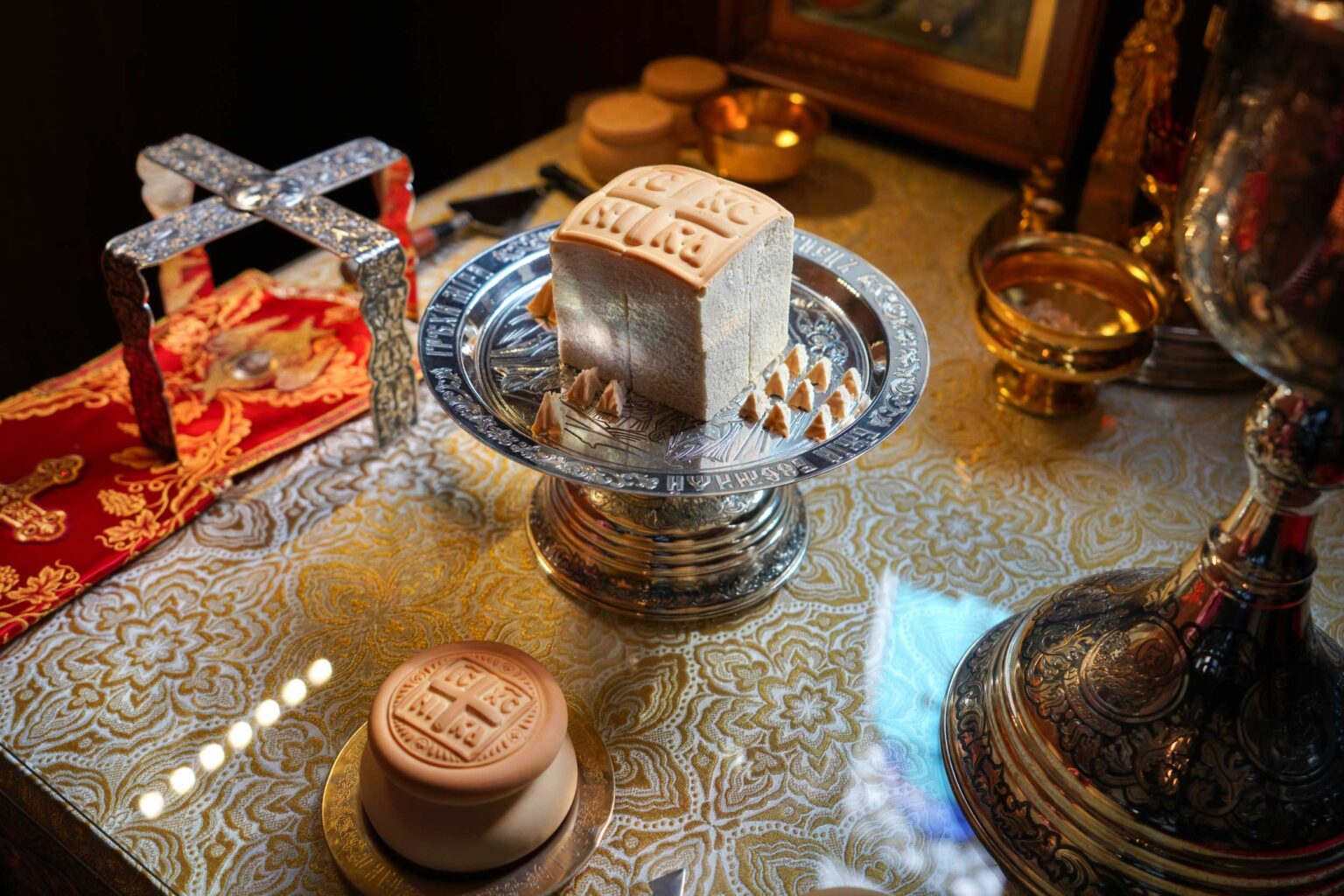
Here we must briefly pause to note one historical aspect concerning the number of the Holy Mysteries. From 1545 to 1563, the Council of Trent was convened intermittently, representing an attempt at reconciliation between the Roman Catholics and the Protestants. Among its many decisions, as a response to Protestantism—which had acknowledged only two sacraments—the Roman Catholic Church formally determined the number of sacraments to be seven. Moreover, Roman Catholic scholasticism sought to explain the sacraments in a rationalistic manner. For example, drawing upon Aristotelian philosophy, the scholastics claimed that the bread and wine of the Eucharist, as material elements, remain bread and wine, while their substance is changed through the invocation. The Roman Catholics coined the term for this: transubstantiation (μετουσίωση). By contrast, in the East the bread and wine are transformed into the Body and Blood (μεταβάλλονται); their essence is not altered, and the mystery cannot be investigated. The East avoids rationalistic analyses. St. John of Damascus affirms that it is sufficient for us to know that the sacrament is accomplished through the uncreated energies of the Holy Spirit.
For the Orthodox Church, there has never been a necessity to count the number of Holy Mysteries. For the Church, the Holy Mystery is the Liturgy itself, and the entire human life as a liturgical being is a Holy Mystery; therefore, the Mysteries are innumerable, like the branches of a tree. Thus, St. Nicholas Cabasilas, in his Commentary on the Divine Liturgy, emphasizes that the Mysteries are manifestations of the Church—not as symbols, but as branches on the vine, in the words of the Lord (John 15:5). Hence, a fixed number of seven Mysteries has no foundation in Orthodox theology, and, moreover, often leads to misunderstandings and errors. For example, the Mysteries are not rites isolated from the Liturgy, independent of the Eucharistic community. Orthodox Tradition cannot accept the private performance of Mysteries apart from the presence and gathering of the faithful.
Because of the counting of the Mysteries and their separation from the body of the community, scholastic dogmatics divided them into “necessary” and “optional.” From the perspective of Orthodox ecclesiology, such a division is utterly unacceptable. The Mysteries are diverse, but all serve the entire body of the Eucharistic community. Orthodox theology rejects an autonomous, individualistic anthropology. Man is part of the Eucharistic community, preserving his wholeness and integrity by participation in the divine, uncreated energies.
III.
The Uncreated God possesses holiness, while created reality participates in that holiness. Nikos Matsoukas stresses that in the mysterious relationship of God with the world, the life-giving, enlightening, and deifying divine energy constitutes the manifestations of the Mysteries within creation. The Mysteries are therefore the manifestations of the relationship between the created and the uncreated, and they accomplish the advancement of liturgical beings in the knowledge of God.
In Orthodoxy, the Mysteries are neither abstract nor meaningless magical acts. The Logos of God is living and active (Heb. 4:12), and He accomplishes the Mysteries. Consequently, there cannot exist a “Logos-less” Mystery. The very character of the Mysteries is anti-magical, since every Mystery is grounded in a concrete historical event. For example, Holy Baptism could not have any foundation or validity as a rite unless it were preceded by the Incarnation, the Cross, and the Resurrection of Christ. In general, no Mystery of the Eucharistic community can be severed from historical reality. For this reason, in the Church, every Mystery is accompanied by concrete material elements that are sanctified and transfigured. It is a matter of truth and life that are “incarnate” within historical reality and that constitute a triumph over the forces that corrupt creation. This triumph is, in essence, the healing of the body of created reality. Therefore, the entirety of sacramental theology rests upon what we might call the chief concern of the Fathers, which has always been to safeguard the reality of man’s deification—a reality possible only within the catholicity of the Church.
The created order is the object of science, whereas Mystery is the object of charismatic experience. Between science and theology there can be no conflict, for the former is concerned with the created, while the latter concerns the uncreated. The reality of deification, however, is vividly and personally described by St. Symeon the New Theologian in his Hymns of Divine Love: “Thou art wholly unmoved, yet ever moved; Thou art wholly beyond creation, yet wholly within all creation … and Thou dost bring us, who dwell in the sensible and visible, forth illumined by Thy light … and we become that which we are—sons by grace … we become members of Christ; Christ is my hand … if I move my hand, Christ Himself, the Whole Christ, is my hand … He, being many, remains One Indivisible, and yet each part is the Whole Christ Himself … God did not disdain to become like unto thee, and dost thou then disdain to become like unto Him?” (Hymn XV).
IV.
Aiming precisely at conformity to the Lord Christ, in early 2018, Radio Beseda began broadcasting the program Sacramental Theology. By the second half of 2020, the series had reached a significant milestone of one hundred episodes, each offering a detailed reflection on the sacramental theology of the Church.
With the blessing of His Grace, Bishop Irinej of Novi Sad and Bačka, the author of this series, catechist Branislav Ilić, simultaneously enriched the contemporary Serbian theological landscape and successfully fulfilled the given task: to introduce listeners to the meaning of the celebration of the Holy Mysteries; to the theological significance of the concepts of Mystery and holiness; to the relationship between the Mysteries and the Liturgy; further, to the understanding of the Mysteries within the context of an active liturgical life—bearing in mind the problem that some, for example, receive Baptism or Marriage and then erroneously regard that as the conclusion of their relationship with the Eucharistic community; and finally, to acquaint listeners with an authentic theological approach to the Mysteries, which were thoroughly presented in all one hundred episodes of the programme Sacramental Theology.
These broadcasts are easily accessible on YouTube, and it would be only natural for them to become part of the audio archive of all who desire to familiarize themselves with authentic Orthodox theology. As the author emphasizes, this is above all in relation to the Holy Eucharist, which is the source of all the Mysteries, and which provides the proper framework for understanding the entire sacramental life of the Church.
In accordance with the views of Christos Yannaras, and under the influence of an institutional and bureaucratic conception of the Church, many people today, when speaking of the Mysteries, have in mind merely pro forma, ceremonial rites, through which priests bestow upon believers a kind of “abstract” blessing. Radio Beseda and catechist Branislav Ilić, through the programme Sacramental Theology, move beyond such an exclusively bureaucratic conception of the Church, and instead present and make present the exalted priestly vocation of man—man who is called to participate in the gracious gifts of the Holy Spirit, to share in the renewal of life, to partake of the medicine of immortality (pharmakon athanasias), to bury the “old man,” and to rise together into new life with the Risen Christ.
This text was published on the portal Kinonia, in the section “Written Word,” on July 23, 2025.
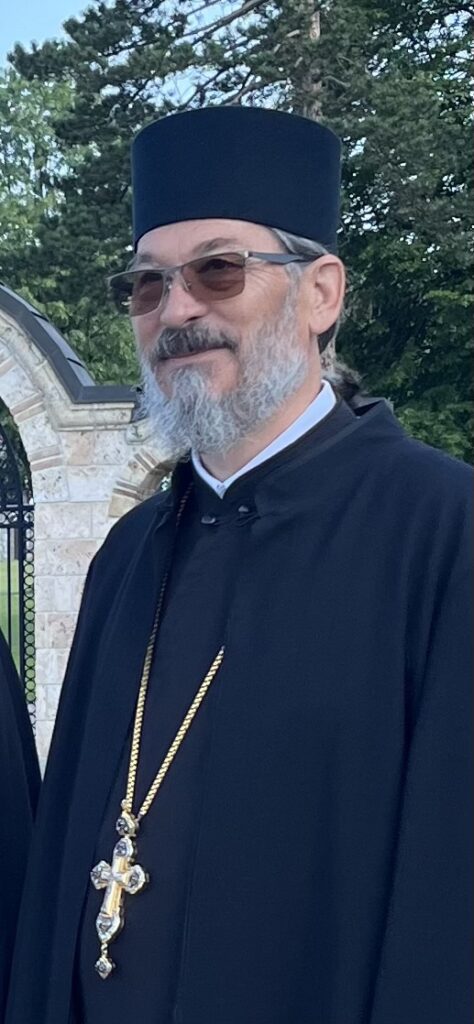
Written by: Bishop David of Dremvitsa (Ninov), permanent contributor to the portal Kinonia.