“Come and see a strange wonder, far greater and more perfect than that seen in the days of Noah: there, water destroyed human nature, but here, the water of Baptism, through the One being baptized, has brought the dead to life. There, Noah built an ark from incorruptible wood, but here, Christ, the spiritual Noah, has made a bodily ark from the pure Virgin Mary. There, the dove held a dry olive branch, foretelling the fragrance of the Lord Christ, while here, the Holy Spirit descended in the form of a dove and revealed the Merciful Lord.”
With these inspired words, Saint Proclus, Archbishop of Constantinople, unveils the mystical significance of water in the light of God’s Theophany at the Jordan. Indeed, holy Feast of Theophany is like a second flood-a flood of God’s love and grace for the spiritual salvation of mankind and its return to paradise. Christ enlightens the world and pours His divine light into our souls. He comes to John the Forerunner to be baptized in the River Jordan, having reached thirty years of age, fulfilling the Law in all things and revealing to mankind that He is God in the flesh, the true Son of God, consubstantial with the Father-the One whom the prophets longingly foretold and whose coming they proclaimed with great expectation.
Even though Christ had no sin, being without sin, He came to the Jordan to be baptized by John to fulfill the Law in all things.
The Great Blessing of the Waters
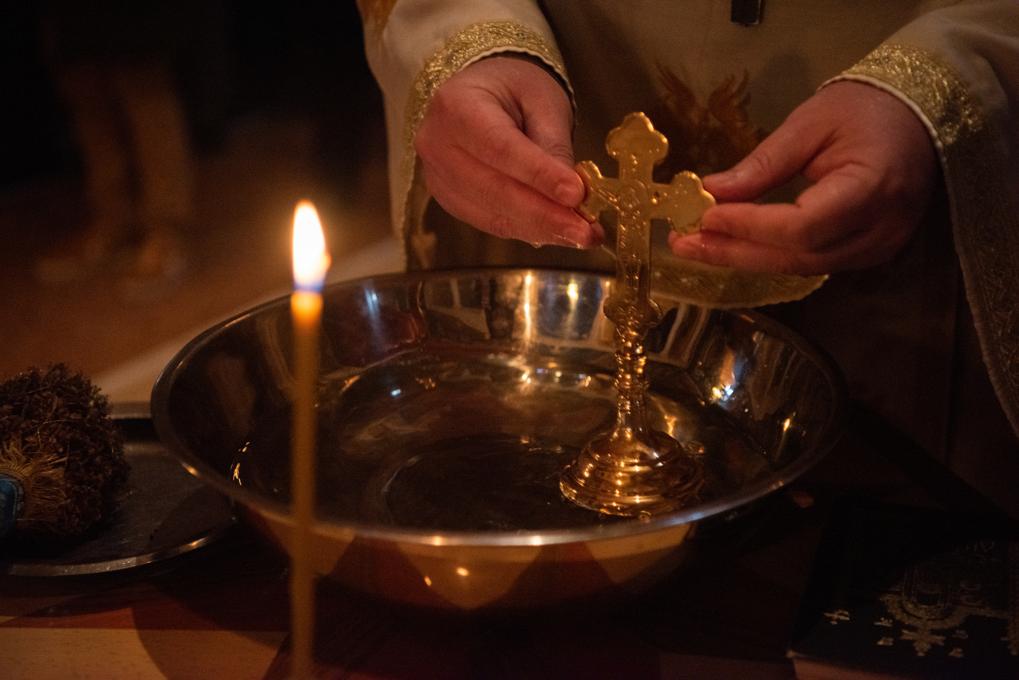
One of the central liturgical elements of Theophany Eve is the Great Blessing of the Waters. At the beginning of this sacred service, special troparia are chanted:
- “The voice of the Lord is upon the waters, crying aloud and saying: Come, all of you, receive the Spirit of wisdom, the Spirit of understanding, the Spirit of the fear of God, Christ who has appeared.”
- “Today the nature of the waters is sanctified, and the Jordan is divided, stopping its flow as it beholds the Lord being baptized.”
- “As a man You came to the river, O Christ the King, and in Your goodness, You hastened to receive the baptism of a servant from the hand of the Forerunner for the sake of our sins, O Lover of mankind.”
These troparia introduce us to the profound symbolism of water and its sanctification, which we reflect upon during the Feast of Theophany.
The Spiritual and Theological Symbolism of Water
Water, as a source, a force, and a symbol of life, has been regarded with deep reverence since ancient times. Saint Cyril of Jerusalem describes water as the greatest element of nature, while Saint Hippolytus of Rome states:
“Water symbolizes the beginning of creation, for through the action of the Holy Spirit upon the waters, all creatures were brought into existence through the Son of God, from non-being into being, from nothingness into existence.” (cf. Gen. 1:2-6; Col. 1:16; 2 Pet. 3:6 ).
Water was an essential part of creation-a symbol of life, birth, and renewal. From both cosmological and anthropological perspectives, water has been regarded as a symbol and bearer of life, as nothing can live without it.
In the Old Testament, water is seen as a symbol of spiritual life (cf. Jer. 2:13) and a source of life, while in the New Testament, it becomes a symbol of the Spirit, the Giver of Life (cf. Rev. 21:6). Furthermore, water is often portrayed as an expression of God’s blessing upon those who believe in Him and serve Him faithfully (cf. Gen. 27:28), whereas drought is a consequence of divine punishment due to human unbelief and impiety (cf. Is. 5:13; Ezek. 4:16).
In the New Testament, water is also a symbol of God’s voice (cf. Rev. 1:15). The Apostle Peter interprets the symbol of water in a Christocentric manner, relating it to Baptism and salvation through Christ (cf. 1 Pet. 3:21)
Conclusion: The Renewal of Creation Through Christ
Through His baptism in the Jordan, Christ sanctifies the waters of the world, renewing all of creation and offering us the path to sanctification. The Feast of Theophany is a celebration of divine enlightenment, reminding us that our souls must also be purified and renewed through repentance, prayer, and participation in the divine mysteries.
Just as the Jordan ceased its flow in awe at the Lord’s presence, so too must we pause from worldly distractions and allow God’s grace to fill our hearts, leading us to true transformation and union with Him.
May this feast renew us spiritually, that we may walk as children of the light, embracing the grace of our Baptism and striving always towards holiness in Christ.
Water as a Divine Gift in the Sacred Worship of the Church
Water holds a prominent place in the sacred worship of the Church. It is used in the administration of various Holy Mysteries as well as in many liturgical rites. The sanctification of water is not performed magically, but rather through the invocation of the Holy Spirit. In his renowned work On the Holy Spirit, Saint Basil the Great speaks about the mystery of the sanctification of water, stating:
“Water, after the invocation of the Holy Spirit and His presence within it, is no longer ordinary water, but has become sanctified.”
Thus, water acquires a salvific significance, becoming living water, bringing sanctification and renewal. It becomes the water of life because it contains within it the grace and power of the Holy Spirit, the power of sanctification. The Holy Spirit Himself is present in it, making the water holy and ready to sanctify and renew those who partake of it for blessing. Through the power of God, sanctified water receives spiritual grace and active divine energy. Outside of the Triune God, water remains a mere natural element, powerless to provide any form of spiritual rebirth to man.
The Symbolism and Grace of Sanctified Water
Regarding the significance of water, its symbolism, and the divine grace it carries, Saint Cyril of Jerusalem teaches in his Catechetical lectures:
“If someone wishes to understand why grace is given specifically through water and not through another element, let him read the Holy Scriptures, and it will become clear to him. Water is something exceedingly great and the finest of the four elements of the world. Heaven is the dwelling place of angels, and the heavens are formed from water; the earth is the dwelling place of men, and it too is made from water. Before the six-day creation of what was to come into being, the Spirit of God moved over the waters (Gen. 1:2). Water is the beginning of the world, and the beginning of the Gospel is the Jordan. Israel was freed from Pharaoh through the sea, and the world is granted freedom from sin through Baptism in water by the Word of God (Eph. 5:26). Wherever God establishes a covenant, water is present. After the flood, a covenant was made with Noah; the covenant with Israel was given on Mount Sinai, but through water, scarlet wool, and hyssop (Heb. 9:19). Elijah was taken up, but not without water: first, he crossed the Jordan, and only then was he lifted into heaven (2 Kings 2:11). The High Priest would first wash himself before offering incense; Aaron was washed before becoming High Priest (Lev. 8:6). For how could one intercede for others without first being purified with water? This is why the laver in the Tabernacle was a symbol of Baptism (Exod. 30:28).”
The Great Sanctification of Water
Water that is sanctified through the Great Blessing of the Waters is often referred to as “Great Agiasma”, meaning “Great Holy Water.” At the conclusion of the service, a hymn was chanted, offering a spiritual exhortation to the faithful who will partake of the sanctified water for blessing and purification:
“Let us, the faithful, praise the greatness of God’s goodness towards us: for, becoming man for our sins, He is cleansed in the Jordan as we are. He alone is pure and incorrupt, yet He sanctifies me and the waters, crushing the heads of the invisible serpents in the water. Therefore, brethren, let us draw water with joy, for to those who draw it with faith, the grace of the Spirit is invisibly bestowed by Christ our God, the Saviour of our souls.”
Thus, sanctified water is not just a material element, but a divine gift filled with God’s presence and grace, serving as a means for spiritual renewal and sanctification for all who partake of it with faith.
Written by: Catechist Branislav Ilić,
Editor of the missionary portal “Kinonia”