We continue with the seventh verse:
And as they departed, Jesus began to speak to the crowds concerning John: What did you go out into the wilderness to see? A reed shaken by the wind?
Saint Ephrem the Syrian explains why the Lord waited for the disciples of Saint John the Baptist to depart, writing: “In the presence of John’s disciples He did not wish to proclaim his glory, lest they should think that Jesus, by praising their teacher before them, was exalting Himself.” Saint John Chrysostom continues this line of thought and says that after instructing John’s disciples, Jesus then proceeded to instruct the people themselves who had observed all of this. He speaks as follows: “For John’s disciples the Saviour did what was necessary, and they returned convinced that He is the Messiah through the miracles performed before them. Now it was necessary to administer the appropriate remedy to the people as well. John’s disciples did not doubt their teacher in the least; however, among the people, to whom the purpose of the disciples’ visit was unknown, their question could give rise to many improper doubts. Many might have thought and said: Has the one who bore witness to Jesus with such power now changed his mind and begun to doubt? Is Jesus, then, or is He not, the One who is to come? Is John speaking in this way with the intention of opposing Jesus? Or has imprisonment taught him to be more cautious? Was his former testimony concerning Jesus in vain? Since, therefore, the people could have surrendered themselves to many such doubts, see how the Lord heals their weakness and dispels these doubts… It is as though He were saying: Why did you leave your homes and cities and go out into the wilderness? Was it to see a pitiable and irresolute man? That is impossible. Your great zeal and the universal haste with which you went out into the wilderness do not testify to that. Such a multitude of people, inhabitants of so many cities, would not have rushed with such eagerness to the River Jordan had they not expected to see there a great, wondrous, and firm-as-stone man. You went out to see not a reed shaken by the wind. Such are frivolous and changeable people who say one thing today and another tomorrow, who take no firm stand on anything.”
Saint Gregory the Dialogist offers a particularly interesting explanation of what the Lord Jesus Christ means by a reed. These are his words: “A reed bends as soon as the wind blows from the opposite direction. What does a reed signify, if not the soul of a person who is wholly carnal? Such is the man who inclines now to one side, now to the other, according to favourable or unfavourable circumstances. For when the wind of praise blows upon him from human lips, he becomes joyful and proud and wholly inclines toward praise. But if the wind of ill will blows from the same direction whence the wind of praise had previously come, he immediately inclines to the opposite side, to the side of hatred. John was not a reed shaken by the wind, for neither did praise incite him to flattery, nor did rejection by others make him harsh. Prosperity could not make him proud, nor could adversity plunge him into despondency. Therefore, John, whom no change of circumstances could divert from his path, was not a reed shaken by the wind. From this, beloved brethren, let us learn not to be reeds shaken by the wind. Let us strengthen our souls amid the winds of the pagans, so that our hearts may remain steadfast. Let no ill temper provoke us to anger, and let no praise incline us towards the expression of vain joy. Let prosperity not drive us to pride, and let misfortunes not disturb us, so that, being established upon the rock of faith, we may never change along with transient things.” Personally, I found his explanation especially appealing, for it turns out that today we all live, as it were, in fields of reeds. However, Saint John of Kronstadt warns us that we ourselves are very often such reeds, bent under the onslaught of passions. Here are the words of this great saint of the Church of the previous century: “Oh, if only we were all so firm on the path of salvation! All of us are like reeds shaken by the wind; we bend in every direction from the slightest breeze of passion. Anything can lead us away from the right path and extinguish our convictions regarding the truth and the unchangeability of the rules of our faith and Christian morality.”
Here is also the following, the eighth verse:
But what did you go out to see? A man clothed in soft garments? Indeed, those who wear soft clothing are in kings’ houses.
Saint Gregory the Dialogist draws attention to something very much present today: “Let no one therefore think that there is supposedly no sin in luxury and in the desire for precious clothing; for if there were no sin in this, the Lord would not have praised John for the roughness of his attire. If there were no fault in this, then the Apostle Peter would not have restrained women from the desire for costly clothing, saying: not with the braiding of hair, or the wearing of gold, or the putting on of fine apparel (1 Pet. 3:3). Consider now how much more blameworthy it is for a man to desire what the Apostle strove to forbid even to women. Yet the account of John—that he did not clothe himself in soft garments—can also be understood in another way. John did not wear soft garments because he did not accommodate himself to the life of sinful people, but because he attacked such a life with great force, saying: Brood of vipers, who warned you to flee from the wrath to come? (Luke 3:7). Therefore Solomon also says: The words of the wise are as goads, and as nails firmly fixed (Eccles. 12:11). The words of the wise are likened to nails and scourges because they do not know how to indulge transgressors, but rather pierce them.”
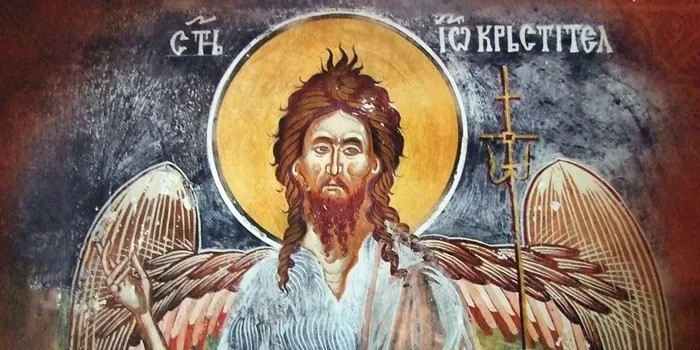
Saint John Chrysostom describes John’s ascetic struggle and shows how easy it would in fact have been for him to possess all wealth and luxury, had he so desired. This is how he explains it: “That John was not enslaved to luxury is shown by his clothing, the wilderness, and the prison. Had he wished to wear costly garments, he would not have lived in the wilderness and in prison, but in royal palaces. Had John merely kept silent, he could have attained the highest honours. For if Herod respected him even while John reproached him and was in chains, all the more would he have flattered him had John remained silent.”
The ninth and tenth verses:
But what did you go out to see? A prophet? Yes, I tell you, and more than a prophet. For this is he of whom it is written: Behold, I send My messenger before Your face, who will prepare Your way before You.
Saint John Chrysostom explains that the Lord Jesus deliberately employs this particular order of words, first speaking of John’s calling as a prophet and then stating that Saint John is even greater than that. This is his interpretation: “After first adducing the testimony of the Jews, Jesus adds also the testimony of the prophet. Or rather, to speak more precisely: first, He presents the opinion of the Jews, which, as the testimony of adversaries, should constitute the strongest proof; second, He points to John’s manner of life; third, He delivers His own judgment; and fourth, He calls him a prophet, in order to silence them completely.”
Euthymius Zigabenus also explains what is meant by the expression “more than a prophet.” He writes as follows: “More than a prophet, because John saw with his own eyes the One of whom he prophesied, whereas the prophets before him were only able to announce Him.” Saint Ephrem the Syrian reveals wherein John’s dignity lies and writes: “If John is greater than the prophets, how great then must his honour be, if the prophetic ministry represents the highest rank among the human race? Was it perhaps because of the priesthood (which belonged to John through his father from birth) that the Lord called him so? Yet there were many other priests as well. Or was it perhaps solely because of prophecy that He called him so? But there were many prophets too…” Thus we see that Saint John the Forerunner was not so highly honoured by the Lord Himself because of his lineage, but because of his virtue.
Verse 11:
Truly, I say to you, among those born of women there has not arisen anyone greater than John the Baptist; yet the least in the Kingdom of Heaven is greater than he.
Saint Isidore of Pelusium explains why Saint John is greater than all those born of women in the following way: “John is greater than those born of women because, while still in his mother’s womb, he prophesied and, hidden in darkness, recognized the Light that was coming.” Saint John Chrysostom continues this thought and explains it in greater detail as follows: “That is to say, no woman has given birth to a man greater than John. To be convinced of John’s dignity, this saying alone is sufficient; but if you wish to know him from his very deeds, picture to yourself his table, his manner of life, and the loftiness of his spirit. Truly, John lived as though in heaven, having risen above all the needs of nature, walking an extraordinary path and spending all his time in spiritual hymns and prayers. By withdrawing from human society, he conversed unceasingly only with God. He saw no one like himself, nor did he associate with any of them; he was not nourished with milk, he had neither bed, nor roof, nor stores of food, nor any of the other things that people make use of, and yet he was at once gentle and austere. For example, listen to the gentleness with which John speaks to his disciples, the courage with which he addresses the Jewish people, and the boldness with which he confronts the king. This is why the Saviour said of him: ‘Among those born of women there has not arisen anyone greater than John the Baptist.’ But lest such great praise should give rise to an improper opinion of John among the Jews, who regarded him as superior to Christ, the Lord also removes this danger. … Great harm would have resulted if Christ’s words had given the Jews an occasion to honour John more than Jesus. Therefore Christ corrects this as well, saying: ‘yet the least in the Kingdom of Heaven is greater than he,’ that is, the One who is lesser in age and in the estimation of many. For indeed they said of Jesus that He eats and drinks (Matt. 11:19), and also: ‘Is this not the carpenter’s son?’ (Matt. 13:55), and everywhere they belittled Him.”
Saint Anthony the Great offers a particularly interesting explanation of these words and, among other things, says that they refer both to the Lord and to the Apostle John the Theologian: “First, the Lord is lesser when considered according to bodily age. Six months after John’s conception, Jesus took up His dwelling in the womb of the Ever-Virgin, clothing Himself in her flesh. ‘The least in the Kingdom of Heaven is greater than John the Forerunner,’ that is, greater than the Forerunner is John the Theologian, the son of thunder. John the Forerunner, even when he was commanded to do so, touched the crown of Jesus’ head with great fear, not daring to touch Him who had taken flesh upon Himself. But John the Theologian, being higher than all, boldly reclined upon the Lord’s breast at the Mystical Supper. And thus he lay upon the most holy and divine breast, as the Gospel relates, when they asked who would betray Him and when Peter signalled to him, wishing to know who would betray the Lord. Neither the Mother who bore Him, nor Joseph who was regarded as His father, nor John the Baptist, nor an Angel, nor an Archangel—no one else dared to touch the awesome breast of the incarnate God the Logos. Yet John lay upon it, embracing it as a father embraces his son. And therefore he was filled with God the Logos and filled the universe with thunder: ‘In the beginning was the Logos (the Word), and the Logos was with God, and the Logos was God’ (John 1:1). John the Forerunner merely saw the divine Holy Spirit flying in the form of a dove descending upon the Lord when He was baptized in the flesh; but John the Theologian received Him from heaven in the form of fire upon his head, together with the other disciples, at Pentecost, as the great Luke testifies in the Acts of the Apostles.”
Adapted for the contemporary reader on the basis of patristic interpretations by Stanoje Stanković.