We continue with Chapter Fifteen, verses 3–5:
But He answered and said to them, “Why do you also transgress the commandment of God because of your tradition? For God commanded, saying, ‘Honour your father and your mother’; and, ‘He who speaks evil of father or mother, let him surely die.’ But you say, ‘Whoever says to his father or his mother, “Whatever benefit you might have received from me has been dedicated as an offering…”’”
St. Ambrose of Milan writes about the sinfulness of this Pharisaic practice, while also offering practical guidance on how to cultivate the virtue of almsgiving and where this ascetical endeavour should begin. Ambrose states:
“If insulting one’s parents, according to the divine commandment, is punished by death (Exod. 21:17), how much more grievous is the sin of allowing one’s parents to suffer from hunger, which is worse than death itself. The Lord restrains those vain actions performed merely for the eyes of others. In order to receive praise from men, many offer to the Church what they have taken from their own families, whereas works of mercy must begin with one’s obligations towards those closest to oneself. First give to your parents; then give also to the poor; and give to the priest from the earthly goods with which you abound, so that through him you may acquire the spiritual treasures that you lack, for he who shows honour shall himself be honored. Consider that the priest, by receiving, is also giving; he does not receive as one who is poor, but as one who intends to return far more. Give to the poor so that you may bring them consolation, and so that you yourself, by sharing your possessions with them, may experience peace. Holy Scripture teaches both the honouring of parents and, when parents stand in the way of a God-fearing soul’s devotion, the necessity of leaving them.”
This final observation concerning discernment in honoring one’s parents is of particular importance, for today, among many believers, there exists the conviction that parents must be obeyed under all circumstances and that only such unquestioning obedience is pleasing to God. Here, however, the saint presents a clear criterion by which such obedience should be measured.
St. John Chrysostom points to the profound wisdom manifested in Christ’s response to the Pharisees. The Lord Jesus does not directly accuse the elders who established these traditions, knowing that such an approach would cause the Pharisees to cease listening altogether. The saint explains how the Pharisaic teaching that Christ now exposes functioned in practice:
“What does Christ do? He neither begins by rebuking nor by defending the conduct of His disciples. Instead, in response to the accusations of the Pharisees, He answers with an accusation of His own, exposing their audacity and demonstrating that one who is guilty of grave offenses ought not to concern himself so anxiously with the insignificant failings of others. ‘It is you who deserve to be accused,’ Jesus is saying, ‘yet you accuse others.’ … Christ chooses another course: while appearing to rebuke those who have approached Him, He is in fact addressing those who established these very regulations. He does not even mention the elders; rather, by directing His accusation against one group, He simultaneously overturns the authority of the other, showing that they are doubly guilty—both for disobeying God and for seeking to please men. It is as though Christ were saying: ‘Your custom of submitting unquestioningly to the elders has become your ruin.’ … The Lord did not say, ‘because of the tradition of the elders,’ but ‘because of your tradition.’ The scribes and Pharisees wished to demonstrate that the disciples of Jesus had transgressed the Law; Christ, on the contrary, shows that they themselves are the transgressors, while His disciples are not subject to their accusations. A human ordinance does not constitute divine law (and this is precisely why Christ calls it a tradition); it is merely a separate ruling devised by lawless men. … If, says Christ, those who dishonor their parents merely by their words are subject to punishment, then how much more will you be punished, who dishonor them by your deeds—not only acting in this manner yourselves, but also teaching others to do the same.”
The Next Three Verses:
“Hypocrites! Well did Isaiah prophesy about you, saying: ‘This people draw near to Me with their mouth, and honour Me with their lips, but their heart is far from Me. And in vain they worship Me, teaching as doctrines the commandments of men.’”
St. Justin of Ćelije writes here about the destructive nature of hypocrisy, a vice that is always close at hand and against which we must remain vigilant, in accordance with the counsel of the Lord Jesus Himself. Why is hypocrisy so spiritually devastating? St. Justin explains:
“Isaiah’s prophecy confirms Christ’s judgment concerning the Pharisees. What Isaiah condemned in former times, Christ now condemns: the replacement of the commandments of God with the teachings of men. Hypocrisy possesses the accursed capacity to divide, fragment, and shatter the integrity of the human person, thereby rendering one incapable of believing in God, serving God, and cooperating with God with all one’s heart, all one’s mind, all one’s understanding, and all one’s strength. The hypocrite substitutes man for God and human teaching for divine teaching. Yet such teaching is in vain, as the Prophet Isaiah declares and as the Lord Christ confirms. Human teaching is futile and spiritually destructive because it lacks the life-giving and resurrecting power that belongs to God alone and can be bestowed only by Him. This is why the Saviour justifies His disciples for not observing those human traditions that are ultimately without value. It is futile to devote one’s entire attention to eating with unwashed hands while neglecting the purification of the heart, the cleansing of the soul, and the sanctification of one’s words.”
St. John Chrysostom observes that the Lord deliberately appeals to the words of the Prophet Isaiah because He knows that the Jews, at least outwardly, profess reverence for the prophets:
“Having shown that those who disregard the Law of God have no right to accuse others of violating the traditions of the elders, Christ proceeds to demonstrate the same truth from the words of the prophet. Continuing His stern rebuke—as He so often does—He supports His teaching with the testimony of Scripture, thereby revealing His complete harmony with God. … What Christ condemns now had already been condemned by Isaiah, namely, the Jews’ contempt for the commandments of God. ‘In vain they worship Me,’ while displaying great zeal for their own regulations, ‘teaching as doctrines the commandments of men.’ Therefore, the disciples are entirely justified in not observing such regulations. Having thus struck the Jews with decisive force and strengthened His rebuke both by His own judgment and by the testimony of the prophet, the Lord ceases addressing them, since they were no longer capable of correction. Instead, He turns His discourse to the multitude in order to impart a teaching that is lofty, profound, and full of divine wisdom. Seizing this opportunity, Christ goes even further and completely overturns the regulations concerning food. But observe when He does so: after cleansing the leper, after demonstrating His authority over the Sabbath, after revealing Himself as Lord of both land and sea, after establishing the Law in its fullness, after forgiving sins, after raising the dead, and after providing abundant evidence of His divinity. Only then does He begin to speak concerning food.”
Verses 10–11:
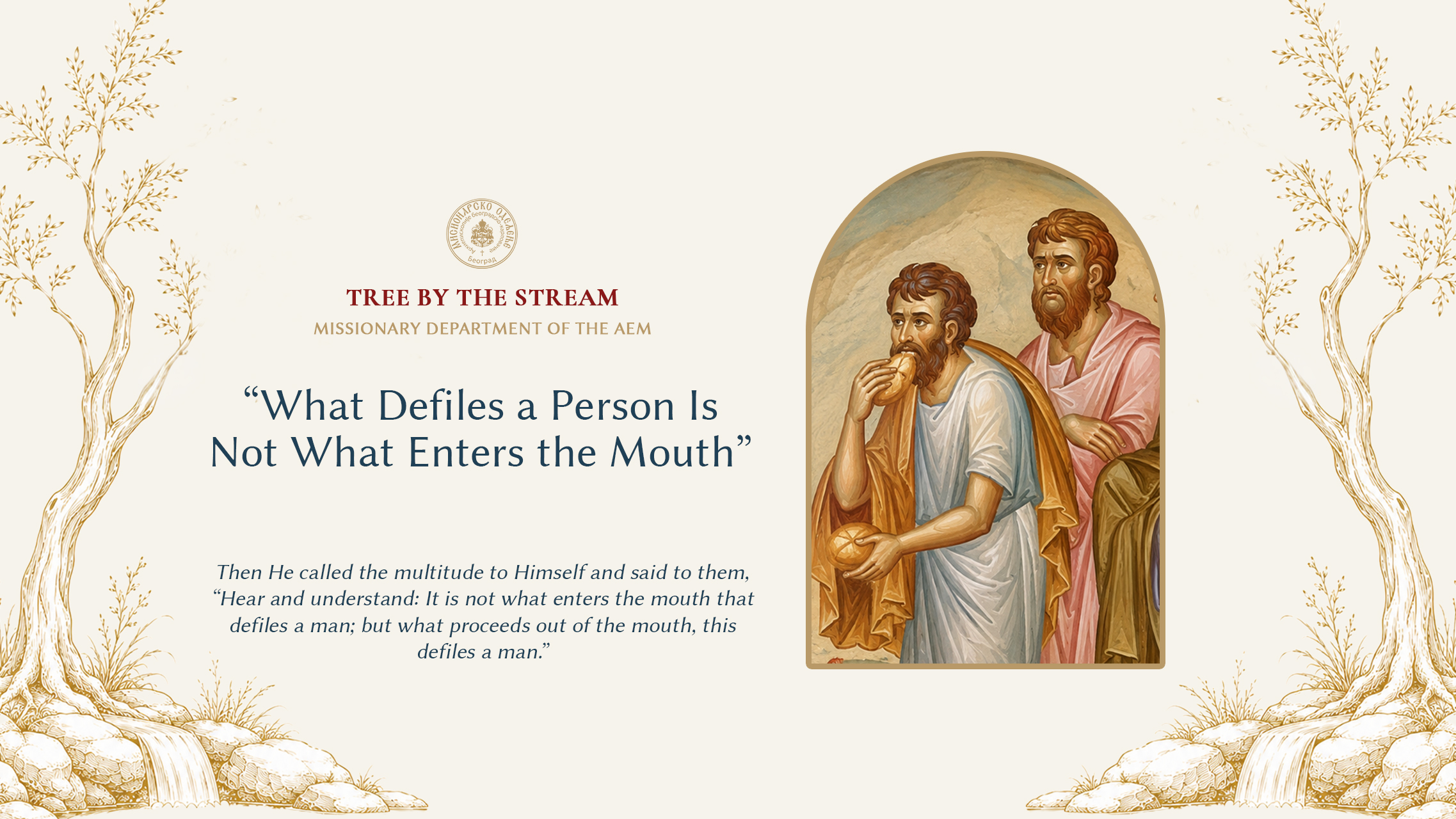
Then He called the multitude to Himself and said to them, “Hear and understand: It is not what enters the mouth that defiles a man; but what proceeds out of the mouth, this defiles a man.”
Blessed Jerome addresses here a question that naturally arises in the mind of a careful reader of Holy Scripture:
“The Jewish people, who took pride in being the inheritance of God, regarded as unclean those foods that were commonly consumed by all other peoples. Yet it is not what enters the mouth that defiles a person, but what proceeds from the mouth. An attentive reader may ask: ‘If what enters the mouth does not defile a person, why then do we refrain from eating food that has been offered to idols? The Apostle also writes: “You cannot drink the cup of the Lord and the cup of demons” (1 Cor. 10:21).’ These words teach us that although food, like every work of God’s creation, is in itself pure, the invocation of idols and demons renders it unclean.”
St. Luke of Crimea explains the entire purpose of the Old Testament commandment concerning clean and unclean foods, while at the same time providing an excellent explanation as to why this commandment lost its former significance in the New Testament era:
“These words became a stumbling block for the Pharisees because they were entirely unexpected and deeply unsettling to them. They knew that Moses had forbidden the Israelites from eating certain kinds of food, namely, unclean animals. How, then, could the Lord now declare that this understanding was no longer valid—that nothing is inherently unclean and that nothing entering the mouth can defile a person? Such teaching scandalized them. Yet they remained silent, for immediately beforehand the Lord had severely rebuked them for their hypocrisy in replacing the Law of God with their own traditions. … What does it mean that the Lord abolished the Mosaic law concerning unclean animals? Why did He declare that nothing is unclean and that nothing entering the mouth defiles a person? This indeed represents the abrogation of the ancient law. Why did the Lord abolish this commandment? Because everything created by God is equally good and pure. But why, then, had this ancient law been established in the first place? To answer this, one must understand the purpose for which the law concerning clean and unclean foods was originally given. By prohibiting certain foods that the Gentiles freely consumed, the Lord set His chosen people apart from all the pagan nations. This distinction was intended to impress upon their minds that they were a people separated from those who did not know God, a chosen nation called to a different way of life and therefore not permitted to do everything practiced by the Gentiles. This was the first reason. The second reason was that, in ancient times, there were no prescribed fasts for the entire nation, as there are in the Christian Church today. Fasting was observed only by those who had dedicated themselves in a special way to the service of God: the Pharisees and their disciples fasted, as did the disciples of John the Baptist. They even asked the Lord Jesus why they fasted while His disciples did not. Thus, only those specially devoted to God practiced fasting, whereas the people as a whole did not. Consequently, the distinction between clean and unclean foods functioned as a substitute for a universal communal fast. … The Lord abolished this aspect of the Mosaic Law, just as He abolished many other prescriptions that possessed only a temporary significance. Sacrificial offerings likewise came to an end, together with numerous other regulations whose purpose was limited to a particular stage in salvation history. Just as children require rules that lose their relevance in adulthood, so too many of the ordinances of the Old Testament became unnecessary in Christianity. The Mosaic Law was given to a people who were not yet capable of grasping the fullness of the highest truth or receiving the supreme Revelation. The Old Testament Law gradually prepared humanity for the acceptance of the Gospel.”
Adapted for the contemporary reader based on the interpretations of the Holy Fathers by Stanoje Stanković.