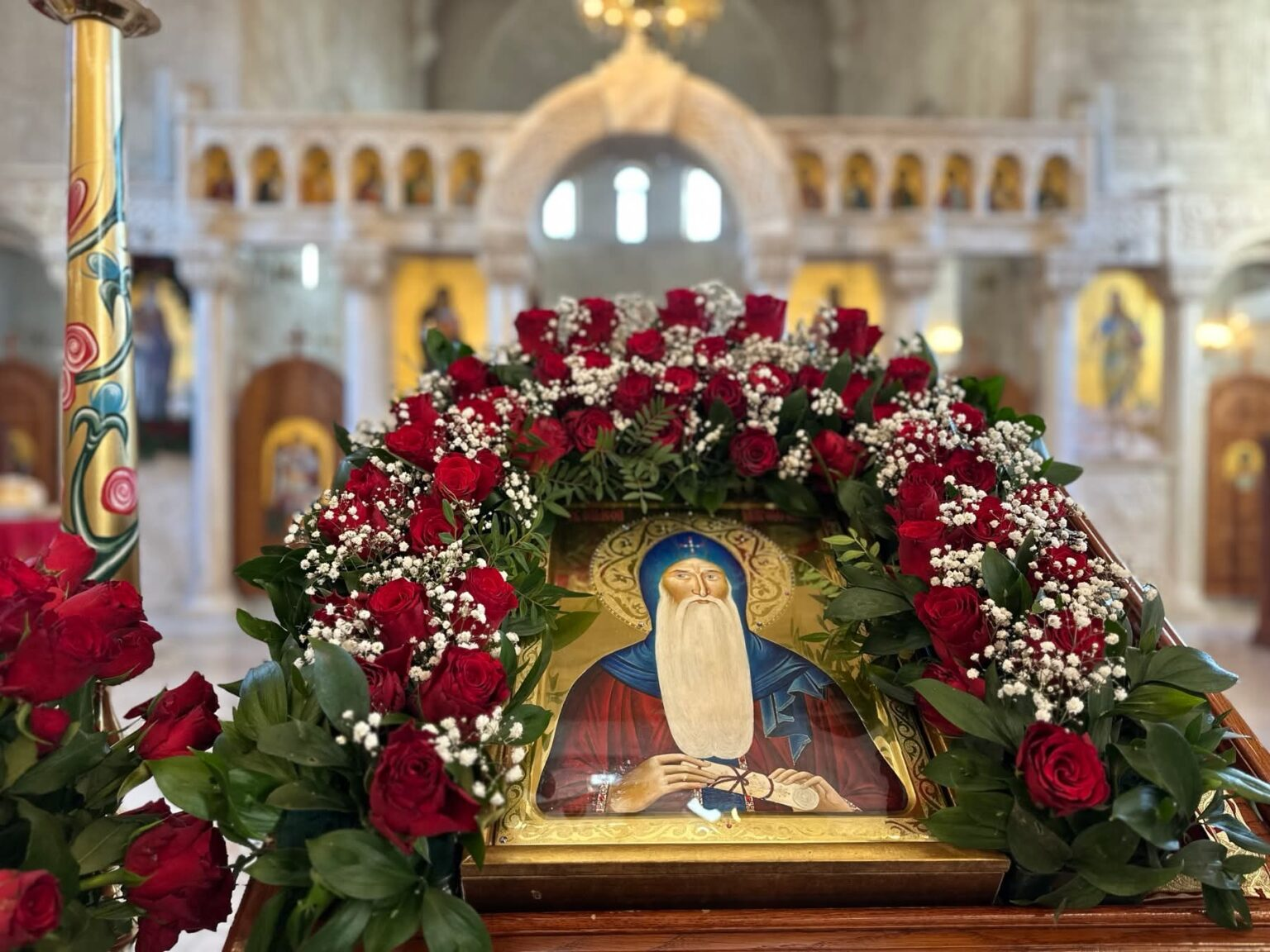
This text was published on the portal Kinonia in the column “From the Editor’s Pen” on March 1, 2026.
The venerable and God-bearing father Symeon the Myrrh-Streaming was a great ruler of the Serbian people, the unifier of the Serbian lands, the founder of the independent Serbian state, a defender of Orthodoxy, and a destroyer of heresies. After establishing the state and confirming the Orthodox faith within it, following the example of his son Sava, he received the monastic tonsure in the Monastery of Studenica in 1195, receiving the name Symeon. After two years of monastic struggle and life in Studenica, the venerable Symeon went to Mount Athos, where he first settled in the Monastery of Vatopedi together with his youngest son Sava. Father and son built six chapels: to the Saviour, to the Holy Unmercenaries, to Saint George, to Saint Theodore, to the Forerunner, and to Saint Nicholas.
When briefly considering the entire life and work of the Grand Prince Stefan Nemanja, two fields of his activity can clearly be discerned in which he left precious traces. The first field of his activity was the strengthening and organization of the Serbian state, by which he is remembered as the progenitor of the holy dynasty of the Nemanjić family. The second important field of his work, both as a ruler and later as a monk, was his care for the Church and for the Orthodox faith. He shone forth as a humble monk, as a great founder of endowments, and as a God-bearing saint whose example many follow even to this day. These two aspects of the life and work of the venerable Symeon are inseparable; they intertwine with one another and represent the most authentic image of our past, both state and ecclesiastical.
Stefan the First-Crowned, Nemanja’s middle son, writes about his father’s struggle in the following words: “Like the prophet Elijah of old, who rose against the shameless priests, he exposed their impiety: some he burned, others he punished with various penalties, others he expelled from his realm; and their houses and all their possessions he gathered and distributed to the lepers and the poor.”
Waging war for the fatherland and for the faith of Christ, Grand Prince Nemanja manifested both severity and mercy at the same time. He persecuted heresy and injustice, while protecting the true faith and those who suffered for Christ. Therefore Saint Sava says of him that he was “truly wondrous and formidable.”
In one place Saint Sava asks how he should describe the venerable Symeon: “Should I call him a ruler, and at the same time a teacher? For he strengthened and enlightened the hearts of all to hold firmly the true faith in God.” Saint Sava calls Nemanja a teacher of the right-believing Christians. In this way he reveals that this strict educator unwillingly prepared even him to set out on the path of seeking God on Mount Athos.
This God-bearing saint is truly a remarkable person. He was born twice (as Nemanja and as Symeon); baptized twice (according to the Western and the Eastern rite); imprisoned twice (by his brothers and by the Byzantine emperor); he bore two weapons (the sword and the cross); he possessed two forms of kinship (a father to his son and a son to his father); he was buried twice (in Hilandar and in Studenica); and he became and remained an indivisible holy unity with Sava, both in this world and in the world to come.
Holy Scripture begins with the words: “In the beginning God created the heaven and the earth…” (Gen. 1:1). Nemanja’s beginning is also ours, and it reads: “Seek first the Kingdom of God and His righteousness, and all these things shall be added unto you” (Matt. 6:33). All the storms, winds, and earthquakes of this world could neither destroy nor overthrow him. He ruled for a full thirty-eight years as the spiritual shepherd of his people, “leading” them first of all to the Lord, like the great prophet and God-seer Moses of old, guiding a new people, as a “second Israel,” the chosen Serbian people.
Stefan Nemanja—Venerable Symeon the Myrrh-Streaming—served his people and his land in a twofold capacity: as a pragmatic ruler and Grand Prince, and as a great ascetic, monk, and man of prayer. As a statesman, he served his people not by placing himself above them, but by standing before them—when a ruler becomes a teacher to his people and an example to rulers in every age. While many rulers leave behind debts and divisions, the Serbian Grand Prince left to his people magnificent endowments for spiritual gatherings and prayerful remembrance. And everything that, through the synergy of divine help, royal wisdom, and Christian virtues, Stefan Nemanja liberated, renewed, united, gathered, strengthened, gained, raised, and defended, he entrusted to his heirs, to his people and to the fatherland—only then peacefully and serenely entrusting himself into the hands of his Church and of Christ.
He surrounded and safeguarded the land with great shrines as its best protection and enclosure—shrines that still stand to this day. He built magnificent churches and monasteries: the Church of Saint Nicholas in Toplica; the Church of the Most Holy Theotokos on the river Kosanica; the Monastery of Đurđevi Stupovi near Ras; the Church of Saint Nicholas in Končul; and Studenica on Vlah Stari—the “mother of all Serbian churches and monasteries.”
All of the above, based on the rich hagiography of the venerable Symeon the Myrrh-Streaming, is in its own way supported and confirmed by the hymnography in the liturgical service dedicated to the commemoration of the venerable Symeon. The church poet emphasizes the saint’s vigilance in faith, zeal in service, and sacrificial love manifested in every field of his activity.
“Rejoice, O blessed Symeon, for you were illumined by the knowledge of the Trinity, and you enlightened your people through faith in the Trinity; by the power of the Cross you overthrew the soul-destroying heresies and you built holy churches; you taught that the Incarnate Son, equal to the Father and the Spirit, is to be glorified; you were adorned with righteousness and mercy and enriched with every holy work; and now, rejoicing with the bodiless powers, you stand before Christ and pray with them that He may send down great mercy upon our souls.” (First sticheron at Lord, I have cried).
“O wondrous venerable father Symeon, you came to the Athonite mountain and became an example to its hermits; in old age you struggled with youthful zeal through abstinence and prayers, renewing the field of your soul and watering it with the rain of tears; you sowed and cultivated within it the grace of the Trinity and became its splendid dwelling place; therefore your tomb is now filled with the Holy Spirit, pouring forth the myrrh of healing, while around it your people stand, O blessed father, asking you to pray to Christ God that He may grant us great mercy.” (Third sticheron at Lord, I have cried).
“On the festive day of the sacred commemoration of you, O blessed father Symeon, the faithful gather with love and glorify you worthily, saying: Rejoice, for at the beginning you uprooted from your people the thorns of heresy and planted the vine of the Orthodox faith; rejoice, champion of the Trinity, founder of churches, benefactor of the poor; rejoice, model of humility and teacher of detachment, for you rejected the passing kingdom and lived the ascetic life in the wilderness; now you rejoice with the angels before Christ and pray with them to Him for us, that our souls may be saved.” (Glory at Lord, I have cried).
“Enlightened by divine grace, O father, you illumined your people who were held in the darkness of heresy, and by your example you taught them to renounce the splendour of the world; therefore with love we glorify you, O wise Symeon, praise of monks.” (Exapostilarion).
WRITTEN BY: Catechist Branislav Ilić, editor of the portal Kinonia.