The text was published on the portal Kinonia in the column “From the Editor’s Pen” on February 22, 2026.
Encounters, encounters, encounters, encounters… Every day we are faced with a multitude of encounters: both great and small, necessary and unnecessary, pleasant and unpleasant. Such is the structure of our lives. And life itself has largely been given to us—but for what purpose? Precisely so that a certain encounter might take place, after which we must change and follow an entirely different path.
Since we have recently celebrated the Feast of the Meeting of the Lord, it is an appropriate time to reflect again and again on the meaning of encounter and meeting. God has brought us from non-being into being and has called us into this life so that we might come to know the truth and encounter it. Thus, the feast of encounter with God answers many of our life’s questions. Among them is the following: why do so many people around us—our relatives, our acquaintances, our loved ones—never experience this encounter with God? And even when they do experience it, it sometimes brings them no benefit, and at times it even leads to condemnation. What is the reason for this?
When our foreparents Adam and Eve sinned, God promised that the Messiah would come and set things right, accomplishing all things for humanity. Through the prophets He foretold everything: when it would happen, where it would happen, where the Messiah would be born, what His name would be, and where He should be expected. For example, the prophet Malachi wrote: “Behold, I send My messenger, and he will prepare the way before Me; and the Lord whom you seek will suddenly come to His temple, even the messenger of the covenant, in whom you delight; behold, He comes, says the Lord of hosts.”
Each of us in this transient life, which the Church’s hymnographer calls a turbulent sea of temptations, seeks happiness and longs to be happy. But is happiness found in the accumulation of transient goods, or is its meaning far deeper?
The word “happiness” (sreća) derives from the verb “to meet” (sretati), from which it becomes clear that true happiness is found in encounter with God, with all the saints, and with our neighbours. The ancient words from the Sayings of the Desert Fathers are well known: “You have seen the face of your brother—you have seen the face of your God.” Thus, to encounter one’s neighbour is to encounter God. Happiness is the meeting of one person with another in freedom and love, and the mysterious encounter between Christ and the elder Simeon the God-Receiver was true happiness. It was happiness for God, because He was received by a sinful human being, and happiness for man, because salvation had come to him. There can be no genuine and true encounter without love and freedom.
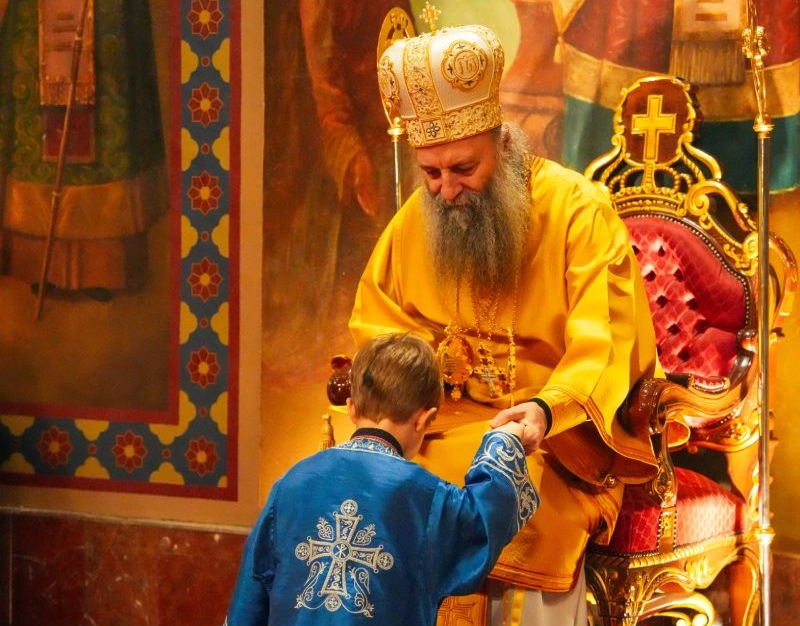
About fifteen days before the Feast of the Meeting of the Lord, I visited an educational centre that is sheltered under the prayerful patronage of Saints Cyril and Methodius, the Holy Emperor Constantine and Empress Helena, as well as the bodiless heavenly powers. Beneath the vaults of this temple of learning—which includes a kindergarten, an elementary school, and a secondary school—I experienced the joy of encounter with my friends and, above all, with brothers and sisters in the love of Christ. That encounter and the several hours of fellowship in such an inspiring environment once again led me to feel within my being that the human person is created as a being of encounter.
Truly, in such meetings and fellowship one senses the presence of God. In our lives there are no accidental encounters; everything is the work of the ineffable providence and love of God. Such encounters enrich us, strengthen us in faith, hope, and love, and return us to the meaning of life. I often tell my students during Religious Education classes that our path to God leads through another person. For this reason, encounters with our neighbours and fellowship with dear people should always be experienced as though we are standing before the face of God, for God reveals Himself in the face of every human being as a God-like creature.
Do we live our lives according to this principle? Do we also strive for that eternal encounter in which happiness is mysteriously hidden?
We live in a time that brings trials and difficulties to us from every side, but alienation is one of the greatest temptations of our age. Insensitivity towards another person, the loss of readiness to embrace with love everyone who appears on our life’s path, and the loss of willingness to listen to another person and place ourselves in the service of our neighbours—all this distances us from the true happiness that is hidden in the mystery of the twofold encounter with God and with our neighbours.
This temptation can be overcome only and exclusively through love and freedom in Christ. Standing in love and freedom, we become ready to encounter God and one another, and through this sacred meeting we are filled with true happiness—happiness that is not of this world and that does not depend on the needs and rules of the present age, but whose meaning lies in the eternal encounter for which we hope and which we experience through participation in the Divine Liturgy. May the Lord grant us spiritual sight, purity of mind, and an open heart, that we may become witnesses and participants in the encounter that gives birth to true happiness.
WRITTEN BY: Catechist Branislav Ilić, editor of the portal Kinonia.