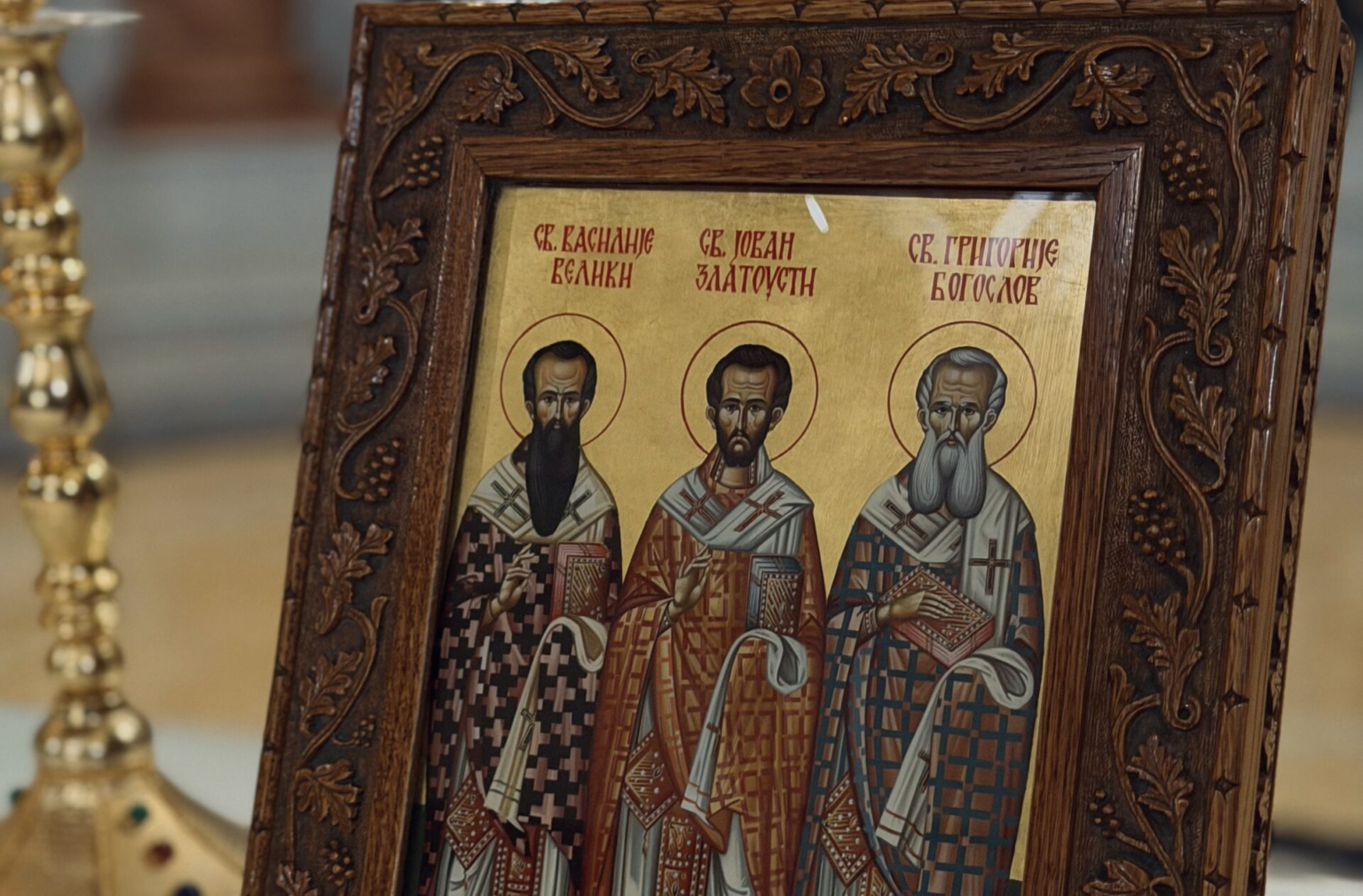
*This text was published on the portal* Kinonija *in the column “From the Editor’s Pen,” on 12 February 2026.*
At the very beginning of January, we celebrated the commemoration of Saint Basil the Great. Relatively recently, we liturgically celebrated the commemoration of Saint Gregory the Theologian, and a few days ago, the Church solemnly magnified the feast of the Translation of the Relics of Saint John Chrysostom.
Why does the Church celebrate these aforementioned hierarchs together in a conciliar manner?
During the reign of Emperor Alexios Komnenos (1081–1118), divisions and disputes arose among the faithful people in Constantinople. The cause of their contention was the veneration of the Three Holy Hierarchs and Fathers of the Church — Basil the Great, Gregory the Theologian, and John Chrysostom.
Some exalted Saint Basil above the other two, for he was, more than anyone else, capable of explaining the mysteries of the faith through words, and by his virtues he ascended to angelic heights. He was the organizer of monastic life, the leader of the Church in the struggle against heresies, and a strict and demanding pastor with regards to Christian morality; in all these respects, they claimed, there was nothing earthly in him. Hence, they argued, he was certainly more exalted than Saint John Chrysostom, who was gentle towards sinners. We know of his courage, his steadfastness, and how he himself repelled the attacks of his enemies, the Arian heretics. Saint Basil the Great adorned the Church through his countless labours and his devout life, leaving behind a rich legacy. This includes, above all, the Divine Liturgy whose Anaphora is attributed to him and which is celebrated ten times a year.
The followers of Saint John Chrysostom emphasized that the glorious Archbishop of Constantinople was admittedly less zealous than Saint Basil in combating vices and leading sinners to repentance. Yet the golden shepherd of shepherds possessed an incomparable eloquence with which he nourished the Church of God, interpreting the word of God and demonstrating how to apply and realize it in daily life more effectively and successfully than the other two saints. Saint John Chrysostom was a great preacher and orator. It is no wonder that the Church preserved for centuries the epithet “Chrysostom” (“Golden-Mouthed”), which a woman once enthusiastically bestowed upon him while listening to his sermon. When the saint preached, applause would resound, for the impulsive Greeks could not restrain themselves and would applaud the astonishing beauty and power of his words.
According to others, Saint Gregory the Theologian ought to have been honoured above the other two because of the purity and depth of his theology. Possessing the knowledge of the sciences and the education of ancient Greece, he attained, as they said, such depth in the contemplation of God that no one was able, as perfectly as he, to articulate the truth of the Holy Trinity. Saint Gregory the Theologian lived with Saint Basil the Great in perfect harmony throughout their lives, except for a brief period when Basil implored him to accept episcopal ordination. Gregory’s humble soul grieved over this and expressed open sorrow towards his friend. Saint Gregory adorned the Church through his works. Among the faithful there are none who have not heard of the Canon of the Nativity and the Canon of Pascha. One begins with the words, “Christ is born, glorify Him,” and the other, “This is the Day of Resurrection; let us be illumined, O people.” The God-inspired sacred hymnographers drew these words from the inspired homilies of Saint Gregory the Theologian.
In order to resolve these divisions in the best possible way, one night the three saints appeared in a dream to Saint John Mauropous, Metropolitan of Euchaita, first separately and then together, speaking with one voice: “As you see, all three of us are with God, and no discord or rivalry divides us. Each of us, in accordance with the circumstances and according to the inspiration received from the Holy Spirit, wrote and taught what was necessary for the salvation of humanity. Among us there is neither first, nor second, nor third; and if you invoke one of us, the other two are immediately present with him. Therefore, tell those who quarrel not to create divisions in the Church on our account, for while we were on earth we spared no effort to restore unity and concord in the world. You may therefore unite our three commemorations into one common service, according to the skill and knowledge that God has given you. Then transmit it to the faithful so that they may celebrate this feast each year. If in this way they honour us as being with God and with them, we promise that we shall intercede for their salvation in our common prayer.”
Saint John immediately revealed this vision to the people. The opposing parties were reconciled. With sober discernment, Metropolitan John selected 30 January as a fitting date for the celebration, since it would serve as a seal upon the month in which each of the three hierarchs already had his own separate commemoration (Saint Basil – 1 January; Saint Gregory – 25 January; Saint John [Translation of the Relics] – 27 January). Thus was established the feast of the Three Holy Hierarchs.
For Saint Basil the Great, Saint Gregory the Theologian, and Saint John Chrysostom, faith and the Church of Christ were not peripheral matters; they constituted the very essence, meaning, and joy of their lives. These great men shone with boundless gifts, leaving us their extraordinary works. Yet through the centuries they have been glorified not only as great hierarchs, profound ecclesiastical writers, wise teachers, and zealous shepherds of their flocks, but also as Christians who possessed an exceptional gift of mercy, regarding mercy as the medicine of the soul and mercilessness and cruelty as the gravest sin.
The Lord’s words, “You are the light of the world” (Matt. 5:14), apply to them, for even to this day these three great luminaries of the Church continue to shine upon the world without exception. For their holy lives, the Lord exalted them and set them as lamps upon a lampstand, that those who enter may see the light (cf. Luke 11:33), and their grace-filled words and teachings illumined the whole inhabited world, rendering them equal to the apostles. The best way to honour the memory of the holy fathers is to follow their example and to imitate their faith and piety.
The Three Holy Hierarchs shone forth in the fourth century as three great luminaries of the Church of Christ and illumined not only their own time but the entire world. Through their lives, ascetic struggles, and teaching, they became living witnesses of the light of Christ — a light that through the three of them shines even to our own day. This light is neither cold nor fleeting, but fervent and drenched in love, for only that which is permeated by love can endure unto eternity. Saint Basil the Great, Saint Gregory the Theologian, and Saint John Chrysostom entered the Kingdom of Heaven by the path of ascetic struggle, humility, and self-offering in love for God and for humanity. Their lives were not separated from their teaching — what they proclaimed, that they lived. For this reason their words retain their power even today, for they are sealed by personal experience of God. They clearly and divinely explained to us the mystery of the Triune God: the Father, the Son, and the Holy Spirit — one God in three Persons. They taught us that the Holy Spirit is the Spirit of life, the Spirit who gives life, who introduces us into communion with God and bears witness that God is not a distant observer of the world but Emmanuel — God with us. Though we are fragile, weak, and prone to falls, the Three Holy Hierarchs encourage us to draw nearer to God, not to abandon the path of salvation, and to strive for living communion with Him. By their example they show us that holiness is not an unattainable ideal but a calling addressed to each one of us.
“The three greatest luminaries of the Tri-solar Divinity, enlighteners of the world with the rays of divine dogmas, honey-flowing rivers of wisdom, who have watered all creation with the streams of the knowledge of God — Basil the Great and Gregory the Theologian, together with the glorious John of golden speech — let us who love their words assemble and with hymns glorify them, for they ever intercede for us before the Holy Trinity.” (Troparion of the Feast of the Three Holy Hierarchs)
In the liturgical hymns of the feast, the Church’s hymnographers emphasize that these three luminaries of the Church spread the light of the true faith throughout the entire earth despite dangers and persecutions, leaving to us, their descendants, a sacred inheritance. Through their works we too may attain supreme blessedness and eternal life in the presence of God, together with all the saints. The service to the Three Holy Hierarchs was composed by John, Bishop of Euchaita; in addition, Saint John of Damascus composed a canon, Saint Nilus Xanthopoulos composed the stichera for “Lord, I have cried,” and Saint Germanus, Patriarch of Constantinople, composed the doxastikon at the Praises. Among the rich hymnography are also two encomia in honour of the three renowned hierarchs.
Throughout the month of January we commemorate many glorious hierarchs, confessors, and ascetics, culminating in the conciliar feast in honour of the three great hierarchs. In this way the Church remembers all the saints who proclaimed the Orthodox faith by their lives and deeds. By this feast we render honour to the totality of knowledge, enlightenment, intellect, and heart that the faithful receive through the word. Ultimately, the feast of the Three Hierarchs becomes a commemoration of all the Fathers of the Church and of all examples of evangelical perfection wrought by the Holy Spirit in every time and place, so that new prophets and new apostles may arise — guides of our souls towards heaven, comforters of the people, and fiery pillars of prayer upon which the Church rests in truth.
WRITTEN BY: Catechist Branislav Ilić, Editor of the portal Kinonia