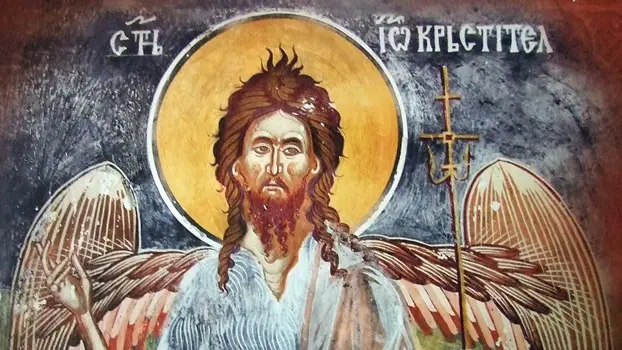
Here is verse 4 of the second chapter: Now John himself was clothed in camel’s hair, with a leather belt around his waist; and his food was locusts and wild honey.
As previously mentioned, John’s appearance and way of life resembled that of Elijah. His clothing and food testified to his strict ascetic life. Saint Nicholas of Ohrid affirms, through the example of the Holy Forerunner, the spiritual truth that all Saints primarily fulfilled the Lord’s commandments through action. The saintly bishop writes: “Like all holy people who did not live by bookish wisdom but by tested realities, so also Saint John. He learned detachment from concern for his bodily life not through reading books and listening to wise men who preach but do not demonstrate, but by actually experiencing detachment. He experienced fasting and realized that a man can live not only without all the foods he so anxiously seeks but even without bread… He used neither wine nor any strong drink. And nowhere is it said that he ever complained of hunger or thirst. He was not nourished by locusts and wild honey, but by God’s power, which came to His faithful and obedient servant through the locusts and the wild honey.”
These concluding words of Saint Nicholai, about John receiving divine strength even through such meager sustenance, are confirmed by the lives of many other Saints who fasted for long periods without food and water or consumed only minimal nourishment. Saint Athanasius the Great adds that this wild honey bore no resemblance to the honey we eat today, but was very bitter and hard to consume. Even in this, we see his ascetic struggle and triumph over human nature.
Saint Maximus of Turin provides an intriguing interpretation of John’s clothing and connects it with Christ. He equates the coarse garment with the human body, which had become coarse and heavy and which Christ took upon Himself for our salvation, while the leather belt symbolizes our feeble human nature, which Christ girded with virtue. Before Christ, human nature was unrestrained by virtue, but now it is tightly bound in virtue.
Saint John Chrysostom urges us to take the Holy Forerunner as an example in our own ascetic efforts, to strive within our ability to resemble him even in a small way: “If John, such a pure man, brighter than heaven, greater than all prophets, of whom there was none greater and who had such boldness – if he led such a harsh life, utterly disregarding all excessive pleasures, what excuse shall we have, who, after receiving so many great blessings and bearing countless sins, do not exhibit even the smallest part of his repentance, but indulge in drunkenness, gluttony, perfumes, living no better than harlots from the theatre, succumbing to every sort of softness and making ourselves easy prey for Satan?”
Here Saint John is not condemning normal care for the body, but rather luxury that subtly distances us from the ascetic spirit of Orthodoxy which we need, even in small measure, to preserve ourselves amid the world around us. The Patriarch of Constantinople reminds us that the Holy Forerunner lived this exalted life during the Old Testament period—before the grace of the Spirit descended on Pentecost and before the Lord opened to us the gates of the Heavenly Kingdom.
Blessed Theophylact of Ohrid offers a symbolic explanation of the leather belt worn by Saint John. The saint writes: “All the saints mentioned in Scripture were girded with belts around their loins, because they were always engaged in work, whereas the lazy and idle were unbelted… The saints were girded with leather because they had put to death the passions of carnal lust, as leather is obtained from the bodies of dead animals.”
In the next two verses, 5 and 6, the Apostle Matthew describes the impact that the preaching of Saint John the Baptist had on the Judean people:
Then Jerusalem, all Judea, and all the region around the Jordan went out to him, and were baptized by him in the Jordan, confessing their sins.
Such an appearance of a prophet aroused great interest among the people. Saint John Chrysostom explains that everyone wanted to hear him, even though his preaching was unexpected for many contemporaries: “Even the very manner of his preaching was strange and unique. In truth, they did not hear from John anything ordinary: not about earthly wars, battles, and victories; not about disasters, famines, and plagues; not about Babylonians and Persians, nor about the conquest of the city, nor any other commonplace topic, but about heaven, the kingdom of heaven, and torment in Gehenna. That is why the Jews, although followers of the rebels Judas and Theudas had been slain not long before in the Jordanian wilderness, went there without fear. John did not call them with the intent of those rebels, i.e., to incite the restoration of the kingdom, rebellions, and innovations, but to lead them to the Kingdom of Heaven. Therefore, he did not keep them in the wilderness to lead them after himself, but dismissed them, administering baptism and the rules of a strict life; he did his utmost to advise them to despise all earthly things and to rise constantly toward the world to come.”
Regarding the preaching of Saint John and the baptisms he administered, the Holy Fathers clearly teach that his baptism could not grant forgiveness of sins but was intended to prepare people for the preaching of the Lord Jesus Christ. According to the words of Blessed Theophylact of Ohrid: “Although they were baptized, John’s baptism did not provide forgiveness of sins. John merely preached repentance and led toward the forgiveness of sins, that is, to Christ’s baptism, through which the forgiveness of sins is obtained.”
We continue with verse 7:
But when he saw many of the Pharisees and Sadducees coming to his baptism, he said to them: Brood of vipers! Who warned you to flee from the wrath to come?
Here, for the first time since the beginning of the Gospel, we encounter the representatives of these groups in the Jewish people. These were groups that held a special status among the people. The very term “Pharisee” means “separated,” as they endeavored to distinguish themselves through their conduct and lifestyle from the rest of the people. For them, the most important aspect was external behavior and ritual or ceremonial piety, expressed through meticulous adherence to rites and numerous inherited traditions. Besides the Mosaic Law, they also accepted many oral traditions which they believed were necessary to strictly uphold the law’s rites and rulings. These traditions they referred to as the “traditions of the elders,” and they rebuked Christ and His apostles for not observing them (Matt. 15:2).
To distinguish themselves from others, they paid close attention to their clothing, wearing broad garments adorned with inscriptions from the Mosaic Law. They enjoyed great prestige among the people as great experts of the Law—which they indeed were, but only in terms of external knowledge of the Law and its provisions. In terms of their beliefs, the Pharisees were closer to the true faith than the sect of the Sadducees. The Sadducees derived their name from Zadok, the Jewish high priest who led the Sanhedrin around three hundred years before the birth of Christ.
They were thorough materialists and rationalists. From the Gospels, we learn that they denied the resurrection, angels, and eternal life. Yet despite being few in number, they held prominent positions, often occupying the role of high priest; they were concerned solely with material wealth, status, and influence which they could gain through those positions. For example, the high priest Caiaphas, who presided over Christ’s trial, belonged to the sect of the Sadducees. The Pharisees avoided high priestly offices because such roles required constant and close contact with the Romans, whom they considered impure Gentiles, and they did not want to be forced into any kind of compromise. For them, influence over the people was more precious than anything.
This scenario illustrates how people behave differently depending on the specific passions they are enslaved to. For the Sadducees, wealth, status, and power were more important than God Himself; for the Pharisees, their power and influence over the people mattered more than God. To such people, the Holy Forerunner John addressed the words: “Brood of vipers!” Both Sadducees and Pharisees could see how great an influence Saint John had over the people and how many were coming to him. This, in turn, meant that their own influence over the people was diminishing, which was deeply troubling for them.
Adapted and structured for the contemporary reader based on patristic commentary: Stanoje Stanković.