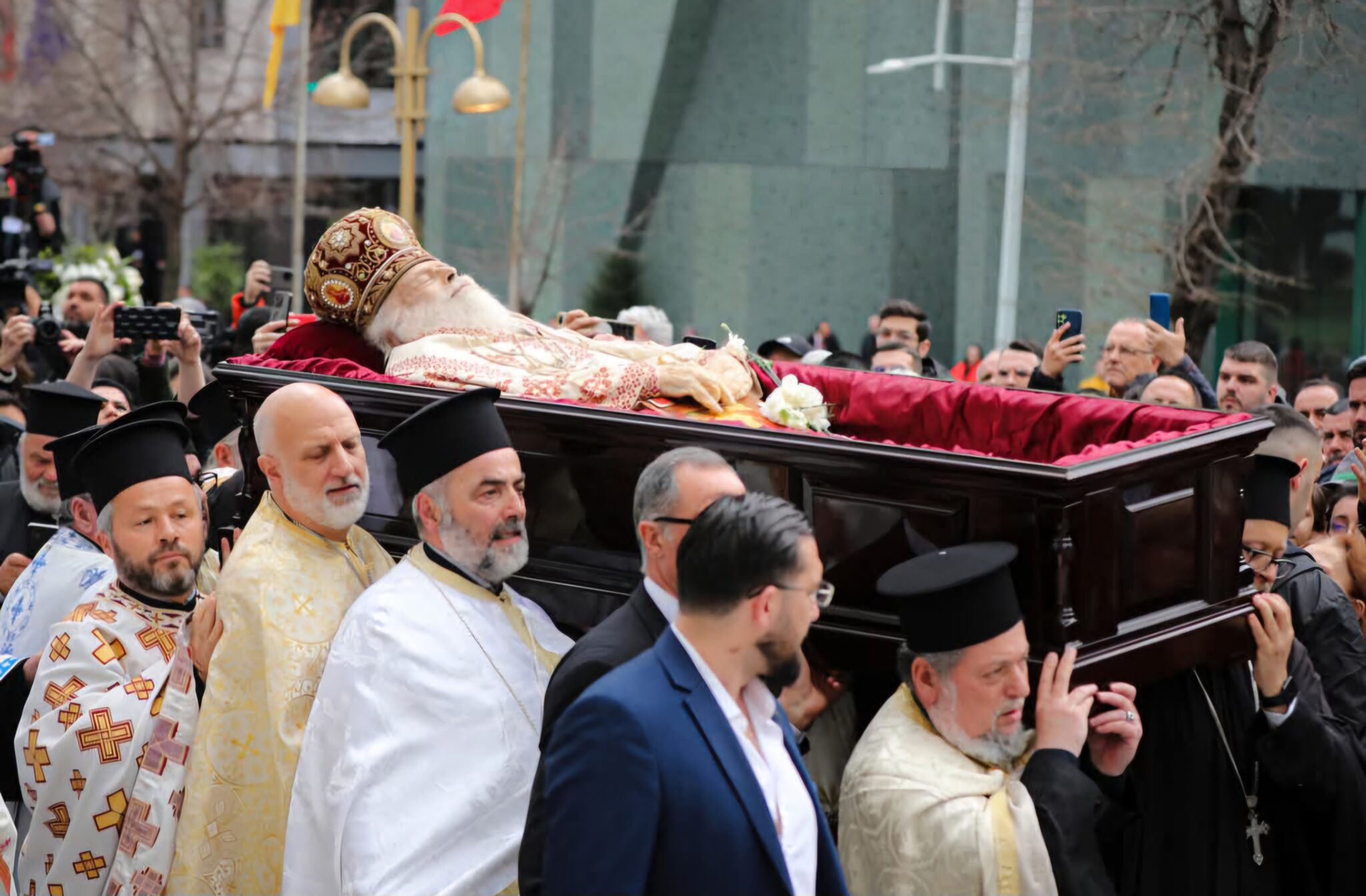
The news of the repose of His Beatitude Archbishop Anastasios of Tirana, Durrës, and All Albania resounded on the morning of January 25, 2025. The passing into eternity of this archbishop bearing the name of the Resurrection inspired in us a desire to recall encounters with Archbishop Anastasios, who, through both word and deed, proclaimed the joy of the Resurrection wherever he went.
The last week of January was marked by joyful sorrow throughout the Orthodox world—joy, for the Heavenly Jerusalem gained another worthy inhabitant, and sorrow, for we on earth lost an archbishop whose blessed example brought many closer to the love of God.
A Farewell Filled with Love and Honour
Following the news from Athens, and later from Tirana, I experienced the prayerful farewell of Archbishop Anastasios as a spiritual feast. The Greek people demonstrated great love for their hierarch, born in Piraeus, who spent most of his life far from his earthly homeland. Yet, love that knows no spatial boundaries remained alive and actively present, as evidenced by the magnificent farewell given to the Albanian archbishop.
The day after his repose, the Divine Liturgy was celebrated in the Annunciation Cathedral of the Metropolis of Athens. Metropolitan Hierotheos of Nafpaktos, vice-president of the Holy Synod of the Church of Greece, presided over the Liturgy near the body of the departed archbishop. After the Liturgy, Archbishop Ieronymos of Athens and All Greece led a memorial service for the repose of Archbishop Anastasios.
With the solemn sounds of the Hellenic Navy Orchestra, the body of Archbishop Anastasios was escorted from the Annunciation Cathedral in Athens with the highest state honurs, as bells tolled in mourning. His remains were then transported overland to Albania via the Kakavia border crossing.
A Profound and Emotional Farewell
Numerous Greek media outlets captured profound and moving scenes of the journey. Along the route of the funeral procession, hierarchs, clergy, and countless faithful gathered at various locations, offering their final respects. At Kakavia, the Church of Greece officially handed over the body of Archbishop Anastasios to the Church of Albania, where an honur guard from the 8th Infantry Brigade of Ioannina paid tribute to one of the most respected hierarchs of Orthodoxy.
The funeral service in Tirana was attended by primates and representatives of all local Orthodox Churches. Eulogies were delivered by:
- Ecumenical Patriarch Bartholomew
- Metropolitan John of Korça, Locum Tenens of the Archiepiscopal Throne
- Pastor Pilay, General Secretary of the World Council of Churches
- Albanian Prime Minister Edi Rama
- Greek Prime Minister Kyriakos Mitsotakis
A Life Dedicated to the Resurrection of the Church
In his funeral oration, Ecumenical Patriarch Bartholomew paid tribute to Archbishop Anastasios’ life work in reviving the Orthodox Church in Albania, after decades of state-imposed atheism.
“A sad duty has gathered us today in the Albanian capital—the fall of a great pillar of the Orthodox Church in Albania,” the Ecumenical Patriarch declared, expressing his deep sorrow at the loss of this eminent hierarch.
He praised Archbishop Anastasios’ tireless efforts in restoring the Church from its ruins, calling him “a servant of the miracle of the Church’s resurrection from the dead.”
Patriarch Bartholomew recalled Archbishop Anastasios’ commitment to the salvation and revival of the Albanian Orthodox flock, referencing his earlier years as the titular Metropolitan of Androusa, and his extensive missionary work in Africa.
He also reflected on Archbishop Anastasios’ roots in Lefkada and Kefalonia, emphasizing his lifelong devotion to theology and missionary service. Recalling the miraculous moment of his birth, the Patriarch stated:
“Doctors advised his mother to terminate the pregnancy due to serious risks, but she chose life, and thus brought into the world this remarkable hierarch.”
A Final Resting Place in the Church He Rebuilt
The final wish of Archbishop Anastasios was to be laid to rest in the church he built and dedicated to the Resurrection of Christ.
Thus, his tomb, placed in a special crypt beneath the Tirana Cathedral, became a symbol of his eternal bond with the Albanian people and the Church he resurrected from the ashes.
Memory Eternal!
May the Lord grant eternal rest to His faithful servant, Archbishop Anastasios, whose name and deeds will forever be associated with the Resurrection—of both souls and the Church.
Blessed Archbishop Anastasios (Yannoulatos): A Life of Faith and Mission
Blessed Archbishop Anastasios of Tirana, Durrës, and All Albania was born on November 4, 1929, in Piraeus, Greece. He was a professor of religious history (1972–1992) and Dean of the Faculty of Theology at the University of Athens (1983–1986). Later, he was named Professor Emeritus of the same university. He held honorary doctorates from 19 universities and theological faculties across Greece, the USA, Cyprus, Romania, Georgia, Albania, Italy, and beyond. He was a corresponding member of the Academy of Athens (1993–2005) and an honorary member from 2006 onwards.
His profound study of world religions led him on extensive travels to regions where faith played a central role in society. He deeply studied the religiosity of the Global South, particularly in Africa and Asia, where he actively engaged in missionary work. He authored extensive studies on African religiosity in countries such as Uganda, Kenya, and Tanzania. Additionally, he wrote on Confucianism, Taoism, Hinduism, and Buddhism, conducting field research in India, Korea, Thailand, Sri Lanka, Japan, China, Nigeria, Lebanon, Syria, and Egypt.
A dedicated linguist, Archbishop Anastasios made efforts to learn the languages of the people he lived among. For example, he acquired fluency in Swahili during his time in East Africa. Besides Modern and Ancient Greek, he spoke English, French, and German and had working knowledge of Latin, Italian, Spanish, and Albanian.
His Role in Orthodox Missions and Theological Research
Archbishop Anastasios was deeply involved in Orthodox missionary efforts. Some of his notable roles included:
- General Secretary of the Executive Board for World Missions of Syndesmos, the Pan-Orthodox Youth Organization (1958–1961).
- Vice President of Syndesmos (1964–1977).
- Founder and President of the Inter-Orthodox Missionary Center “Porefthentes” (since 1961).
- Member of the International Commission on Missionary Studies of the World Council of Churches (WCC) (1963–1969).
- Secretary for Missionary Research and Relations with Orthodox Churches at the WCC (1969–1971).
- Founder and Director of the Centre for Missionary Studies at the University of Athens (1971–1974).
A prolific writer, he authored 24 books, covering African religious traditions, theological essays, and missionary history. Some of his most influential works include:
- Islam: A General Overview (which saw 16 editions and was translated into Serbian).
- History of Living Religions.
- Facing the World.
- Missionary Work in the Manner of Christ.
- To the Ends of the Earth.
- Coexistence.
- The Cross and Resurrection in Albania.
He published over 200 studies and articles in dogmatic and pastoral theology, translated into 17 languages.
His Clerical and Episcopal Journey
- Ordained as a deacon in 1960 and as a priest (archimandrite) in 1964.
- In 1972, he was elected titular bishop of Androusa while serving as General Director of Apostoliki Diakonia, the publishing house of the Church of Greece (1972–1992).
- He was appointed Locum Tenens of the Irinoupolis Diocese in East Africa (1981–1990).
- In 1991, he became Metropolitan of Androusa and Patriarchal Exarch of Albania, before being elected as Archbishop of Tirana, Durrës, and All Albania in June 1992—a position he held until his repose.
The Rebirth of the Albanian Orthodox Church
Upon his arrival in Albania, Archbishop Anastasios found a completely devastated Orthodox Church. For 23 years, under Enver Hoxha’s militant atheism, all forms of religious expression were banned. Although freedom of religious expression was formally reinstated, the nineties were a dramatic and challenging period for the Albanian Orthodox Community.
The challenges were overwhelming:
- No bishops had survived the state persecution.
- Only 15 elderly and ailing priests remained.
- Churches had been demolished or converted into secular buildings.
- There were no financial resources for rebuilding.
- Extreme poverty affected the entire population, and the state provided no support for religious communities.
A Biblical Rebirth from Ruins
In biblical terms, the Church of Albania had become a wasteland. Yet, through the tireless work of Archbishop Anastasios, the Orthodox Church in Albania was reborn from the ashes.
With faith, resilience, and an unwavering missionary spirit, he oversaw the restoration of churches, the training of clergy, and the revival of Orthodox education. His legacy remains a testament to faith, perseverance, and Christ-centred love, making him one of the greatest modern Orthodox missionaries and hierarchs.
May his memory be eternal!
Archbishop Anastasios: A Legacy of Faith and Mission
To address the dire needs of the Orthodox Church in Albania, the Ecumenical Patriarchate appointed one of the most distinguished figures in the Orthodox world—Professor Dr. Anastasios (Yannoulatos). At the time, he was the Metropolitan of Androussa, Moderator of the Commission on World Mission and Evangelism of the World Council of Churches, and Locum Tenens of the Archdiocese for Kenya, Uganda, and Tanzania.
Upon his arrival in Albania, Archbishop Anastasios encountered a spiritual and material wasteland, a grim remnant of the militant atheist regime. However, he was undaunted by the challenges and determined to restore and revitalize the Orthodox Church. His first steps included:
- Opening a theological seminary to educate and train new clergy.
- Restoring Church properties that had been confiscated by the communist regime.
- Building new churches, many of which he dedicated to the Resurrection of Christ.
While focusing on material reconstruction, he was equally committed to the spiritual renewal of the Albanian Orthodox faithful.
A Rich Spiritual and Cultural Legacy
Archbishop Anastasios founded numerous institutions to support the Church’s mission and foster religious education and communication. Among these were:
- The publication of religious newspapers and magazines, including Ngjallja, the youth magazines Gëzohu and Kambanat, the scientific journal Kërkim, and the bulletin News from Orthodoxy in Albania.
- The establishment of an Orthodox radio station, expanding the Church’s reach.
- Printing houses, iconography workshops, and wood carving studios, ensuring the artistic and theological preservation of Orthodox heritage.
An Enduring Missionary Legacy
The missionary work of Archbishop Anastasios extended beyond Albania, having already left a profound impact in Africa before his arrival in the Balkans. His contributions included:
- The construction of numerous churches and monasteries.
- The establishment of theological schools.
- The founding of hospitals and medical centres, providing humanitarian aid to those in need.
- A network of charitable institutions, reflecting his deep commitment to Christian philanthropy.
His remarkable pastoral ministry in Albania from 1990 until his repose demands not only a series of articles but also serious scholarly studies that would document his extraordinary efforts in rebuilding the Lord’s spiritual vineyard.
A Prayer for a Great Hierarch
May the Lord grant His heavenly Kingdom to the newly departed Archbishop Anastasios.
May we strive to follow the luminous examples set by such great shepherds of the Church.
Αιωνία η μνήμη – Eternal Memory!
Written by: Catechist Branislav Ilić, Editor of the “Kinonia” Portal