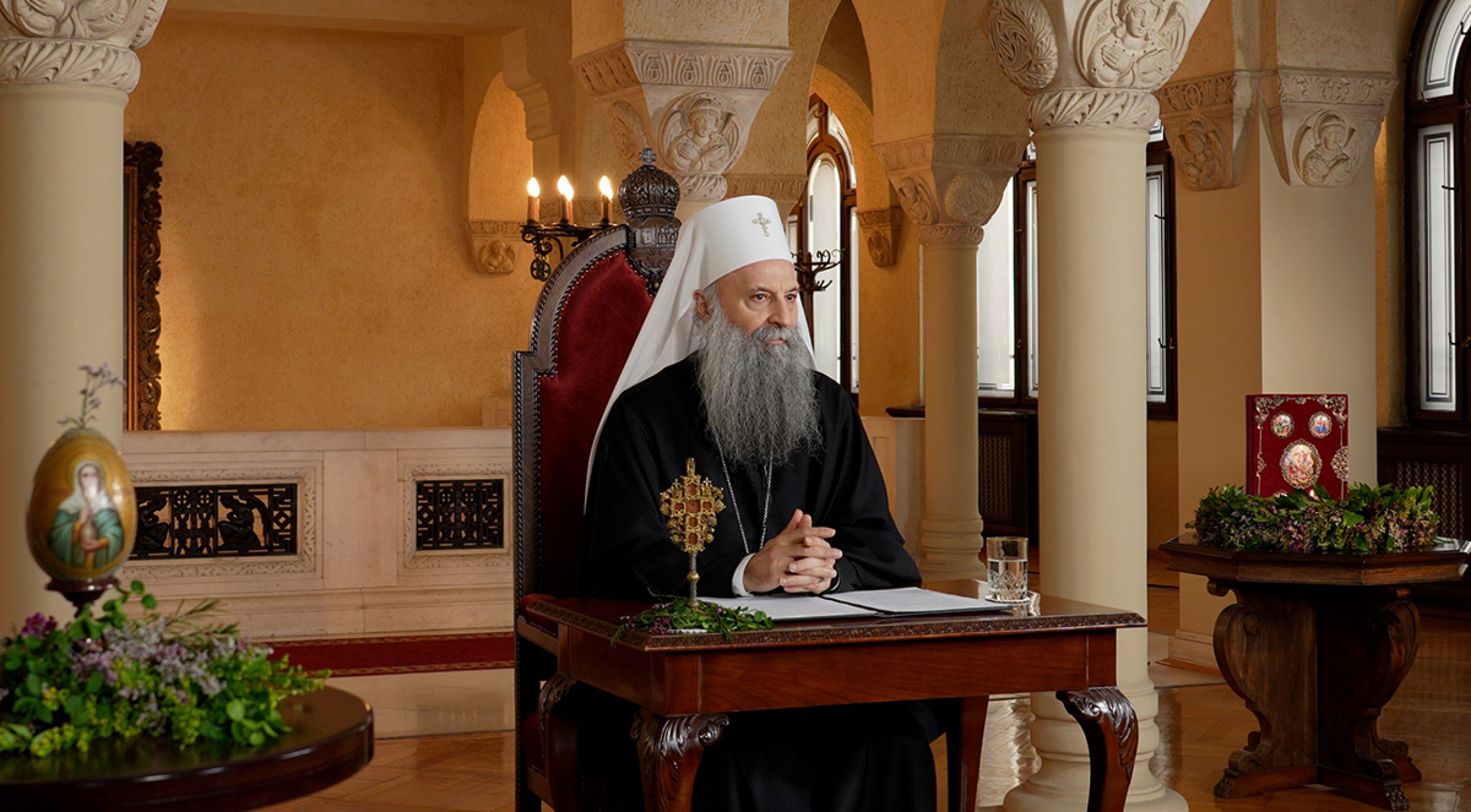
THE SERBIAN ORTHODOX CHURCH TO HER SPIRITUAL CHILDREN AT PASCHA 2026
PORFIRIJE
Orthodox Archbishop of Peć, Metropolitan of Belgrade and Karlovci, and Serbian Patriarch, together with all the hierarchs of the Serbian Orthodox Church – to the clergy, monastics, and all the sons and daughters of our holy Church: grace, mercy, and peace from God the Father, and our Lord Jesus Christ, and the Holy Spirit, with the joyful Paschal greeting:
CHRIST IS RISEN!
The Word of God, the Gospel of Christ, the spiritual treasury of the Church of God, from which, by the right hand of the Lord, the seeds of eternal life are sown into our hearts, is filled with truths hidden in God. These are not abstract ideas, but words that are fulfilled in our lives. Among them are also the words by which the Lord warns us of times when peace will be taken from the earth (Rev. 6:3–4), when we shall hear of wars and rumurs of wars, for nation will rise against nation and kingdom against kingdom (Matt. 24:6–7; Luke 21:9–10).
These words, which to many generations of our ancestors sounded as a warning of future times and their announcement, have today become the reality in which we live. We see unrest among nations, we hear reports of wars, and we are witnesses to wars, suffering, and uncertainty in the world. While the skies are torn by the trails of missiles of death, and in the ears of a troubled humanity resound the sirens announcing destruction and suffering, from the depths of Christ’s empty tomb is heard the voice of the angel, a witness of the Resurrection, who proclaims to the myrrh-bearing women, and through them to all of us, as well as to every human being: “Do not be afraid!” (Matt. 28:5). It is not only the angel who dispels fear from us, but, before and above him, He who has abolished the fear of death, which is the essential cause of every fear. By trampling down death by death, the risen God-man Christ also addresses us with the words: “Do not be afraid!” (Matt. 28:10). Thus encouraged, we know that the terrifying events of our days are not the final word of history, but a call to vigilance and steadfastness in God.
What do the signs of the times tell us today? Although Christ’s empty tomb has overcome the power of every tomb and has shown that no grave has the final word, in history and in our present reality there still exist living tombs filled with hatred, selfishness, passions, and self-love. We recognize them in the darkened human hearts, in unbounded selfishness, in media that spread falsehood, in wars, and in all our passions and sins against the love of God. These tombs, despite Christ’s Resurrection, continually distort and disfigure life itself as the priceless gift of God’s love.
One of the most striking examples of such a reality is the fact that the consequences of today’s global crisis are, regrettably, measured by cold economic indicators, by the standards of the merchants of the earth (cf. Rev. 18:3)—financial losses, disruptions, and declines in stock exchanges and markets—while in the deep shadow of such calculations remain human tragedies: the death of the innocent, the suffering of children, and the misery of millions. Precisely such a perspective, in which material gain is placed above human life, has not only led to wars and injustices—it is also reinforced by them. This is a great defeat for us as human beings.
The world in which we live is becoming increasingly unstable, and humanity ever more fearful. Systems of values are being deliberately and forcibly altered, and in the direction of anti-values. Promises and agreements, once solemnly signed, are being brutally trampled. The awareness of such betrayals gives rise to violence and ever greater divisions among nations, while political and cultural gaps continue to deepen. Upon the ruins of dying civilizations, spiritual uncertainty and the loss of meaning flourish.
Why, in such universal darkness, is the Risen Lord neither recognized nor seen? The answer to this question has already been given in the Gospel itself. Even His own disciples and immediate followers were not able to recognize the risen God-man Christ at once. Mary Magdalene saw Him near the empty Tomb, not knowing that it was the Lord Jesus Christ (John 20:14). She recognized Him when He addressed her by name: “Mary!” (John 20:16). Likewise, the apostles Luke and Cleopas did not recognize the Lord (Luke 24:16) on the road to Emmaus, but only “in the breaking of the bread” (Luke 24:35), when the Lord communicated them.
Nor did the apostles recognize the risen Lord when He stood on the shore of the Sea of Tiberias, observing their unsuccessful fishing (John 21:4). They recognized Him only after, obeying His command, they cast the net on the right side of the boat and caught a multitude of fish (John 21:6–7). They recognized Him in the miracle as the spiritual space in which the power of God and human faith meet and embrace.
Nor did the apostles recognize Him even in their Sunday gatherings behind closed doors: once, in fear, they thought they saw a spirit (Luke 24:37), and another time, on the basis of the wounds from the nails and the spear, they believed in the reality of the Resurrection and His presence (John 20:27). The risen God-man Christ was among them, yet they were not able to recognize Him immediately by the common human means known to them until then. The mystery of not recognizing Him did not remain merely an event from the distant past, tied to the first days after the Saviour’s Resurrection; it is a reality that endures to this very day.
In order to see and recognize the Risen Lord, ordinary human sight is not sufficient. What is required is a new, spiritual perception—a gift from above, an experience of the Holy Spirit. In other words, it is necessary for us to enter into a relationship with Him so that He may grant us the knowledge of Himself. Thus, to His disciples Luke and Cleopas, the Lord ultimately opened their eyes and granted them spiritual sight so that they might recognize Him (Luke 24:31), while to the apostles gathered behind closed doors He opened their minds so that they might understand the prophecies of the Holy Scriptures (Luke 24:45) and all that was to befall the Lord.
The fact that the Risen Christ was not immediately recognized does not mean that He was hiding from people, but rather that He respected their freedom. In this way He once again showed and confirmed what was given to man from the beginning: the freedom to choose God and, from that freedom, to believe in Him and serve Him. Christ did not impose upon the human race the truth of the Resurrection, but placed it within the realm of faith. What would have happened if the Risen One had appeared to Pilate, stood before the Sanhedrin, or manifested Himself in the marketplaces of Jerusalem? In that case, the proclamation of the Resurrection would have become a demonstration of force and power, and the truth itself would, in a certain sense, have been imposed. Instead, the Lord appears to those who love Him, thereby establishing new ways of recognizing and embracing true life.
What, then, are these ways, and how can contemporary man experience this reality? Contemporary man experiences this reality above all as a personal encounter with God, in which the Risen One calls him by name, just as He revealed Himself to Mary Magdalene. Without a personal life of prayer and ascetic struggle, it is neither possible to know nor to recognize God. He experiences it further as communion, as participation in the Eucharistic assembly, by partaking of the Body and Blood of Christ in the Holy Liturgy. Like Luke and Cleopas, man receives from the very hands of Christ—through the hands of the clergy—the Bread that comes down from heaven and gives life to the world. Finally, he experiences it as obedience to the word of God and as the experience of miracle, like the apostles who, on the Sea of Tiberias, understood that everything in the Risen God-man is wondrous and salvific.
Miracles are not merely extraordinary events nor only great divine interventions in history. The parting of the Red Sea was indeed a miracle. But it is also a miracle when we forgive and break the cycle of hatred. This is not merely a moral demand nor an abstract principle. It is a manifestation of the Resurrection and a participation in its power and glory. Revenge is crucifixion without resurrection, while unforgiveness and hatred are death and a tomb sealed forever. Therefore, the Resurrection is not merely an event belonging to the past, but a reality into which we enter each time we forgive, when we do not return blow for blow, and when we recognize a brother in our enemy. Then we choose life instead of death. Then the stone is rolled away from our own inner tomb.
We also recognize the Lord in every instance of human suffering—which, unfortunately, abounds—as well as in every poor, rejected, and despised person, encountering Him in them through active love. For the Risen Lord Jesus Christ said: “As you did it to one of the least of these my brethren, you did it to Me” (Matt. 25:40). It is precisely here that it becomes evident that faith in the Resurrection is not merely an inner conviction, but a force that shapes our relationship towards others, towards every human being as an icon of God.
Today, with particular attention and care, we pray for our brothers and sisters in Kosovo and Metohija, the centuries-old historical cradle and spiritual centre of the Serbian people, sharing directly with them all the trials and challenges they continually face, and strengthening them to persevere in their witness and to remain faithful to their Church, their faith, and themselves. At the same time, we remind each and every one among us that it is not enough to love Kosovo and Metohija merely in words. This love must be translated into deeds, into concrete care for our neighbours, into fraternal works of mercy, into concern for children and for all those in need. It must not be allowed that, in the consciousness of our people, the Serbs of Kosovo and Metohija be portrayed as an obstacle or hindrance to some supposedly better future life. Without them, without our Serbs of Kosovo and Metohija, without the Serbs of Old Serbia, there is no better life for any of us. We are all one people and one Body in Christ, united by the same faith and the same suffering, but also by the same hope and the same glorification.
From such faith and such communion, beloved spiritual children, let us enter into the joy of the Resurrection and say: “Having beheld the Resurrection of Christ, let us worship the holy Lord Jesus, the only Sinless One,” and with the Holy Apostle Paul let us exclaim: “O death, where is thy sting? O Hades, where is thy victory?” (1 Cor. 15:55). Comforted by the power and grace of this great and solemn Feast of feasts, the new and holy Pascha, the great and blameless Pascha, the mystical Pascha which has opened to us the gates of Paradise, let us embrace one another and say even to those who hate us: Brothers! And at the end, which is also the beginning, let us sing in one accord: Christ is risen from the dead, trampling down death by death, and upon those in the tombs bestowing life.
We greet you all with the all-victorious and all-joyful greeting:
CHRIST IS RISEN!
Given at the Serbian Patriarchate in Belgrade, at Pascha 2026.
Your intercessors in prayer before the Risen Christ:
Archbishop of Peć, Metropolitan of Belgrade and Karlovci, and Serbian Patriarch
PORFIRIJE
Archbishop of Sarajevo and Srebrenica and Metropolitan of Dabar-Bosnia CHRYSOSTOM
Archbishop of Cetinje and Metropolitan of Montenegro and the Littoral JOANIKIJE
Archbishop of Sirmium and Metropolitan of Srem BASIL
Archbishop and Metropolitan of Banja Luka JEFREM
Archbishop and Metropolitan of Buda LUKIJAN
Archbishop of Vršac and Metropolitan of Banat NIKANOR
Archbishop of New Gračanica and Chicago and Metropolitan of Midwestern America LONGIN
Archbishop of Toronto and Metropolitan of Canada MITROPHAN
Archbishop of Novi Sad and Metropolitan of Bačka IRINEJ
Archbishop of Stockholm and Metropolitan of Scandinavia DOSITEJ
Archbishop and Metropolitan of Žiča JUSTIN
Archbishop and Metropolitan of Vranje PAHOMIJE
Archbishop of Kragujevac and Metropolitan of Šumadija JOVAN
Archbishop of Požarevac and Metropolitan of Braničevo IGNJATIJE
Archbishop and Metropolitan of Zvornik-Tuzla FOTIJE
Archbishop and Metropolitan of Mileševa ATANASIJE
Archbishop of Düsseldorf and Berlin and Metropolitan of Germany GRIGORIJE
Archbishop and Metropolitan of Raška and Prizren TEODOSIJE
Archbishop and Metropolitan of Kruševac DAVID
Archbishop of Romuliana and Zaječar and Metropolitan of Timok ILARION
Archbishop and Metropolitan of Niš ARSENIJE
Archbishop of Sydney and Wellington and Metropolitan of Australia and New Zealand SILUAN
Archbishop of Zadar and Šibenik and Metropolitan of Dalmatia NIKODIM
Archbishop and Metropolitan of Budimlje and Nikšić METODIJE
Archbishop of Mostar and Trebinje and Metropolitan of Zahumlje-Herzegovina and the Littoral DIMITRIJE
Archbishop of Los Angeles and Western America MAXIM
Archbishop of Upper Karlovac GERASIM
Bishop of Washington, New York and Eastern America IRINEJ
Bishop of Pakrac and Slavonia JOVAN
Bishop of Switzerland ANDREJ
Bishop of Bihać and Petrovac SERGIJE
Bishop of Buenos Aires and South and Central America KIRILO
Bishop of Osijek-Polje and Baranja HERUVIM
Bishop of Valjevo ISIHJE
Bishop of Šabac JEROTEJ
Bishop of Paris and Western Europe JUSTIN
Bishop of London and Great Britain and Ireland NEKTARIJE
Retired Bishop of Zvornik-Tuzla VASILIJE
Retired Bishop of Canada GEORGIJE
Retired Bishop of Central Europe KONSTANTIN
Retired Bishop of Slavonia SAVA
Retired Bishop of Mileševa FILARET
Retired Bishop of Niš JOVAN
Vicar Bishop of Remesiana STEFAN
Vicar Bishop of Mohács DAMASKIN
Vicar Bishop of Marča SAVA
Vicar Bishop of Hum JOVAN
Vicar Bishop of Hvosno ALEKSEJ
Vicar Bishop of Novo Brdo ILARION
Vicar Bishop of Lipljan DOSITEJ
Vicar Bishop of Toplica PETAR
Vicar Bishop of Jenopolje NIKON
Vicar Bishop of Moravica TIHON
Vicar Bishop of Dioclea PAJSIJE
Vicar Bishop of Kostajnica SERAFIM
Published: 10 April 2026
Source: spc.rs