We now begin our commentary on the fourteenth chapter of the Gospel according to Matthew. The first two verses read:
“At that time the report about Jesus reached Herod the tetrarch. And he said to his servants, ‘This is John the Baptist; he has been raised from the dead, and that is why these powers are at work in him.’”
St. John Chrysostom, commenting on this passage, explains the inner turmoil and constant unrest that the murder of a righteous man produced in the soul of a hardened sinner such as Herod:
“At that time the report about Jesus reached Herod the tetrarch. King Herod, the father of Herod the tetrarch—the one who slaughtered the children of Bethlehem—had already died by this time. The Evangelist does not mention the time casually, but so that you may understand the vanity and negligence of rulers, who hear of Christ’s deeds not at the beginning but only after a long time. Such is often the case with those who possess power and greatness: when they hold something in little regard, they hear of it only belatedly.
Yet consider the greatness of virtue: Herod fears even the dead John, and in his fear he speaks correctly about the resurrection. ‘And he said to his servants: This is John the Baptist; he has been raised from the dead, and that is why these powers are at work in him.’ Do you see the magnitude of his fear? Even now he does not dare to say this publicly but speaks only to his servants.
Nevertheless, his reasoning is absurd. Although many had been raised from the dead, none had performed such miracles. It seems to me that Herod’s statement arose from a combination of vanity and fear. Indeed, a soul not governed by reason often harbours contradictory passions within itself.
According to the testimony of the Evangelist Luke, some among the people said that Christ was Elijah, or Jeremiah, or one of the ancient prophets; but Herod, as though reasoning more wisely, identified Jesus with John. Earlier, when others called Jesus John, Herod likely rejected the notion with self-assured pride, saying, ‘I have killed John.’ Therefore Mark and Luke attribute to Herod the words: ‘It is John whom I beheaded’ (Mark 6:16; Luke 9:9). Yet when the reports grew stronger, Herod himself began to repeat what the people were saying.
The Evangelist then proceeds to describe the event itself. Why did he not describe it earlier? Because the sole intention of the Evangelists was to speak of the deeds of Christ; they included nothing superfluous or unrelated to that purpose except what could contribute to it. Therefore, they would not have mentioned this event at all had it not concerned Christ and had Herod not declared that John had risen from the dead.
The Evangelist Mark adds that Herod greatly respected John, even though John openly rebuked him. Such is the power of virtue!”
St. Theophan the Recluse develops this thought further, describing Herod’s fear and the torment of his conscience:
“The report of the Lord’s deeds reached Herod as well. Immediately he concluded: ‘It is John risen from the dead’ (Matt. 14:2). Could not many other explanations have been offered for these deeds? Yet he thought of no one else but John. What directed his thoughts in that way? His conscience.
One cannot hide unconscionable deeds from conscience. Its judgment cannot be corrected or altered by anything. Herod claimed for himself the right to behead John, and others did not dispute that right. Yet conscience spoke its own word, and he could not silence it. That is why the thought of John continually forced itself upon him.
How many similar stories do we know in which conscience pursues the sinner, presenting before him the object and act of his sin so vividly that he seems to see them even externally? This demonstrates that there exists within us a voice which we must acknowledge is not truly our own. But whose voice is it, then? It is God’s. The same One from whom our nature comes is the source of that voice.
If it is God’s voice, then it must be obeyed, for the creature must not contradict the Creator. That voice declares that God exists, that we are entirely dependent upon Him, and therefore that we ought to be filled with the fear of God. Possessing such fear, we are obliged to fulfill the will of God, to which conscience continually points.
All this is accomplished by the word of God inscribed within our very nature—a word which we read inwardly and to which people of every age and nation have listened with proper attention. Everywhere people believe in God, everywhere they listen to conscience, and everywhere they await the life to come.
Only in our own time has it become fashionable to deny these truths. Such is the path taken by the naturalists. Yet this means that the naturalists are preaching something contrary to nature itself.”
We would do well to remember these final reflections of St. Theophan in moments of doubt or whenever our neighbour is in need of consolation. The contemporary fashion of rejecting faith in God, mocking His commandments, and despising the teaching of Christ is something that will pass away. Faith in God has always existed and always will exist. Our task is simply to hold fast to that which is eternal and imperishable.
St. Philaret of Moscow writes here about the spiritual law that was at work in Herod’s soul, but which continues to operate today in the lives of those who resist their conscience and refuse to amend their lives:
“A heart filled with transgressions cannot be at peace or free from the torment of conscience; it continually punishes itself and thus unwillingly becomes an instrument of God’s justice against itself. In vain does the shameless man arm himself with impiety; in vain does the ungodly refuse to acknowledge his shamelessness. The miracles of Jesus will always be a source of torment to his heart. Not only the glory of the Saviour, but also His religion, the worship He established, and His divinity confessed throughout the world will be a heavy burden, weighing upon the ungodly man and disturbing the peace of which he vainly boasts.
At Herod’s court no one reflected upon the Messiah; the very thought of Him would have cast Herod and his servants into even greater terror than the thought of the risen John. Do not imitate these insensitive blind men. Confess the Divine Master through the works of His omnipotence. If you have committed transgressions, heed the reproach of conscience and flee to the mercy of Jesus. If grace has preserved you from impiety or delivered you from it, give thanks to Him and pray that He may never cease to sustain you on the paths of innocence and repentance.”
Blessed Jerome uses this passage to respond to an argument that was widespread in his own day and remains common even now. It has become customary for certain occultists and followers of New Age ideology to seek support for their teachings in the Gospel itself. This is one of the passages they appeal to when attempting to justify erroneous beliefs concerning reincarnation through events described in Holy Scripture.
Blessed Jerome addresses the matter as follows:
“Can these words possibly provide a foundation for the doctrine of the transmigration of souls, when it is beyond dispute that the Lord was thirty years old at the time of John’s beheading? The doctrine of transmigration teaches that souls enter different bodies only after the passage of many years.”
Jerome thus explains that it is impossible for the Lord Jesus to have been a reincarnated John, since the difference between their births was only six months. Likewise, occultists attempt to persuade us that John was in fact the reincarnation of the Prophet Elijah because the Lord said of him: “he is Elijah who is to come” (Matt. 11:14). Yet, as in the previous example, the truth is easily defended by using the very teaching that is employed to attack it.
Let us continue with the next three verses:
“For Herod had seized John and bound him and put him in prison for the sake of Herodias, his brother Philip’s wife, because John had said to him, ‘It is not lawful for you to have her.’ And although he wanted to put him to death, he feared the people, because they regarded him as a prophet.”
Blessed Jerome explains why St. John the Forerunner rebuked Herod and Herodias, and what was actually at stake in this situation:
“Ancient history records that Philip, the son of Herod the Elder (during whose reign the Lord fled into Egypt), was the brother of the Herod during whose reign Christ suffered. Philip married Herodias, the daughter of King Aretas. Not long afterwards, having conceived certain suspicions against his son-in-law, the father took back his daughter and arranged her marriage to Herod, to the misfortune of her first husband. Concerning the identity of Philip, the Evangelist Luke speaks in detail: ‘In the fifteenth year of the reign of Tiberius Caesar, Pontius Pilate being governor of Judea, Herod being tetrarch of Galilee, and his brother Philip tetrarch of Iturea and the region of Trachonitis, and Lysanias tetrarch of Abilene’ (Luke 3:1).
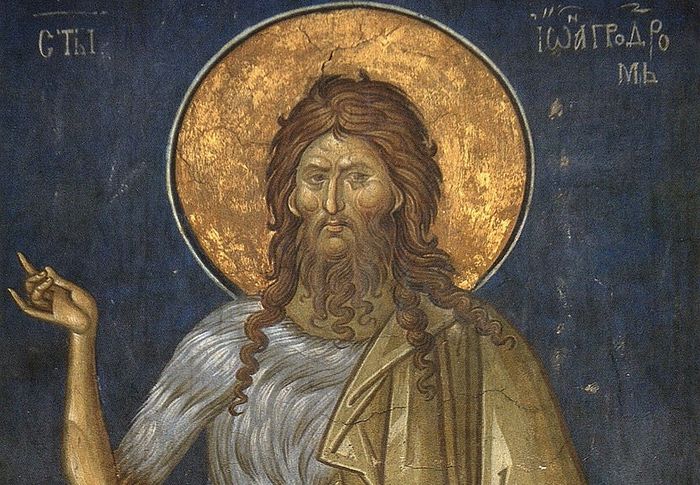
Thus John the Baptist came in the spirit and power of Elijah, with the same authority by which Elijah rebuked Ahab and Jezebel. John rebuked Herod and Herodias for entering into an unlawful marriage, because Herod could not take his brother’s wife while his brother was still living. John preferred to expose himself to danger from the king rather than, through flattery of the ruler, appear as one who had forgotten the commandments of God.”
St. John Chrysostom further notes that John directed his rebuke primarily towards Herod rather than Herodias because Herod possessed the greater authority and therefore bore the greater responsibility for this unlawful union.
St. Ambrose of Milan sees in the actions of the holy Forerunner a striking example of greatness of soul and unwavering fidelity to the commandments of God:
“John could have remained silent had he considered it honourable, out of fear of death, to suppress the truth, to lower his prophetic dignity before a king, and to flatter the ruler. John certainly knew that he would die if he turned the king against himself, yet he chose honour above his own life. He cared little for his earthly existence, for what could be more beneficial than for a holy man to obtain the glory of martyrdom?”
Another Father of the Church, Blessed Peter Chrysologus, interprets this passage by drawing attention to the manner in which the holy Forerunner rebuked Herod. Many people assume that rebuke consists merely of shouting, condemning, and reproaching, as though the manner in which something is said were of little importance. Blessed Peter writes:
“John approached Herod through persuasion rather than accusation. He desired to correct Herod, not to drive him into destruction. Yet Herod chose destruction rather than humility. Those who are enslaved begin to hate the freedom of those who are not guilty of transgression.
Virtue stands opposed to vice; holiness is terrifying to blasphemers; chastity is hateful to impiety; honesty hinders theft; temperance opposes luxury; compassion cannot tolerate cruelty; justice cannot endure injustice.
The Evangelist confirms this when he says: ‘For John had said to him, “It is not lawful for you to have her.”’ Here John becomes the victim. He who withdraws from evil gives offense. He becomes the victim because he seeks to catch transgressors. John spoke what was in accordance with the law, with righteousness, and with salvation; and naturally, his words were filled with love rather than hatred.
What reward did such a good deed receive from the ungodly?… ‘And he wanted to put him to death, but he feared the people, because they regarded him as a prophet.’
Such fear may restrain the power of sin, but it cannot remove the desire for sin. For the man whom fear restrains from sin is often drawn all the more strongly towards it by that very fear. Only the fear of God is capable of directing the mind aright, turning it away from transgression, preserving innocence, and granting steadfastness.”
St. Philaret of Moscow likewise writes about the inner resistance that sinners have towards the truth—the resistance they display when the word of God is preached to them. He also emphasizes that those who remain faithful to God must be prepared to suffer greatly at their hands:
“Threats, insults, imprisonment—such is at times the lot of those who, by virtue of their calling, are obliged to proclaim the truth to the powerful of this world…
Do not become embittered, faithful servants of the Lord Jesus, if the world showers you with insults. It is impossible to fulfill your ministry properly without becoming the object of unjust persecution. What will you not suffer from the demons while zealously striving to overthrow the dominion and kingdom of sin? What will you not suffer from those enslaved to their passions when you expose their vices and preach to them the narrow way that leads to heaven?
Be convinced beforehand that if you faithfully carry out your duty, you will not escape afflictions. The holy Apostle Paul spoke not only about preachers of the truth, but about all Christians when he said: ‘Indeed, all who desire to live a godly life in Christ Jesus will be persecuted’ (2 Tim. 3:12).”
Adapted for the contemporary reader based on the interpretations of the Holy Fathers by Stanoje Stanković.