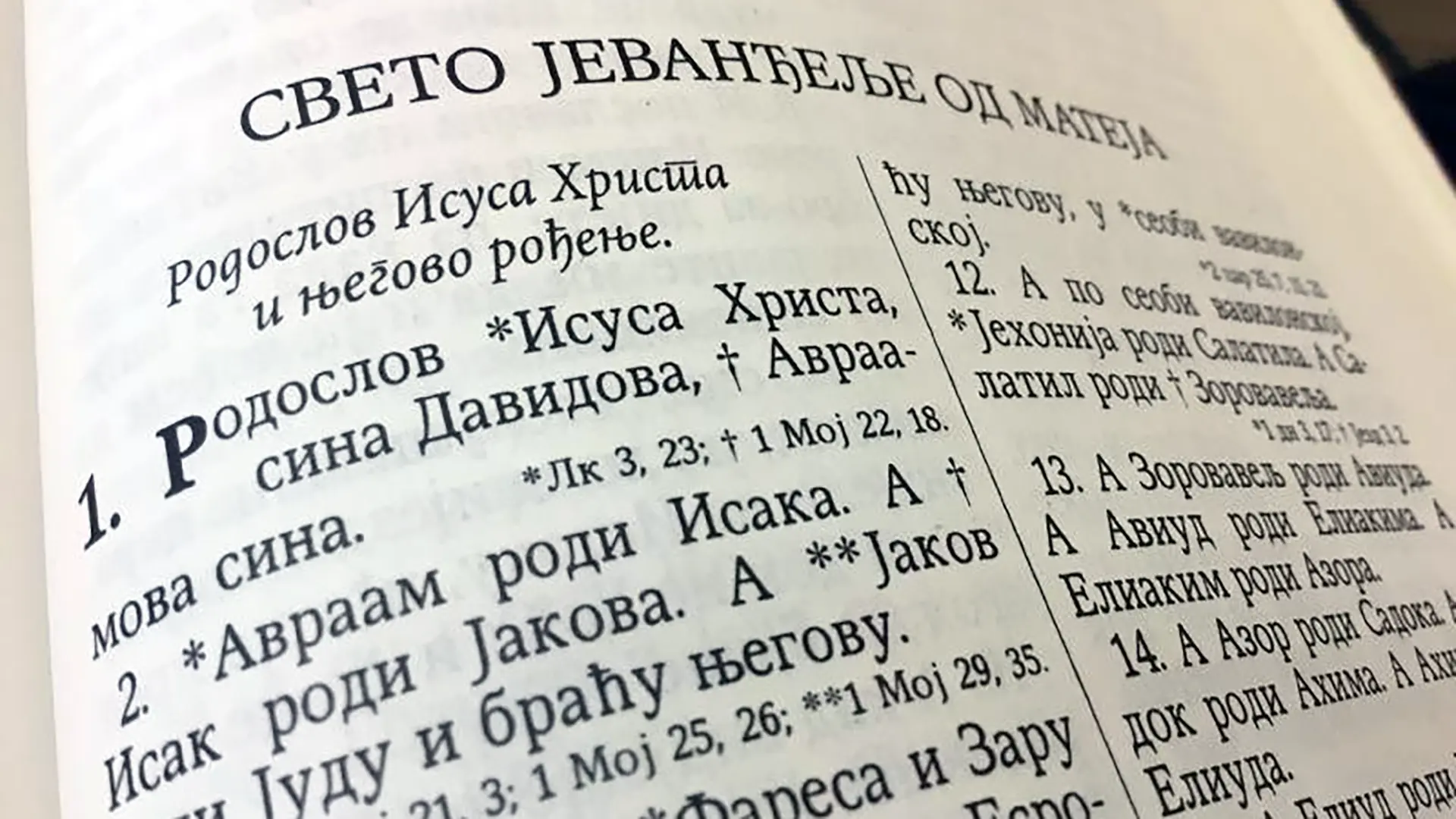
Today, we will study the mysteries of the Genealogy of Our Lord Jesus Christ. I deliberately use the word “mysteries” because, after a casual reading, we see only a list of unfamiliar and thus seemingly uninteresting, even tedious names. This was my experience when I first started reading the Gospel, which is why I’ve always tried to quickly go over the first 17 verses of the first chapter of the Gospel of Matthew.
The first verse reads:
1.“The book of the genealogy of Jesus Christ, the Son of David, the Son of Abraham.”
Saint John Chrysostom, from the very start points to the idea that seems almost unbelievable to us – namely, that God would even contemplate to become man, and that is the biggest miracle ever. We may even casually disregard this, as we seem to have become accustomed to the idea in this day and age. Here’s how Chrysostom explains it: “So, when you hear of this ineffable birth, don’t think that you’re hearing of something trivial. Awaken your mind and tremble when you hear that God has come to Earth. Don’t you see the enormity of the good news at the very outset? If you are doubting your divine sonship, become convinced by hearing what happened to Him. By human reasoning, it is much harder for God to become man than for man to become a son of God. Therefore, when you hear that the Son of God is the son of David and Abraham, doubt no longer that you, a son of Adam, will become a son of God.”
The name ‘Jesus’ means ‘God Who saves’, or Saviour. ‘Christ’ means the Anointed One, or, in other words, the Messiah. In the Old Testament, both priests and kings were called the “anointed ones”, as they were anointed with the holy oil, as a blessing for their designated service. For example, the prophet Samuel anointed King David. The Lord is called Christ both as a king, for He reigned over sin, according to the Holy Fathers, and also as a priest, for He offered Himself as a sacrifice for us.
Blessed Theophylact of Ohrid writes that Jesus was “fully anointed with the true oil, the Holy Spirit, for who else had the Spirit like the Lord?” He further explains the difference between Christ and the saints in relation to the Holy Spirit: “While the grace of the Holy Spirit works in the saints, it is not so in the case of Christ, Who Himself, together with his consubstantial Spirit works miracles.” Therefore, the Holy Spirit in all His fullness dwells only in Jesus Christ, the Son of God, while the saints only have gifts of the Holy Spirit. This is the fundamental difference.
Another important point concerning the phrase: “Son of David, Son of Abraham.” At first sight, it seems as if Matthew has from the outset altered the chronological order of Christ’s ancestors by putting David before Abraham, even though David came long after Abraham. The reason for this lies in the fact that David was much better known among the Jews; everyone spoke of him and knew that the Messiah would come from David’s bloodline.
Saint John Chrysostom explains it this way: “Though God gave promises to both men, the promise to Abraham, being ancient, was seldom spoken of, while the promise to David was constantly reiterated. The Jews themselves say: “Has not the Scripture said that the Christ comes from the seed of David, from Bethlehem, the village where David was?’ (John 7:42).
The promises Saint John refers to here – those God made to Abraham and David – are as follows: To Abraham, God said, “in your seed all the nations of the earth shall be blessed” (Genesis 22:18), and to David, He promised, “I will set upon your throne one of your offspring; there I will make the horn of David grow; I will prepare a lamp for My Anointed” (Psalm 132:11). By referring to Jesus as the “Son of David”, the apostle also intended to distinguish the Lord Jesus from another well-known figure to the Jews, and that is Joshua (Jesus), son of Nun, who led Israel into the Promised Land. King David himself prefigured Christ, for he became king after Saul, who was rejected by God. Similarly, as Blessed Theophylact explains, “Jesus reigned over us after Adam was stripped of his reign and dominion over all living creatures and demons,”. I find Theophylact’s insight particularly fascinating, when he draws attention to the fact that before the fall, Adam had authority even over the demons. Thus, Satan could only deceive Adam through trickery, as Adam was, at that time, more powerful than him. This is also evident today, in the New Testament era, when the Lord grants His saints authority over the demons.
Here’s an example from the lives of the saints: Martyr Codratus of Nicomedia says to the Roman official torturing him: “Not only does no demon have power over me, but this alone is certain: I have power over your father, Satan; and not only over him alone, but over all of his servants; by the grace of my Christ, I command the entire host of his army; and all the power of hell fears me and trembles, seeing on me the fearful and invincible mark of Jesus Christ and His grace, which is with me.” This is not arrogance on the part of the martyr, but a simple acknowledgement of the real authority given to him by God. And not just to him, but to many other saints as well.
Second verse:
2. “Abraham begot Isaac. Isaac begot Jacob. Jacob begot Judah and his brothers.”
From this verse, Apostle Matthew begins in the chronological order, first citing Abraham, Isaac, and Jacob – the Old Testament patriarchs. Abraham was the father of the Jews, and to him were given the promises concerning the Messiah. He was a righteous man of such holiness that he was greatly revered by the Jews. It’s no coincidence that John the Baptist sought to awaken the Pharisees from their imagined righteousness by reminding them: “And do not think to say to yourselves, ‘We have Abraham as our father’” (Matthew 3:9). His name means “father of many nations.” Regarding Isaac, his name means “joy”. Apostle Matthew mentions only Isaac and not Abraham’s children with Hagar, for the promise to Abraham was given specifically regarding Isaac, as the Apostle Paul writes: “Now we, brothers, like Isaac, are children of promise.” (Galatians 4:28).
Abraham and Isaac are part of one of the most significant events in the Old Testament – the command God gave Abraham to sacrifice Isaac. Isaac represented a prefigurement of Christ, His foreshadowing. While ascending the mountain where he was to be sacrificed, Isaac himself carried on his back the wood upon which he would be offered. Saint Ephraim the Syrian and Saint Gregory the Dialogist both see this as a prefigurement of Christ carrying His cross. And Abraham, in this event, represents God the Father, who “gave His only-begotten Son so that we may have eternal life”, as the Apostle John states in his Gospel (John 3:16). What is especially important is this: Do you know the name of the place where Abraham was to offer Isaac as a sacrifice? The Golgotha. The very place where Abraham was to offer Isaac is the same place where our Lord offered Himself as a sacrifice for the entire human race.
I want to draw attention to the promise given to Abraham from another, more contemporary, perspective. Perhaps you have heard of certain individuals or groups who promote theories that everything in the world is somehow of Serbian origin, that the Serbs are the oldest race etc. These people claim that even the ancient kings were Serbian, that everyone in ancient times spoke the Serbian language, and some even claim that Jesus Himself spoke Serbian. The most radical among them even claim that Jesus Himself was of Serbian descent.
Apart from displaying an alarming ignorance of basic religious facts, it is important for us to know that any suggestion that Jesus was not of Jewish descent directly contradicts the Divine revelation and the promises made by God to Abraham and David. If Christ was not from the Jewish people, then He is a false Messiah, and the Saviour of mankind has yet to come. In that case, Jesus of Nazareth, whom the Orthodox Church confesses as the Messiah, is not the promised Saviour. Do you see the danger in such theories? This is not merely the harmless delusion of some eccentrics, but an actual blasphemy against the Holy Spirit.
Thus, we see that those who think that they are exalting the Serbian people by expounding their theories, wish for Jesus not to be the “Jewish God”, as the neopagans claim, but they envisage some spurious “Serbian god”. In essence, they are working for God’s adversary, and against God. And we all know what happens to those who fight against God.
Let us continue.
Apostle Matthew writes: “And Jacob begot Judah and his brothers.” He mentions Jacob and Judah because from them came the twelve tribes of Israel, that is, the entire nation of Israel. Patriarch Jacob, while blessing his children on his deathbed, uttered the famous prophecy regarding the time of the coming of the Lord Jesus: “The scepter shall not depart from Judah, nor the ruler’s staff from between his feet, until Shiloh comes, and to Him shall the obedience of the people be.” (Genesis 49:10). This was fulfilled at the time of Christ’s birth, for the Jews had no king of their own then; King Herod ruled over them instead, and their kingdom belonged to the Romans.
Based on patristic interpretations, compiled by Stanoje Stanković