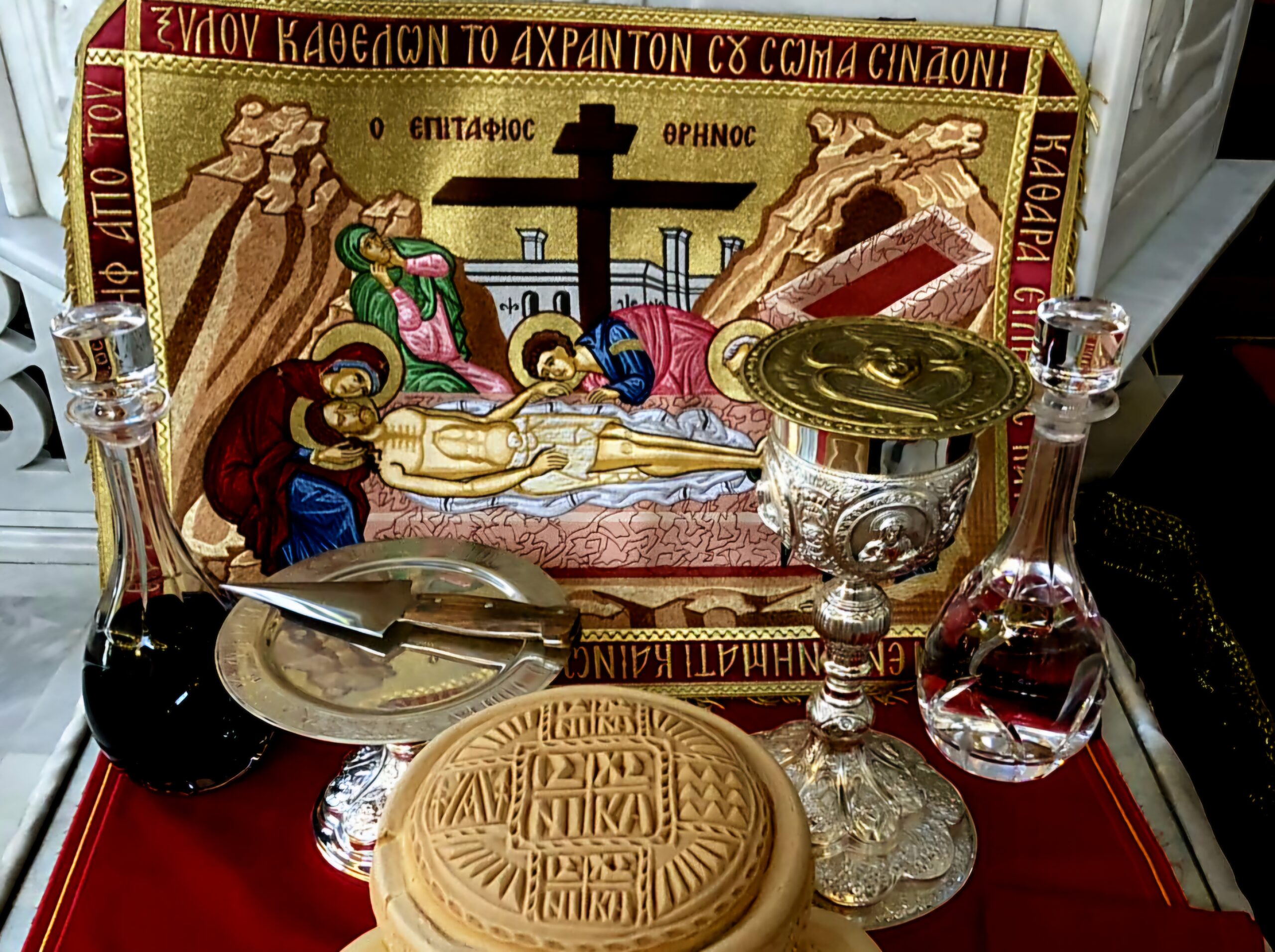
The Divine Liturgy is the centre of our entire life. Our Lord Jesus Christ instituted the Mystery of the Liturgy on the eve of His Passion, at the Mystical Supper. Gathering all His apostles, He gave thanks to God the Father, took bread, blessed it, broke it, and gave it to the holy apostles, saying: “Take, eat; this is My Body” (Matt. 26:26). He then blessed the cup and gave it to them, saying: “Drink from it, all of you. For this is My Blood of the new covenant, which is shed for many for the remission of sins” (Matt. 26:28). He commanded the holy apostles: “Do this in remembrance of Me” (Luke 22:19). Since that Mystical Supper, Christians have unwaveringly and faithfully fulfilled this commandment, assembling to celebrate the Liturgy. After the common prayer of the clergy and the faithful, the bread and wine prepared are transformed by the Holy Spirit into the Body and Blood of Christ. Partaking of the Body and Blood of the Saviour, under the appearance of bread and wine, we commune with Christ Himself.
During the sacrament of Holy Baptism, the priest asks the one to be baptised—or their godparent (sponsor): “Do you believe in God? Have you united yourself to Christ?” The one being baptised or the sponsor responds that they have united themselves to Christ and believe in Him as King and God. In this way, we all pledge to serve the Lord. Immediately after this response, the Symbol of Faith (the Nicene Creed) is recited, outlining precisely what we believe. Specifically, the Creed includes the following words: “I believe in One, Holy, Catholic, and Apostolic Church.” Therefore, alongside belief in God, we confess belief in the Church. What does it mean to believe in the Church? We do not profess some mere obligation to attend Church on Sundays and feast days, nor do we simply promise God that we will fast, confess, and receive Communion. To believe in the Church means to confess that she is the Body of Christ, of which we are members. We come to Church to become part of it—to become her very being, her essence. The Church makes us partakers of Christ, for we are her body, and He (Christ) is her Head. According to Saint Justin of Ćelije, the Church is the God-man Jesus Christ. Christ teaches us: “I am the Way, the Truth, and the Life” (John 14:6). The same may be said of the Church: the Church is the way, the truth, and the life of the person who lives in faith. Our hope is that man is saved unto eternal life, united with God. Eternal life is abiding in God, union with Him, and the deification of man, when he becomes god by grace. The significance of the Church lies in the fact that man cannot reach God by any other means. This is why Christ established His Church on earth—through her, man receives grace, comes to know God, and enters into communion with Him. God became fully man, and man becomes a son of God by grace. Only within the Church can man become god by grace, for the Lord gives us the possibility to commune with His Body and Blood. This is granted to us through the great mystery of the Church—through our life in her, for Christ has said: “If anyone thirsts, let him come to Me and drink” (John 7:37).
The consecrated tradition of the Church has always understood—and continues to understand—the Eucharist, as the consummation of the Mystery of Christ the God-man, to pertain to the Church and her movement through history toward the age to come. At the same time, it is the very source of the Church’s identity as the image of the Holy Trinity—that is, of the Trinitarian mode of being. The Church, or rather the Eucharist, is a communion of faith, hope, and love. Love, as an indispensable element of communion, is manifested in the Church through the unconditional acceptance of the other as a unique and unrepeatable person. Hope, in the context of the Eucharistic life of the Church, is realised through various practical and spiritual expressions and is oriented toward the expectation of the unwaning Day of the Lord.
The Divine Liturgy is the centre of Christian life. When we prepare for the Liturgy, spiritual dispositions are awakened within us: humility, fervent faith, repentance, and love for God and neighbour. Filled with these virtues and a spiritual mindset, we come to the gathering of the Church, bringing something of ourselves—a small gift from God. The Liturgy is celebrated by Christ Himself. He is the one who offers and is offered, who receives and who is distributed, as we read in the prayer of the Cherubic Hymn. Where the Lord is, there are all the ranks of heaven, as one Theophany hymn declares: wherever the King is, there also are all His heavenly hosts. At every Liturgy, the Lord is present, and with Him are all the angels and saints, as well as all God’s elect in this life. When we come to the Liturgy prepared and bring with us even a small offering, we are united with the Body of Christ and made partakers in the gifts of the other members of Christ—those glorified in heaven and those striving on earth. Thus, we are enriched through the grace-filled communion of the Mystery of the Liturgy. Saint Paul teaches that whenever we come to the Liturgy, we must bring the best of what we have. Whether it be prophecy, teaching, singing, the gift of tongues, or any other (1 Cor. 14:26)—these were the gifts of the early Church. At that time, the Liturgy had not yet taken on the fully developed form passed down to us by the Holy Fathers. Today, we no longer need to bring prophecies, teachings, and hymns, since we have the text of the Anaphora, yet the principle remains the same: when we come to the Liturgy, we must bring the best of what we have and what we have gained through our preparation. The grace of the Liturgy is given to us in proportion to the depth of our preparedness for it.
The Fathers of the Church teach that the world continues to exist because the Divine Liturgy is served within it. Just as the celebration of the Liturgy is the greatest event in the life of the world, so too can our participation in the Liturgy be called the most important event of our personal lives. God created us through His boundless love so that we might delight in that love. And how can we delight in His love? Only by glorifying His holy name. This is a great privilege given to us. If we continually proclaim in our lives, “Glory to You, O God! Glory to You, O God!”, our lives are transformed at their very root—even when burdened by thousands of problems, hardships, and sorrows, we are transfigured and renewed by giving glory and thanksgiving to God for all His gifts.
Our preparation for the Liturgy and our participation in it shape our lives. One contemporary elder from Mount Athos wisely observed that Christians, living from one Liturgy to the next, dwell continually in the grace bestowed by the Mystery of the Liturgy. The Liturgy becomes our catechesis and a constant call to examine our conscience at every moment. The Liturgy is the measure of our life—by it we live, we exist, and through it we attain our true and authentic identity. If the Liturgy is our measure, then it will also define the way we relate to other people and to the entirety of God’s creation. Liturgical catechesis teaches us to walk the path of this life through prayer and good works, to forgive and to love those whom God brings into our lives—for no encounter is accidental, every meeting is a work of Divine providence. As participants in the Liturgy, we bring liturgical peace into this fallen and sin-filled world. We begin the Liturgy with the blessing of the Kingdom of the Father, and of the Son, and of the Holy Spirit, and with a call to peace; and the same call marks the conclusion of the Liturgy: “Let us depart in peace” or, in the text of the ancient liturgies, “Go in peace”—meaning: Go forth and proclaim everywhere the blessed and sanctified peace which you have received in the Liturgy. In our human weakness, we often fall into lesser or greater conflicts with those close to us, and all too often, disagreements and discord lead to the breaking of communion, simply because we are not ready to forgive sincerely. Our weak and sin-burdened nature prevents us from recognising the image of God in every person and from being willing to forgive. “Let us love one another that with one mind we may confess”—this line from the Liturgy reminds us that love for our neighbour is the prerequisite for participating in the Mystery of Mysteries, so that we may thereby manifest our love for God in deed. These are all essential lessons presented to us daily through the liturgical way of being.
This text was published on the Kinonia portal in the section “From the Editor’s Pen,” on 20 July 2025.
WRITTEN BY: Catechist Branislav Ilić, Editor of the Kinonia Portal