During the reign of Emperor Anastasius I (491–518), there lived in Constantinople a deacon who possessed little talent for reading and chanting in the church. Although other clerics often mocked him for this reason, the deacon was beloved by Patriarch Euthymius because of his virtuous life and the fervent prayer that he maintained.
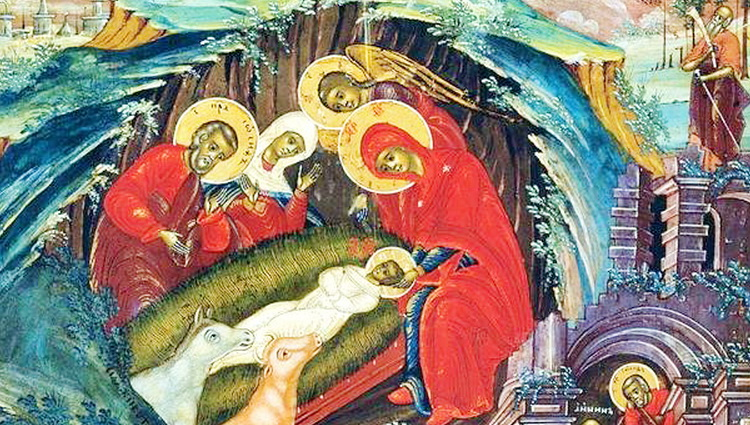
On the eve of the Nativity, in the year 518, during an all-night vigil at the Church of Blachernae, this deacon was assigned to read the kathismata. He read so poorly that the typikon reader interrupted him and replaced him with another, which provoked further mockery from the rest of the clergy. Humiliated, he withdrew to the side and sat in one of the stasidia. Weeping, he prayed to the Most Holy Theotokos until he was overcome by sleep. In a dream, the Most Holy Theotokos appeared to him and gave him a scroll to swallow. As soon as he swallowed it, he awoke. The vigil was still in progress; the chanters were just concluding the sixth ode of the canon of the Matins service of the Nativity of Christ. To the astonishment of all, the deacon stepped forward into the middle of the church and chanted a hymn hitherto unknown: “Today the Virgin gives birth to the Transcendent One, and the earth offers a cave to the Unapproachable. Angels glorify Him with the shepherds in hymns, and the Magi journey with the star; for for our sake a little Child is born, the pre-eternal God.”
The emperor, the patriarch, and all those present were amazed not only by the chanting ability of the brother who only moments before had been reading syllable by syllable, but also by the depth of the words of the new hymn, whose content expressed the very meaning of the feast.
The wondrous chanter of this account was Saint Romanos the Melodist, the composer of the first kontakion in the history of the Church. Until the end of his life, Saint Romanos, as an inspired hymnographer, composed several thousand different kontakia (up to 8,000 are attributed to him). He reposed in the year 510 as a deacon and hymnographer of the Great Church of Christ, Hagia Sophia (the Holy Wisdom of God), in Constantinople.
From this miraculous event to the present day, the kontakion is always chanted after the sixth ode of the canon, precisely at the point where Saint Romanos himself first chanted it. This liturgical hymn of concise form, whose content sets forth the meaning of the feast it celebrates, is called a kontakion in remembrance of the scroll swallowed by Saint Romanos, which, because of the rod around which it was wound, was called a kontakion (κοντάκιον).
Source: Kinonia Portal