The final week of the Saviour’s earthly life is known as Passion Week or Holy Week. The Church Slavonic word strastʹ (passion) encompasses several meanings: suffering, endurance, and pain. Each day of Passion Week is called “great” and “holy” because of the great and salvific events from the Saviour’s life that it commemorates liturgically, with each day dedicated to particular moments of prayerful remembrance.
According to Saint John Chrysostom, this week is called “Great” not because its days are longer or more numerous, but because during these days the Lord accomplished mighty works: the kingdom of the devil was destroyed, death was vanquished, sin was conquered, the curse was lifted, Paradise was opened, and heaven became accessible to humanity. Human beings were united with the angels; the dividing wall was broken down and removed, and the God of peace reconciled the heavenly and the earthly. This is why it is called Great Week. Saint Epiphanius of Cyprus teaches that the early Christians spent the days of Passion Week in particular piety, with complete fasting and intensified prayer. Through active participation in the services of Passion Week, every Christian becomes a partaker in Christ’s path of the Cross and suffering. The Lord goes willingly to His Passion, and we must go with Him. This is the duty of anyone who confesses that it is through Christ’s sufferings that they have become what they are, and that they will yet receive something so great and glorious that it has not even entered into the heart of man. The text of the troparia sung during the first three days of Passion Week awakens spiritual vigilance within us. Thus, already at the Matins of Great Monday, we sing in the first sedeleon that the Lord hastens toward His voluntary Passion:
“Today the day of the saving Passion has dawned for the world as a radiant beacon; for Christ, in His goodness, goes willingly to suffer. He who holds all things in His hand accepts to be nailed to the Cross, in order to save mankind.”
The liturgical distinctives of the first three days of Passion Week include a common troparion and exapostilarion at Matins, as well as a common dismissal. Following the sedeleons at Matins, the Gospel reading is interpreted, along with a patristic commentary on the pericope appointed for that day. On Great Monday, Tuesday, and Wednesday, the Liturgy of the Presanctified Gifts is celebrated, with Old Testament readings including the Book of Genesis and, in place of Proverbs, selected passages from the Book of Job. On these days, it is recommended to serve the Presanctified Liturgy according to the rite of Saint James, the Brother of the Lord, in its Serbian translation prepared by the late Bishop Chrysostom (Stolić) of Žiča and published by the Diocesan Administrative Council of the Diocese of Banat in 1996.
A notable feature of these days is the reading of the Four Gospels at the Third, Sixth, and Ninth Hours. The official Typikon of the Holy Synod of Bishops of the Serbian Orthodox Church notes:
“In practice, this reading of the Holy Gospel on the first three days of Passion Week has proven difficult to maintain. Although there are several adaptations that deviate from the current Typikon, the late Professor A. A. Dmitrievsky affirmed that the closest practice to the ideal expressed in the Typikon is to complete the Gospel readings of the sixth and seventh weeks of Lent rather than limiting them to the seventh week alone.”
The liturgical services of Great and Holy Monday commemorate the Righteous Joseph the Chaste, also known as a prefiguration of Christ, since he was sold by his brothers for thirty pieces of silver and imprisoned, but ultimately, through suffering and divine providence, emerged victorious. Throughout the Canon of Great Monday, we honour and glorify Righteous Joseph as an exemplar of chastity. On this first day of Passion Week, we also commemorate the cursing and withering of the fig tree by the Lord—a symbolic act representing the Jewish synagogue in which the Saviour found no spiritual fruit, but only the shadow of the Law. Therefore, He removed even that shadow, fulfilling the Law in Himself. According to certain interpretations, the Lord, in cursing the fig tree, demonstrates His authority to judge as the Son of Man, but desiring not to condemn man, He instead condemns the senseless and unfeeling tree. Saint Isidore of Pelusium reminds us that the fig tree also represents the tree of disobedience, with whose leaves Adam and Eve covered their sinful nakedness.
Through the liturgical hymns of Great Monday, we are called to go with the Lord into Jerusalem—with a purified mind and passions subdued.
Holy and Great Tuesday
On Holy and Great Tuesday, we prayerfully remember the Lord’s response to the Pharisees and Sadducees, His teaching concerning His Second Coming, and the parable of the ten wise and ten foolish virgins. According to the testimony of Saint Matthew the Apostle and Evangelist, on the morning of Tuesday of Passion Week, our Lord Jesus Christ spent time in the Temple in Jerusalem, where He taught the people. Many of the chief priests and elders, upon hearing His words and realizing that He spoke about them, sought to arrest and kill Him, yet they feared the people. In teaching His disciples and the people, Jesus often spoke in parables. Thus, on Great Tuesday, we remember His parable about the ten wise and ten foolish virgins. Through the liturgical services of Great Tuesday, the Church reminds us not to fall into spiritual negligence, but to sustain our ascetic efforts with the oil of mercy and love—without which we shall not be able to meet the Lord, the Bridegroom of the Church. This Gospel pericope teaches us to be ever vigilant and prepared for the coming of the Bridegroom, adorned with chastity, almsgiving, and good works, so that the lamps of our souls may shine with virtue and true faith.
Holy and Great Wednesday
On Holy and Great Wednesday, we commemorate the sinful woman who washed the Saviour’s feet with her tears, dried them with her hair, and anointed them with myrrh. On this third day of Passion Week, the Church also calls to mind the betrayal of Judas. According to the Church’s teaching, it is now that we hear from the lips of the Lord the instruction given to the Apostles not to hinder the anointing with myrrh, for His body was being prepared for death. Before Him now stands only death—the final mystery of His coming into the world for our salvation. The services of this day reveal the power of repentance and love, by which God’s grace is poured out like oil in abundance upon all who repent sincerely. In the figure of the penitent harlot, we see an example of profound and loving repentance. All four Evangelists record the event of the sinful woman anointing the Lord’s feet with precious myrrh, emphasising that this act serves as a preparation for His Passion and burial. Undoubtedly, her repentance did not come suddenly or by chance: she had undergone inner preparation, was illumined by the power of the Saviour, rejected her shameful deeds, and, while the Lord dined in the house of Simon the leper, she acted in true repentance for all her sins.
In contrast to her great repentance, the Church’s hymnographers remind us of the dark betrayal committed by Judas. On this holy day, the celebration of the Liturgy of the Presanctified Gifts ceases, as does the recitation of the Lenten Prayer of Saint Ephraim the Syrian.
Holy and Great Thursday
On Holy and Great Thursday, we liturgically commemorate the Mystical Supper of Christ at which the Holy Eucharist was instituted. We also remember the Saviour’s Farewell Discourse, His washing of the disciples’ feet, and His High Priestly Prayer before the Passion. The central commemoration of Holy Thursday is the institution of the Mystical Supper, during which the Lord, having given thanks to the Father, broke the bread, blessed it, and gave it to His holy disciples and apostles, saying: “Take, eat; this is My Body,” and, “Drink of it, all of you; for this is My Blood of the New Covenant, which is shed for you and for many for the remission of sins” (Matt. 26:26–28). From this moment onward, the Church of God has been nothing other than a continual Mystical Supper—a perpetual gathering in the name of the Lord and communion with Him.
When a certain elder on Mount Athos was once asked, “Elder, what is the Church?” he replied: “The Church is the unceasing Liturgy.”
During the Mystical Supper, the Lord foretold to His disciples that one of them would betray Him, knowing that it would be Judas. “Truly I say to you, one of you will betray Me” (Matt. 26:21). “Then Judas, who betrayed Him, answered and said, ‘Surely it is not I, Rabbi?’ He said to him, ‘You have said so’” (Matt. 26:25). “Peter said to Him, ‘Even if I must die with You, I will not deny You’” (Matt. 26:35).
After the Mystical Supper, Christ, accompanied by His disciples, goes to the Garden of Gethsemane, where His personal prayer teaches us that prayer in times of suffering, tribulation, and temptation is the greatest strength for enduring every hardship—even bodily death.
On this holy day, we also remember Christ’s washing of His disciples’ feet, thereby showing the utmost humility. Holy Thursday is marked by many liturgical distinctives—from the Liturgy of Saint Basil the Great, which begins with a Vespers service, to the Great Vigil. On the evening of Holy Thursday, during the second hour of the night, the Matins of Great Friday is served. This service is known as the Great Vigil or the Service of the Holy and Saving Passions of the Lord. The Twelve Gospel readings present the narrative of Christ’s Passion, their number corresponding to the twelve hours of the night. The Gospel readings concerning the Passion are taken from all four Evangelists and are arranged sequentially. Between the readings, antiphons—hymns resembling Gospel texts—are sung.
In our region, the incorrect custom of kneeling during the reading of the Passion Gospels has become widespread. According to canonical order, kneeling is not permitted during this period—from now until the Vespers of Pentecost. Moreover, before the reading of these Gospels, the deacon calls the faithful to “stand aright” and to “listen attentively” to the passages concerning the Lord’s Passion.
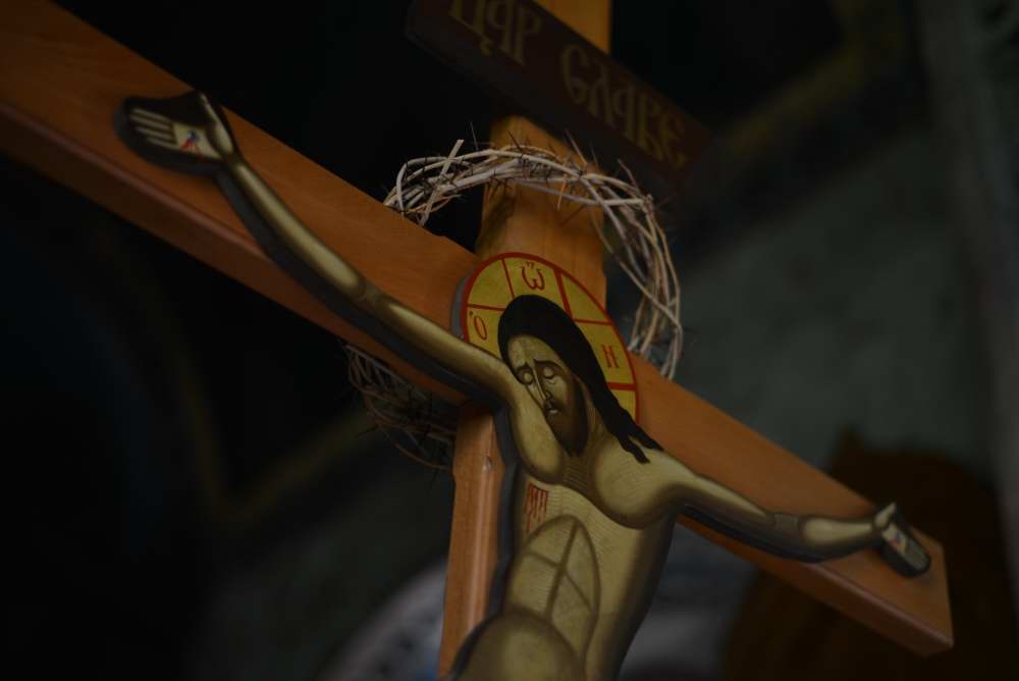
On Holy and Great Friday, we commemorate the holy, salvific, and awe-inspiring sufferings of our Lord, God, and Saviour Jesus Christ, which He willingly accepted for our sake: the spitting, the blows, the mockery, the ridicule, the scarlet robe, the reed, the sponge, the vinegar, the nails, the spear, and after all of this—the Cross and death itself.
On this most sacred and Great Friday, the Church prescribes the strictest fast, which includes complete abstention from food. Saint Dionysius of Alexandria attests to this, saying: “On two days—Great Friday and Great Saturday—all observe a complete fast.” According to Church Tradition, the Typikon of Great Friday reminds us:
“We must also know that in Palestine it was received and handed down that on this holy day of Great Friday, neither is the Liturgy of the Presanctified Gifts served, nor the full Divine Liturgy; no table is set, and no food is consumed on this day of the Crucifixion. If anyone is very weak or elderly and cannot endure the fast, they are permitted bread and water only after sunset. For we have received such a command from the holy Apostles, that on Great Friday one does not eat. For the Lord said to the Pharisees: ‘When the Bridegroom is taken away from them, then they will fast in that day.’ This the divine Apostles received, and you will find this carefully stated in the Apostolic Constitutions. The same is confirmed in the canonical epistle of the most holy Archbishop Dionysius of Alexandria, who publicly affirms it.”
The office of the Royal (Great) Hours served on Great Friday is attributed to Saint Cyril of Alexandria and Saint Sophronius of Jerusalem. The liturgical character of this day includes the celebration of the Royal Hours and the Vespers with the bringing out of the Epitaphios (Plaschanitsa).
The troparion of Great Friday most aptly captures the spirit of this sacred day:
“Thou hast redeemed us from the curse of the Law by Thy precious Blood; being nailed to the Cross and pierced by the spear, Thou didst pour forth immortality upon mankind: O our Saviour, glory be to Thee!”
On Holy and Great Saturday, we commemorate the Burial of the divine Body and the descent into Hades of our Lord and Saviour Jesus Christ, by which He renewed the human race from corruption and led it into eternal life. Liturgically, we remember Joseph of Arimathea and Nicodemus, who took down the Body of Christ from the Cross, wrapped it in linen cloths, anointed it with spices, and placed it in a new tomb in Joseph’s garden, sealing the tomb with a great stone.
Just as in the first creation God made all things and, on the sixth day, created man, then rested on the seventh day from all His works, sanctifying that day and calling it Sabbath, meaning “rest”—so too, in the spiritual re-creation, Christ completed the work of redemption on the sixth day (Friday), re-fashioned fallen man through the life-giving Cross and death, and on the Sabbath—the seventh day—He rested in perfect repose from His salvific labours.
The Gospel accounts testify that present at the Lord’s burial were Mary Magdalene and Mary the mother of James. According to the liturgical order, Great Saturday is the only Saturday of the year that is observed with fasting (in this context, a strict fast), because on this day we remember the Lord’s resting in the tomb.
The celebration of this blessed and holy day begins on Friday evening with the Matins of Holy Saturday, during which the Lamentations (Stases) are sung before the Epitaphios. The Divine Liturgy of Saint Basil the Great is celebrated in connection with Vespers, and, according to the Typikon, it should ideally be served at the tenth hour of the day. During this Vespers service, the Resurrectional stichera are already sung together with those from the Triodion, thus proclaiming the coming glory of Christ’s Resurrection.
For centuries, Christians have prayerfully awaited the Feast of feasts. This prayerful vigil is manifested in the reading from the Acts of the Apostles, as this New Testament book offers perhaps the most authentic testimony to the Resurrection of Christ. After this edifying reading, the Midnight Office (Nocturns) is served, during which the Canon of Great Saturday is sung.
This brief survey of the great and holy days of Passion Week points us to the vital importance of participation in the liturgical life of the Church. Only through such participation can we truly encounter and experience this spiritual journey toward Golgotha and the empty, life-giving tomb of Christ. Our presence in these sacred days is of profound importance; the order of the services assumes the presence and involvement of the laos—the people of God—and the content of the prayers and hymnography bears eloquent witness to this.
We conclude this reflection with the words of a sticheron sung on Holy and Great Friday:
“Today He who hung the earth upon the waters is hung upon the Tree.
The King of the angels is crowned with thorns.
He who wraps the heavens in clouds is wrapped in the purple of mockery.
He who freed Adam in the Jordan receives blows upon His face.
The Bridegroom of the Church is transfixed with nails.
The Son of the Virgin is pierced by a spear.
We worship Thy Passion, O Christ.
We worship Thy Passion, O Christ.
We worship Thy Passion, O Christ.
Show us also Thy glorious Resurrection!”
WRITTEN BY: Catechist Branislav Ilić, Editor of the “Kinonia” Portal