The text was published on the Kinonia portal, in the column “From the Editor’s Pen,” on 2 January 2026.
When our Lord Jesus Christ dwelt on earth and preached to the people about the Kingdom of God, He noticed among the crowd a young child. The Lord called the child to Himself, embraced him, and then said: “Unless you turn and become like children, you will never enter the Kingdom of Heaven; and whoever receives one such child in My name receives Me” (Matt. 18:3). That child was Saint Ignatius the God-Bearer. In the service commemorating Saint Ignatius the God-Bearer, the hymnographer emphasizes the importance of this wondrous encounter: “Ignatius, bearer of God, you were upon the breast of your beloved Christ, and you received your reward by ministering the Gospel of Christ, and for His sake you ended your life in blood; thus you became like the wheat of the immortal Husbandman, for you were ground by the teeth of wild beasts and appeared before Him as sweet bread; therefore pray for us, O blessed sufferer” (Doxastikon at Lord, I have cried). In the same spirit, the church poet chants the following words as well: “You were rightly called ‘God-Bearer,’ for the blessed hierarch Ignatius embraced you with mercy, revealing with loving wisdom the heavenly dogmas; then you received a most radiant ray, and like a sponge you drew illumination from the abyss as water; therefore, at the call you followed in the footsteps of Christ our God—entreat Him to save and enlighten our souls” (First sticheron at Lord, I have cried).
This God-bearing saint was bishop of Antioch and lived in the second half of the first and the beginning of the second century. He was a direct disciple of Saint John the Theologian and the second bishop of Antioch in succession (70–107). The Church of Antioch was governed by Saint Apostle Peter from the year 47 to 57 of our Lord, then by Saint Evodius until the year 68, and from 68 to 107 this great Christian centre was shepherded by Saint Ignatius the God-Bearer. To this day, seven epistles attributed to him have been preserved: six addressed to local Churches (Rome, Ephesus, Magnesia, Tralles, Philadelphia, and Smyrna), through which he passed on his journey to Rome, and one addressed to Polycarp, the renowned and righteous bishop of Smyrna. The works of the God-bearing Father Ignatius of Antioch are of exceptional importance for understanding ecclesiology (the doctrine of the Church). In addition to expounding the teaching on the Church, Saint Ignatius strengthens the faithful in the confession of the faith and speaks against the Gnostic movements that were widespread in his time.
Alongside his great apostolic zeal in governing the Church of Antioch, this holy hierarch, by divine revelation, was the first to introduce antiphonal chanting in the Church. Tradition thus ascribes to him the introduction of antiphonal (alternating) singing in liturgical worship. The earliest testimony to this is found in the church historian Socrates at the beginning of the fifth century: “Ignatius of Antioch in Syria, the third bishop after the Apostle Peter, had a vision of angels glorifying the Holy Trinity with antiphonal hymns. The manner of singing which he saw in the vision he transmitted to the Church in Antioch, whence this tradition spread to all the Churches.”
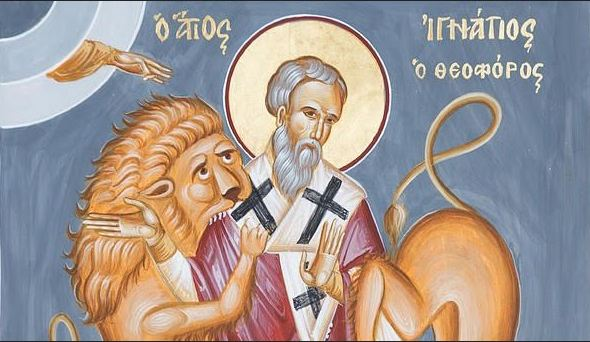
This servant of God and great preacher of the eternal Word of God was condemned to death during the persecution of Christians under Emperor Trajan (98–117). The saint was brought to Rome around the year 107 and thrown to the lions in the Colosseum. The remains of Saint Ignatius’ bones were carefully gathered by Roman Christians and transferred to Antioch. When the Persians occupied Antioch in the sixth century, his relics were once again returned to Rome. In hymnography we magnify Saint Ignatius as a saint who, in his martyrdom, was conformed to the crucified and risen Lord: “When you were co-crucified with Christ, O hierarch glorified, you cried out inspired words: ‘My love has been crucified; therefore I greatly strive to attain the sufferings of Christ!’ You, blessed Ignatius, hastened like the sun from east to west, and thus, illumined, you arrived there; adorned with a royal crown, you were brought to Christ—entreat Him to save and enlighten our souls” (Third sticheron at Lord, I have cried).
Saint Ignatius accepted martyrdom willingly and with joy. In his Epistle to the Romans, in which he asks the Christians of the capital not to prevent his suffering, we see the fearlessness and steadfastness of faith of this great Antiochian saint: “From Syria to Rome I fight with wild beasts, by land and by sea, by night and by day, bound to ten leopards—that is, a band of soldiers—who, even when treated kindly, become worse. Yet in their injustices I learn all the more, though by this I am not justified. I long exceedingly for the beasts that are prepared for me, and I pray that they may be ready for me. I shall urge them to devour me quickly, and not, as with some, refrain from touching me out of fear. Forgive me; I know what is beneficial for me. Now I begin to be a disciple. Let nothing visible or invisible hinder me, that I may attain Jesus Christ.”
Concerning Saint Ignatius, his predecessor on the throne of the Antiochian bishops, Saint John Chrysostom (347–407) recorded the following: “Ignatius presided over our Church courageously and with such exactness as Christ desires. For Christ said that the Good Shepherd lays down his life for the sheep (John 10:11), and this man laid it down for his sheep with all courage. Ignatius put aside his body with such ease as another might lay aside a garment. He governed the Church perfectly at a time when her path had not yet been well trodden. He governed the Church of our fatherland, so great a city, and a multitude of two hundred thousand people. In Antioch persecution arose against Christians solely because they rejected false demonic belief and embraced faith in the true God and His Only-begotten Son. From our city to Rome the Lord called him, and the cities along his journey ran to him from all sides and met the ascetic. And he taught them all by deeds and words along the way in every city. Thus he was a wonderful teacher not only to the Romans, but also to all those in the intermediate cities… He taught them all by his deeds, going forth from the East and, like a sun rising, hastening towards the West, and shining even more brightly than the sun.”
Saint Hieromartyr Ignatius was also an outstanding defender of the unity of the Church. He was the first among the Church Fathers to skillfully describe the relationship that ought to exist between Christians and their bishops, priests, and deacons: “Honour the deacons as the commandment of Jesus Christ, and the bishop as Jesus Christ Himself, the Son of God the Father, and the presbyters as the council of God, as the assembly of the apostles. Without them there is no Church.”
The liturgical commemoration of Saint Ignatius the God-Bearer is celebrated during the days of the forefeast of the Nativity of Christ. The hymnography presents the most important details from the saint’s life, and the church poet repeatedly emphasizes that the God-wise Ignatius, the hieromartyr of Antioch, appeared as a true God-Bearer and as a fearless preacher of the Word of God. His courage, which is the fruit of living and active faith, is likewise highlighted, as is his wise governance of the Church of God in Antioch from the sacred throne on which he was the successor of Saint Apostle Peter. Upon this firm foundation of the apostle Peter’s steadfast faith, Saint Ignatius, as arch-shepherd, continued to build the mystical and mysterious edifice—the living Church. Together with the church poet, we glorify this God-bearing saint with the following words: “Your annual feast has dawned, O spiritual tower, and your image, O God-bearing Ignatius, is made alive for us; it guides us holy and proclaims your courage and your resistance for the faith unto blood. Blessed also is that never-forgotten voice of yours which says: ‘I am God’s wheat, and the teeth of beasts shall grind me!’ Thus you too suffered like your Christ; entreat Him that our souls may be saved” (Doxastikon at the Praises).
As we glorify the Lord and His servant Saint Ignatius the God-Bearer, we are called to fill our lives with virtues, and in this spiritual ascent along the ladder of virtues to become like Saint Ignatius, who even in the difficult days of persecution preserved to the end the unquenchable flame of faith. Saint Ignatius proclaims to Christians today that Christ-like love casts out fear and wavering, and teaches us even more clearly that our Christian calling is to be true God-bearers—that is, that the measure and pattern of our life should be our Lord Jesus Christ, our true God, who said of Himself: “I am the Way, the Truth, and the Life” (John 14:6).
WRITTEN BY: Catechist Branislav Ilić, editor of the Kinonia portal