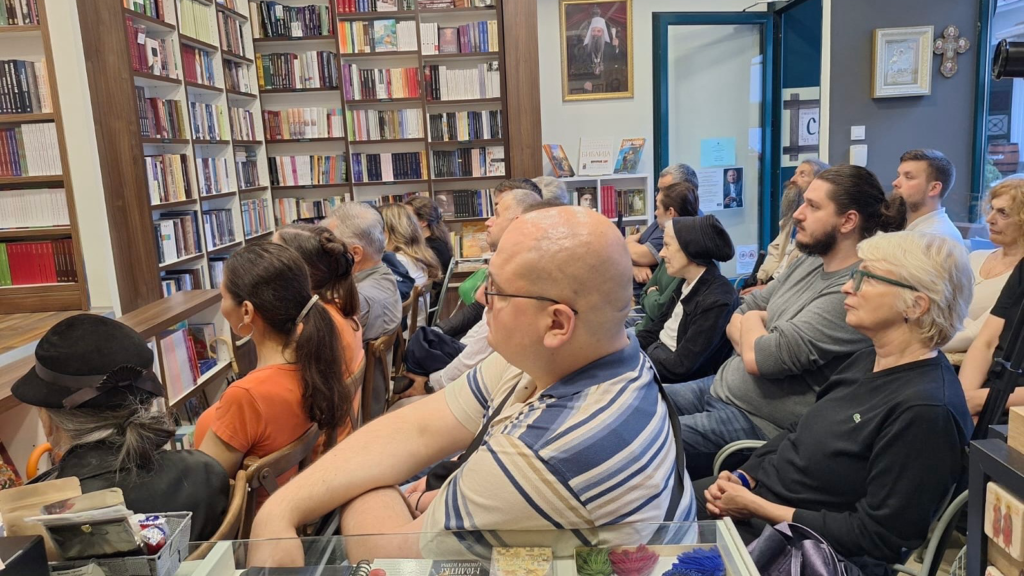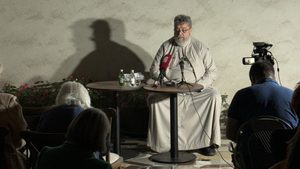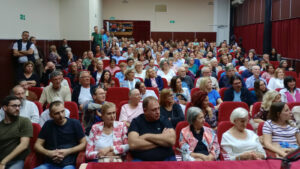
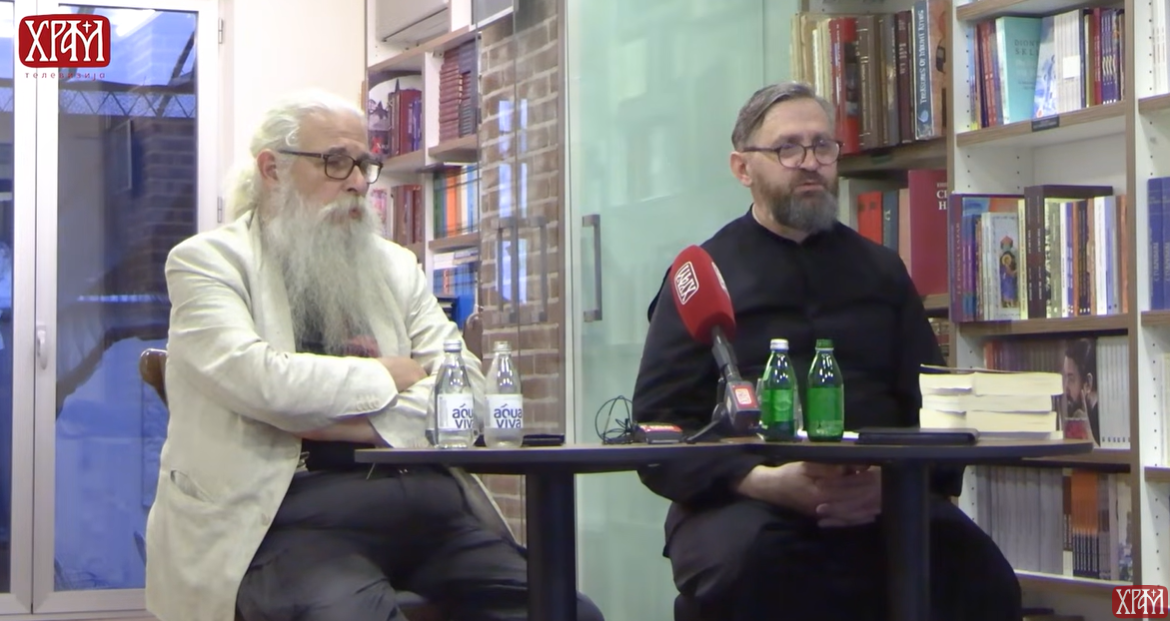
As part of the project “A Book as a Reason for Conversation,” organized by the Public Dialogue Section of the Missionary Department of the Archdiocese of Belgrade-Karlovci, the first discussion on the topic “Science Between Faith and Atheism” was held on Monday, May 11, 2026, at the “Slovo” Bookstore Café in Belgrade. The discussion was inspired by the books The God Delusion, Outgrowing God, and The Selfish Gene by Richard Dawkins. The participants in the discussion were Dr. Aleksej Tarasjev, Research Advisor at the “Siniša Stanković” Biological Institute of the University of Belgrade, and Presbyter Dr. Aleksandar Milojkov, Coordinator of the Public Dialogue Section of the Missionary Department of the Archdiocese of Belgrade-Karlovci.
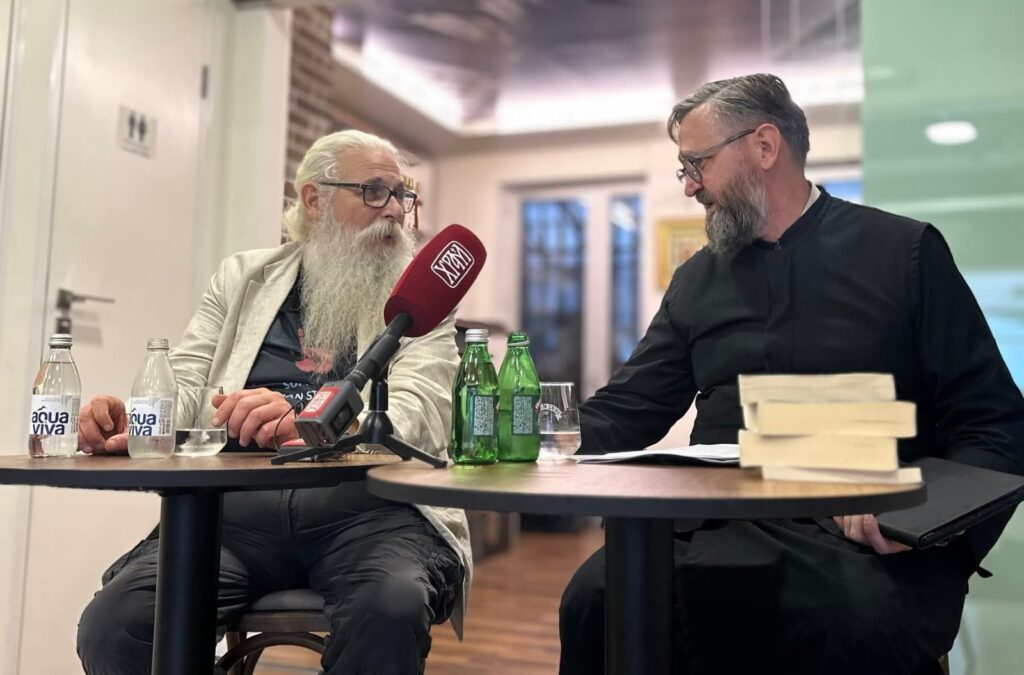
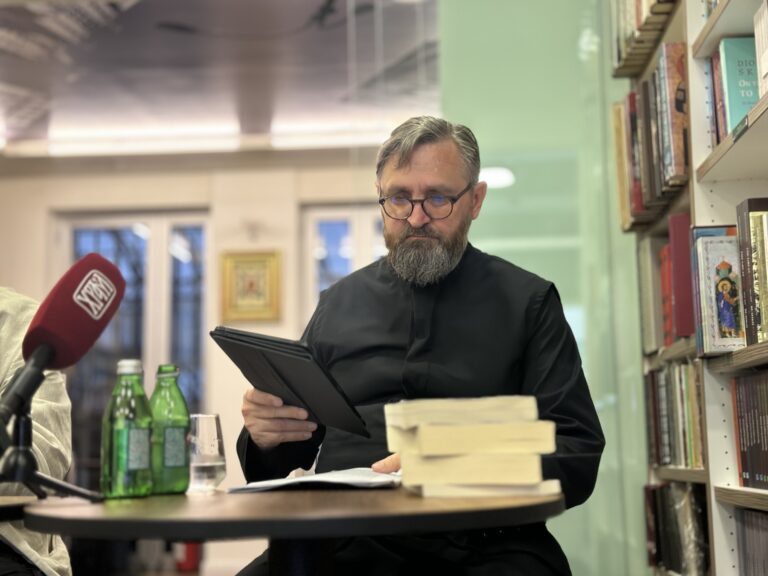
Analyzing the key positions advanced by Professor Dawkins, the participants pointed to the unfounded nature of his claim that science necessarily leads to atheism. Dr. Tarasjev particularly emphasized that both faith and atheism represent worldviews, and that science, in its ultimate epistemological framework, cannot be identified either with faith or with atheism. In that sense, he stressed that there exists a “non-overlapping of paths” (NOMA) between science, on the one hand, and faith and atheism, on the other. In this part of the discussion, Presbyter Aleksandar Milojkov pointed out that there nevertheless exists a so-called scientific worldview, and that Professor Dawkins approaches the relationship between science, faith, and atheism precisely in that manner. Father Aleksandar further explained, with the agreement of Dr. Tarasjev, that such an approach is no longer science, but rather the ideology of scientism.
Important concepts were explained, including methodological naturalism and ontological naturalism, as well as the distinction between them. Methodological naturalism is fundamental to the scientific method, insofar as phenomena in nature are explained through natural causes and mechanisms. Without methodological naturalism, science — particularly the natural sciences — cannot survive as such, since it would lose its essential characteristics: testing, experimentation, verifiability, repeatability, predictability, falsifiability, and others. However, methodological naturalism should never be confused with ontological naturalism, which is a philosophical — rather than scientific — position claiming that nature is all that exists and that nothing can exist beyond the realm of nature accessible to science. It was concluded that this is precisely the position advocated by Professor Dawkins, who erases the distinction between methodological and ontological naturalism. This, it was argued, is the very reason why he interprets science as an atheistic narrative, or atheism as the necessary conclusion of science.
In connection with methodological naturalism, Father Aleksandar explained why the biblical Creator God cannot be an object of scientific investigation or a part of the scientific narrative. The reasons, he noted, are not only scientific but also theological. Namely, any attempt to encompass the Creator God within methodological naturalism would imply reducing the uncreated God to created nature — something closer to pagan theogonies, in which the gods emerge from the same nature as everything else that exists, but not to the biblical God, who is ontologically Other in relation to the created world. In this context, alongside Dawkins’s scientism, the opposite extreme — creationism, insofar as it claims to be a scientific theory — was also critically examined.
Towards the conclusion, the question was raised as to whether natural science can aspire to provide a complete account of reality. Can it offer a final and all-encompassing answer to the question of what a human being is? The participants agreed that science certainly has its epistemological limits and that such a comprehensive answer should not be expected from it. In this part of the discussion, particular attention was given to one of Dawkins’s statements, which revealed a certain inconsistency in his views. Namely, although he advocates a firm ontological naturalism and a strongly scientistic outlook, when asked about free will and the possibility of overcoming biological determinism, Dawkins admitted that he finds the idea compelling that human beings can, through free will, transcend the dictates of “selfish genes.” When asked: “If we are, therefore, gene machines, then our behaviour is probably programmed by genes — a thesis you have defended. Christians, however, would say that there is something called free will, and that it gives us genuine choice regarding our actions; in other words, free will enables us to overcome biology. What is your response to that as a scientist?”, Dawkins offered a response that, according to the participants, completely undermines his own naturalism and scientism:
“I am very sympathetic to the idea that we can use free will to overcome biology. Indeed, I constantly encourage people to do so. A large part of the message of my first book, The Selfish Gene, was precisely that we must understand what it means to be a gene machine, what it means to be programmed by genes, so that we may be better equipped to resist it; so that we may be better equipped to use our large brains, our conscience, and our intelligence to distance ourselves from the dictates of selfish genes and create for ourselves a new kind of life which, as far as I am concerned, is better insofar as it is less Darwinian. For the Darwinian world in which our ancestors were selected is a very cruel world. Nature is indeed ‘red in tooth and claw.’ And when we sit together to discuss, reflect, and decide how we wish to organize our societies, I think we should regard Darwinism as a terrible warning about how society ought not to be organized.”
The audience appeared visibly surprised by this response from Dawkins. In conclusion, Father Aleksandar presented his own understanding of the relationship between faith and science, which he termed the “Christological NOMA concept” — an inseparable yet unconfused vision of one unified reality, encompassing both the world and the human person. According to his explanation, this vision consists of two dimensions: the natural-scientific and the metaphysical. Only then, Father Aleksandar emphasized, does it become possible to perceive and understand reality in its fullness.
Following the presentations, numerous questions were posed by a diverse audience ranging from believers to atheists. The recording of the event, covered by TV Hram, willl be shared upon publication.