This text was published on the portal Kinonia in the column “From the Editor’s Pen,” on 15 February 2026.
Forty days have passed since the Feast of the Nativity of Christ, and we continue to celebrate, in chronological order, the events of the Saviour’s earthly life.
The Meeting of the Lord (the Presentation in the Temple) is one of the most ancient Christian feasts, as attested by the preserved homilies of Saints Cyril of Jerusalem, Gregory the Theologian, Gregory of Nyssa, and John Chrysostom dedicated to this feast and delivered in the fourth and fifth centuries. From Byzantine chronicles we know that in the year 544, during the reign of the pious Emperor Justinian the Great, a terrible plague was raging in Antioch. Hundreds of people were dying each day. By a miracle of God, a Christian received a revelation that the plague would cease if the Feast of the Meeting of the Lord were publicly and solemnly celebrated. Immediately after the Divine Liturgy and the procession, the plague came to an end. It was a miracle. In remembrance of this wondrous event, the Feast of the Meeting of the Lord began to be celebrated throughout Byzantium at the state level from the sixth century onwards.
Why did this event — in some sense ordinary for a pious Jewish family of that time — become so significant for the Christian Church and so widely celebrated?
While translating the Book of the Prophet Isaiah, the righteous Simeon came upon the phrase: “Behold, a virgin shall conceive and bear a Son, and shall call His name Emmanuel,” which means, “God with us.” This was a prophecy concerning the coming Messiah. Yet the learned interpreter doubted the accuracy of the word “virgin.” If a woman gives birth to a child, she cannot be a virgin. Indeed, as the holy Apostle Paul said: “I will destroy the wisdom of the wise, and bring to nothing the understanding of the prudent.” Human reason is powerless before the greatness and providence of God. At that point, faith replaces reason. Simeon resolved to replace the word “virgin” with “woman.” But at that very moment, an Angel of the Lord stopped him and revealed the will of God. Because of his doubt, he would not die until he had seen the Messiah come into the world.
From that moment, the life of the righteous Simeon became a standing before God, a walking in His presence. It was an ascetic feat of faith. He recalls the righteous of the Old Testament who believed the words of God concerning the coming Messiah — the Saviour of the world and of humankind — and through their righteousness served His coming.
The only temple on earth where the true God was glorified and magnified was the Temple of the Jewish people. It was built precisely for this purpose — to receive Christ. The aim of the Old Testament was exclusively to prepare the Jewish people for this encounter, for the coming of the Messiah.
It is noteworthy that the Temple of the Old Covenant was oriented westwards by its altar. Our churches are oriented towars the east, whereas in the Old Covenant the altar faced west. The Lord was to be met in the Temple. The Church of the Old Testament, which lived entirely in expectation of future blessings, was to bow before Him. The humanity of the Old Covenant was to recognize Him, to receive Him, and to acknowledge Him. And that encounter did indeed take place.
In Solomon’s Temple — while our altar faces east — the entrance, conversely, was from the east. Why? The prophets often compared the coming Messiah to the rising sun, or simply to light. The Temple, as it were, awaited its Teacher, who was to come from the east. Thus its doors were turned eastwards.
The Most Holy Theotokos, together with Joseph the Betrothed, came into the Temple and offered a sacrifice — not as the wealthy (who would bring a year-old lamb), but only two turtledoves, which was the offering prescribed for the poorest. In early Christian symbolism, the turtledove signified Christ and was also a symbol of marital fidelity.
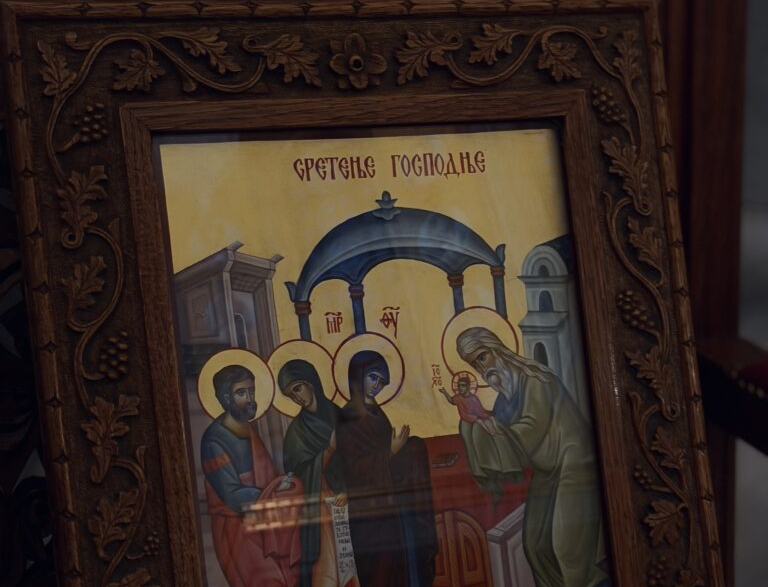
The Lord came into the Temple of Jerusalem, thereby fulfilling the prophecies of the Old Testament. The Bridegroom met the Bride — the Lord met the earthly Church. In the Temple, where prayers had daily been offered for His coming, a multitude of priests and people were presenting the prescribed sacrifices. And then came Simeon, who had waited three hundred years. It seemed as though death had forgotten him. All his relatives and acquaintances had already reposed. This encounter was the greatest event in the life of Simeon, the “righteous and devout man,” upon whom, according to the Gospel, “the Holy Spirit was.” There was also Anna, who had married at seventeen, lived seven years with her husband, and for the remaining sixty years lived in the Temple, leading a strict life. She too had hope, and her entire life was dedicated to the coming of the Messiah.
The righteous elder Simeon sensed in his heart that this was the promised Messiah whom he had awaited. Then he uttered the well-known words which we ourselves recite daily at Vespers: “Lord, now lettest Thou Thy servant depart in peace, according to Thy word; for mine eyes have seen Thy salvation, which Thou hast prepared before the face of all peoples; a light to enlighten the Gentiles, and the glory of Thy people Israel.”
In this prayer we hear the words “Thy salvation,” and we ask what their meaning is.
According to the interpretation of the holy Fathers, “Thy salvation” refers to Christ. Thus, the Child brought to the altar is the long-awaited Messiah. The Saviour’s name, Jesus, derives from the word Yeshua, meaning “salvation.” In other words, Simeon publicly, before all, pointing with his finger, declared: “Behold the Christ whom you await — this is salvation.”
How is it that only these two persons recognized the Messiah and bowed before Him? The answer is found first and foremost in the Gospel, where Christ says: “Blessed are the pure in heart, for they shall see God.” And in Psalm 50 we read: “Create in me a clean heart, O God, and renew a right spirit within me.” Solomon says: “Wisdom will not enter into a malicious soul, nor dwell in a body enslaved to sin.” God is not to be proven; He is not demonstrated, but revealed. Yet He reveals Himself only to those who fulfill the conditions under which it is possible to see God. When a person encounters Christ, he cleaves to Him by the grace of the Holy Spirit. As people of the New Covenant, we may encounter God through prayer, through grace, and through communion in the Body and Blood of Christ.
The Feast of the Meeting of the Lord is the feast of our freedom. Only in Christ do we receive true freedom — freedom from sin and death, freedom to be children of God, as the holy Apostle Paul says (cf. Eph. 2:3). The period of the Old Testament ended two thousand years ago. We now live in the New Covenant, and only one thing is required of us: to accept the Divine Messiah — Christ as our Saviour, to receive Him into our hearts so that He may cleanse us from sin and make us worthy of the Kingdom of Heaven.
In the life of every person there are many different encounters: interesting and ordinary, those quickly forgotten and those that leave a lasting imprint upon our being. Yet the most important encounter for each of us remains the encounter with God.
Man once dwelt with God, possessing perfect knowledge and understanding of Him. He was a participant in His holiness, His grace, and His love, and this made him immortal. Each of us, in the depths of our being, senses all of this. Somewhere deep within our souls, this memory lives on in us from our forebears, Adam and Eve. It is precisely for this reason that the soul of every human person is Christian by nature, for it longs for God and thirsts for an encounter with Him in order to recover what was once lost.
Sooner or later, each of us will encounter God. At that moment, a question arises: shall we wish to remain with God? Are we prepared for this? Will He wish to keep us near Him?
In His boundless mercy and love for us, the Lord has granted us time in our earthly lives to prepare for this encounter and to answer for ourselves whether we desire it. For us, the righteous Simeon the God-Receiver has become a vivid example of longing for and awaiting such a meeting. His waiting endured for more than three hundred years. Each day only strengthened his faith, for no one in those days lived as long as the righteous Simeon. It was an evident miracle. The Lord rewarded his faith. The Lord is always faithful to His word, and what He promised to Simeon was fulfilled in due time. The Holy Spirit, who rested upon the righteous elder, revealed to him the long-awaited event, led him into the Temple, and pointed out the Saviour who had come into the world. In the person of the elder Simeon, all Old Testament righteousness receives the Infant — the Sacrificial Lamb — into its arms, offering and dedicating Him to God. In the Gospel we find the words of the Saviour: “Do not think that I have come to abolish the Law or the Prophets; I have not come to abolish, but to fulfill.” The Gospel narrative that forms the basis of the Feast of the Meeting of the Lord confirms these words.
Being sinless, the Infant Christ had no need to offer sacrifice for Himself. Being Perfect God, eternally abiding in the Holy of Holies of the Father’s glory, He had no need of consecration in Solomon’s Temple or of a priestly blessing. The Son of God voluntarily humbles Himself, becomes incarnate, and becomes perfect Man while remaining true and perfect God. He assumes all the burdens of human nature from birth and fulfills the entire Law. He offers and consecrates Himself as a sacrifice to God for all humanity.
With the Feast of the Meeting of the Lord, the Nativity cycle dedicated to the coming of the Saviour into the world draws to a close, and joy gives way to the awareness of Christ’s sacrificial ministry, His inevitable suffering and death for us all. The dual character of the feast also lies in the fact that, in its content and meaning, it is both a Feast of the Lord and a Feast of the Theotokos. Ultimately, in the Theotokos lies the source of our salvation.
“God is love,” and true, perfect love is never selfish or vain. It is always ready to sacrifice itself and its own interests. The proof of God’s love for us is the Cross of the Lord. We would not be mistaken in saying that the Feast of the Meeting of the Lord marks the beginning of the path towards the Cross.
“Rejoice, O Virgin Theotokos full of grace, for from thee has shone forth the Sun of Righteousness, Christ our God, enlightening those in darkness; be glad also, O righteous elder, who hast received in thine arms the Liberator of our souls, who grants us the Resurrection.” (Troparion of the Feast)
According to the testimony of Egeria, the Feast of the Meeting of the Lord began to be celebrated in Jerusalem in the fourth century. Egeria interestingly calls it the fortieth day after Theophany, while Saint Cyril of Alexandria describes it as a beautiful and wondrous feast. In the West, the feast began to be celebrated somewhat later, from the fifth century. Noteworthy is the liturgical practice of the procession with lighted candles, originating in Rome and later transmitted to the Christian East, as mentioned by Protopresbyter Lazar Mirković. The entire hymnography of the feast, while richly describing the salvific event, emphasizes the central moment of the encounter between God and man. The feast also has its own prayer behind the ambo:
“O Master, Lord God, Thou didst send into the world Thine Only-begotten Son and Word, born of a woman and under the Law, to redeem those under the Law; and through Thy Spirit Thou didst foretell His coming to the elder Simeon and announce Him to him. Do Thou Thyself now bless us, Thy unworthy servants, with Thy light; and as Thou didst accept the confession of the prophetess Anna, so also receive our prayers; and vouchsafe that we may be embraced by the spiritual arms of Thy incarnate Word and be anointed in Thy sanctified temples with Thy All-holy Spirit. Gladden our faithful people by Thy power, granting them victory over their adversaries, that in us also may be glorified Thy majestic Name and that of Thine Only-begotten Son and of Thy worshiped and life-giving Spirit, now and ever and unto the ages of ages. Amen.”
The Feast of the Meeting of the Lord has one day of forefeast and seven days of afterfeast. It is important to mention a particular liturgical feature of the Divine Liturgy of this feast. The Meeting is the only feast of the Most Holy Theotokos that includes an entrance verse, the so-called vkhodnoe (“The Lord has made known His salvation; before the nations He has revealed His righteousness”), as well as a special festal dismissal at the end of the Liturgy (“Christ our true God, who for our salvation deigned to be held in the arms of the righteous Simeon…”), which is not the case with the other feasts of the Most Holy Theotokos. As the Communion hymn, the psalm verse is sung: “I will take the cup of salvation and call upon the name of the Lord” (Ps. 115:4 LXX/116:13 MT).
“Thou who didst sanctify the Virgin’s womb as was fitting and bless the hands of Simeon, hast now also saved us, O Christ God. Grant peace to Thy commonwealth in wars and strengthen our people whom Thou hast loved, O only Lover of mankind.” (Kontakion of the Feast)
WRITTEN BY: Catechist Branislav Ilić, Editor of the portal Kinonia