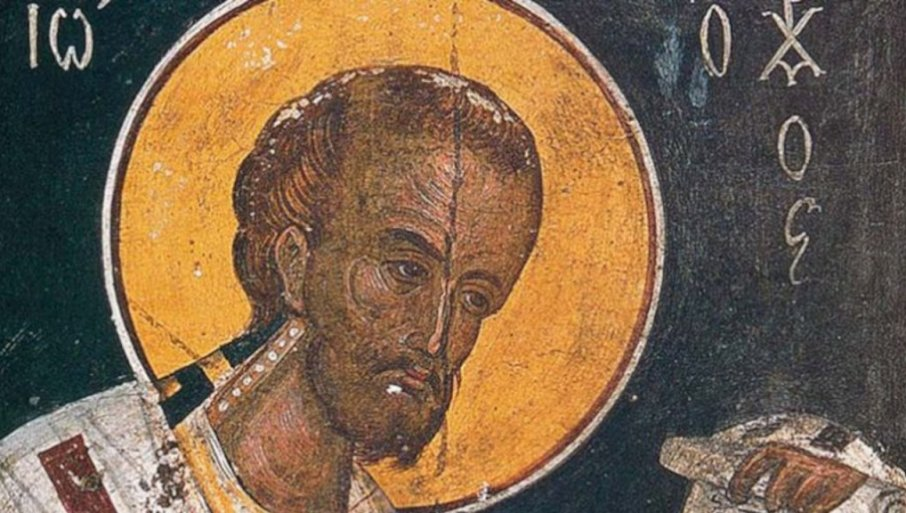
The Word of Saint John Chrysostom
In conclusion, we would recommend to our brethren among the Old Calendarists—both Greek and Serbian—that they carefully read Saint John Chrysostom, at least Homily V Against Those Who Fast with the Jews, from which we translate several excerpts for readers who do not have the opportunity to consult it themselves.
This took place in Antioch around the year 386 (that is, several decades after the First Ecumenical Council of Nicaea in 325), when certain Antiochene Christians were still celebrating Pascha together with the Jews, fasting at the same time as they did, and observing some of their feasts and solemnities. The Golden-Mouthed preacher reminded them of what the Apostle Paul had said to the quarrelsome and divided Corinthians: that by such divisions they were “tearing apart the body of Christ (that is, the Church) into many pieces.” And this (Paul) said not only to them, but also to those after them who suffer from the same maladies. To such persons, he says, he would immediately explain what Pascha is and what the Forty Days (that is, the Fast) are; and then also what is the Jewish Pascha and what is ours; and why their Pascha occurred once a year, whereas ours is accomplished at every Assembly (that is, at the Liturgy). Chrysostom further reminds his hearers that we Christians also formerly (that is, certain Churches during the first three centuries) celebrated together with the Jews, “but we afterwards chose concord and agreement rather than the observance of times (προετιμήσαμεν συμφωνίαν τής των χρόνων παρατηρήσεως).”
By this concord (συμφωνίαν), Chrysostom further understands what “three hundred Fathers or even more, having assembled in the region of Bithynia (at Nicaea at the First Ecumenical Council in 325), enacted as law: together with the faith (that is, the Creed) they enacted this also—that this Feast of Pascha be celebrated together and in harmony.” “And the fact,” he continues, “that Christ kept the Pascha with the Jews (at the Mystical Supper), He did not do so in order that we should now celebrate it with them, but in order to introduce the Truth in place of the shadow… since the old Pascha was a type of the one to come.” He goes on to say that he will show his listeners that Christ “not only did not command us to observe days, but even freed us from that necessity,” and he cites the Apostle Paul (Gal. 4:10–11 and 1 Cor. 1:2 and 11:26), where Paul, on the one hand, says that we ought not to “observe days and months and seasons and years,” and on the other hand, that the celebration of the Divine Liturgy and Holy Communion is the “proclamation of the Lord’s death,” that is, Pascha itself.
And Saint Chrysostom continues: “Pascha and the Forty Days (that is, Great Lent) are not the same thing; rather, Pascha is one thing, and the Forty Days another. The Forty Days occur once a year, but Pascha (that is, the Liturgy) occurs three times a week, and even four times—indeed, whenever we will. For Pascha is not a fast, but the Offering (the Eucharist) and the Sacrifice, which takes place at every Assembly (that is, at the Liturgy).” And he cites the Apostle Paul (1 Cor. 5:7 and 11:26), so that every time you approach (Holy Communion) with a pure conscience, you celebrate Pascha—not when you fast, but when you participate in this Sacrifice (that is, when you partake: 1 Cor. 10:16–17). Pascha is the proclamation of Christ’s death (1 Cor. 11:26). For the Offering (the Eucharist) accomplished today, and that accomplished yesterday, and that performed daily, is identical and one and the same as that which takes place on that day of the Sabbath (that is, the night of Pascha). That (the Offering, or the Liturgy on Pascha) is in no way more honourable than this, nor is this inferior to that; rather, it is one and the same, equally awe-inspiring and salvific.”
To the question of his listeners, “Why then do we fast?”, Chrysostom replies: “We do not fast because of Pascha, nor because of the Cross, but because of our sins, since we are about to approach the Mysteries. For Pascha is not a cause for fasting, nor for sorrow, but for joy and gladness. For the Cross abolished sin, became the purification of the world, the reconciliation of long-standing enmity; it opened the gates of Heaven, made those who were hated into friends, raised our (human) nature to Heaven and seated it at the right hand of the Throne (of God); it granted us countless other blessings… If, therefore, the Cross is the cause and praise of love, let us not say that we grieve (by fasting) because of it—God forbid!—but because of our sins; therefore we fast. A catechumen (the unbaptised) never celebrates Pascha, even though he fasts every year, because he has no communion in the Offering (the Eucharist). As for the one who does not fast, if he approaches with a pure conscience, he celebrates Pascha—whether today or tomorrow, or whenever he partakes in Communion. For the best approach to Communion is judged not by the observance of times, but by a pure conscience… Therefore you must maintain this exactness and this good disposition (την ακρίβειαν ταΰτην καϊ την ευτονίαν), not in observing times, but in approaching Communion… For God does not require an account from us concerning times and such observances.”
“And if someone celebrated Pascha in this or that month, no one was ever punished or accused on that account. What shall I say now about us (in the Church), who have been freed from such necessity, and who have our citizenship in Heaven, where there are no months, nor sun and moon, nor cycles of years? For even among the Jews, if one wishes carefully to inquire, one will see that there was not much disputation concerning times, but that for them the place—Jerusalem—was of greater importance. For (once in the Old Testament), when ‘certain men came to Moses, saying: We are unclean because of the dead body of a man; why should we be deprived of offering the sacrifice of the Lord’s Pascha at its appointed time among the children of Israel? Moses said to them: Stand here, that I may present this before the Lord, and hear what He will command. And when he presented it (before the Lord), he received from Him a law saying: If any one of you or of your descendants is unclean because of a dead body, or is on a distant journey, and cannot keep the Pascha in the first month, he may keep the Lord’s Pascha in the second (following) month, on the fourteenth day in the evening’ (Num. 9:7–11). If, therefore, for the Jews the strict observance of times was relaxed in order that Pascha might be kept in Jerusalem, why do you set time above the concord (συμφωνία = agreement) of the Church, unless it be that you wish to appear as one who follows days, while you mock the Mother of us all (the Church) and shatter the holy Assembly (the Liturgy)? And how will you be worthy of forgiveness, choosing, for the sake of nothing, to sin so greatly?”
“Let us not, therefore, dispute, nor say: ‘I have fasted in this manner for so long—shall I now change?’ Precisely for that reason change, because you have for so long been separated from the Church, and therefore return to the Mother… This is what also ruined the Jews, who, always seeking to preserve the old custom, were carried off into impiety.” – “Nothing is equal to peace and concord; for this reason the father (the Bishop) does not ascend this throne (the episcopal seat in the church) before he has given peace to us all in prayer (‘Peace be unto all!’). And when he rises, he does not begin his teaching (sermon) until he has given peace to us all.”
The Golden-Mouthed pastor further notes how even the deacon, in the litanies of the Service, asks of God for us an “Angel of peace,” and how the entire litany is called the “Litany of Peace” (τά ειρηνικά), and finally, “when he dismisses us from this Assembly (the Eucharist), he likewise wishes this for us in prayer: ‘Let us depart in peace!’ And in general nothing is possible either to say or to do without peace, for it is our nourisher and our mother… But peace according to God, which arises from spiritual concord and agreement.”
At the end of the Homily, Chrysostom adds: “Therefore let us not observe days and seasons and years, but everywhere follow the Church with exactness (πανταχοϋ τη Εκκλησία μετ’ ακρίβειας έπώμεθα), choosing above all love and peace (emphasis ours). For even if, let us say, the Church had erred (in regard to time), there would not have been so much gain from accuracy in time as there has been evil from this separation and schism (from the Church). As for me now, the question of time is of no importance, since it is of none to God, as we have shown—for I have expended many words on this—but I seek only one thing: that in peace and concord we do everything, lest, while I and all the people are fasting, and while the priests are offering common prayers for the whole world, you remain at home drinking.”
“With all freedom, let us do everything together with the Church. For the Church does not insist upon exactness of times (ουδέ γάρ ή Εκκλησία χρόνων ακρίβειαν οἶδε),[3][4] but since in the beginning the Fathers (at Nicaea) decided that those who were divided (regarding the celebration of Pascha) should be united together and determined this day (of Pascha), therefore the Church, honouring concord everywhere and loving unity, accepted what had been decreed. For it is impossible that we, or you, or anyone at all, should appropriate to ourselves this Day of the Lord (αυτής τής Κυριακής ήμέρας), as has been sufficiently shown above. Let us not, therefore, fight with shadows (σκιομαχώμεν), nor dispute about incidental matters, and thereby harm ourselves in matters of great importance. For to fast at this or that time is not an evil; but to rend the Church, to behave contentiously, to create schisms, and continually to deprive oneself of the Assembly (τής συνόδου = the liturgical Synaxis), is inexcusable and worthy of condemnation and severe punishment.”
And Saint John Chrysostom—the Ecumenical Hierarch, Father and Teacher of the Church—concludes, and with him we also conclude, addressing all who are separated from the Church, including our brethren among the Old Calendarists: “Let us all together pray for our brethren, that they may return to us, that they may love peace, withdraw from unseemly contentiousness, despise this estrangement (from us), and acquire within themselves a certain elevated and noble mind (διάνοιαν, that is, reason and discernment), so that they may be freed from the observance of days; that we may all, with one accord and one mouth, glorify God and the Father of our Lord Jesus Christ, together with the Holy Spirit, to Whom be glory and dominion, now and ever, and unto the ages of ages. Amen.”
From the book The Delusions of Schismatics and Old Calendarists, by Bishop Atanasije Jevtić (2004).