This text was published on the Kinonia portal, in the column “From the Editor’s Pen,” on 25 December 2025.
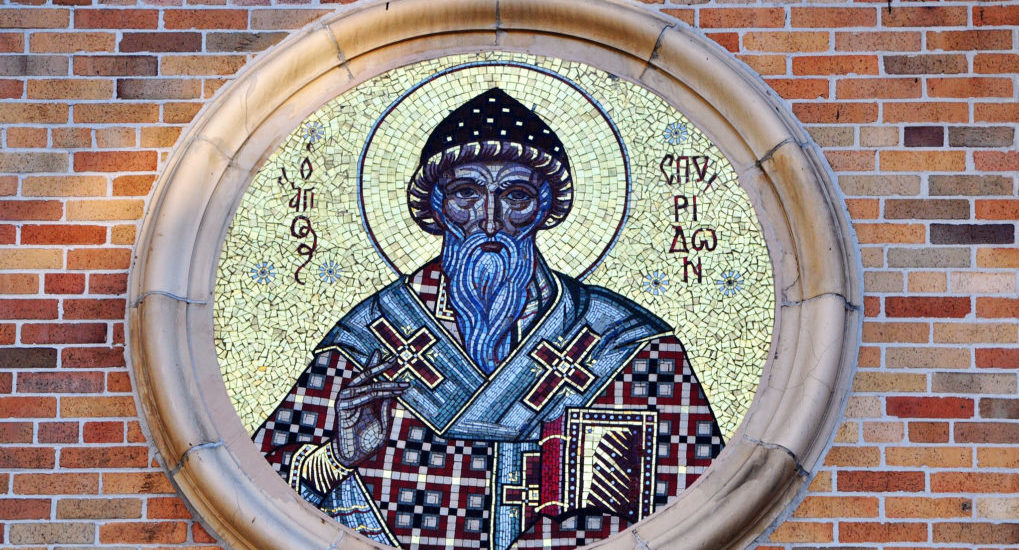
Saint Spyridon of Trimythous, the wonderworker, is one of the most venerated saints of the Orthodox Church. He spent his life on Cyprus, the third largest island in the Mediterranean Sea. He lived from the third century into the early fourth century of the Common Era. At the time of his birth, the Christian Church—founded on Cyprus by the Apostles Paul and Barnabas—had already existed for more than two and a half centuries. For most of his life he was a simple shepherd, and later he served as a hierarch. This servant of God led a pure and God-pleasing life, imitating David in meekness, Jacob in simplicity of heart, and Abraham in hospitality. Saint Spyridon of Trimythous reposed in the year 348, when Saint John Chrysostom was still an infant, and when Saints Gregory the Theologian and Basil the Great were in their youth.
Living in the world, this saint pleased God to such an extent that he was deemed worthy of the gift of wonderworking. He healed incurable diseases and cast out demons with a single word. Saint Spyridon cared for his flock with great love. Through his prayers, droughts were replaced by abundant and life-giving rains, and incessant rains were replaced by fair weather; the sick were healed and demons were driven out. In what follows, we shall mention only a few of the wondrous events from the life of this servant of God.
A woman came to him carrying her dead child, seeking the saint’s intercession. After prayer, he restored the newborn to life. The mother, overwhelmed with joy, collapsed and died. Through the fervent prayer of the saint of God, the mother too was restored to life. Hastening to save his friend, who had been slandered and condemned to death, the saint was stopped on the road by a great torrent that had suddenly overflowed due to flooding. The saint commanded the torrent: “Stand still! The Master of the whole world commands you, so that I may cross and hasten to help my friend.” The torrent immediately ceased to flow, and he crossed safely to the other side.
One day, Saint Spyridon entered an empty church, ordered that the lamps and candles be lit, and began the service. When he pronounced the blessing with the words, “Peace be unto all,” he and the deacon heard a multitude of voices from above responding in chant: “And unto thy spirit.” This choir was more majestic than any human singing. To each petition of the ekteny, the invisible choir chanted, “Lord, have mercy.” Drawn by the singing that issued from the church, those who were nearby hastened to enter it, and as they approached, the wondrous chanting increasingly filled their ears and gladdened their hearts. When they entered the church, they saw no one except the bishop and the deacon.
When Saint Spyridon was travelling to attend the First Ecumenical Council in the year 325, he spent the night at an inn. Intending to prevent the saint from participating in the council, the Arian heretics secretly slaughtered his two horses during the night, cutting off their heads. When the saint saw what had happened at daybreak, invoking the help of the Lord, the Creator of heaven and earth, he ordered his servant to reattach the severed heads to the horses’ bodies. The servant obeyed the command, but in his haste attached the head of the white horse to the body of the black one, and the head of the black horse to the body of the white one. Through the wondrous intervention of God, by the prayer of Saint Spyridon, the horses came back to life. The saint continued his journey to Nicaea, and all those who encountered him on the road marvelled at seeing a black horse with a white head and a white horse with a black head. By this miracle as well, the saint put the foolish heretics to shame. Like Saint Nicholas of Myra the Wonderworker, Saint Spyridon participated very fervently in the work of the First Ecumenical Council. As the holy fathers of the council engaged in lengthy disputes concerning the One God in Trinity, in order to depict symbolically the unity of the Holy Trinity, Saint Spyridon took a brick and pressed it firmly, whereupon fire rose upward from it, water flowed downward, and clay remained in the saint’s hand. Then Saint Spyridon said: “Behold, three elements, yet one brick. So it is also in the Holy Trinity: three Persons, yet one God.”
The saint manifested works of mercy and compassionate love towards every human being in various ways, as is testified—among many similar miracles—by the following event. At the beginning of Great Lent, a traveller knocked on the door of Saint Spyridon. Seeing that the traveller was extremely weary, the saint said to his daughter: “Wash this man’s feet and offer him something to eat.” Since it was the season of Great Lent, the necessary food supplies had not been prepared, for the saint ate only on certain days and fasted on the others. His daughter replied that there was neither bread nor flour in the house. Then the saint of God, apologizing to the guest, instructed his daughter to roast a little salted pork that he had kept in reserve, and, having seated the traveller at the table, the saint himself began to eat, encouraging the man to do the same. When the latter, calling himself a Christian, refused, the saint added: “All the more should you not refuse, for the word of God says: ‘To the pure all things are pure.’”
On one occasion, thieves decided to steal the sheep of Saint Spyridon. Late at night they entered the sheepfold, but immediately found themselves bound by an invisible force. When the new day dawned, the saint came to the flock and, seeing the bound robbers, prayed, released them, and finally persuaded them to abandon their lawless and sinful deeds, instructing them always to earn their livelihood through honest labour. The saint gave each of the thieves one sheep. As he dismissed them, he kindly said: “May your vigil not be in vain.”
People often turned to Saint Spyridon for support and assistance. There are many instances in which all human needs were miraculously resolved through the saint’s goodness. Being in distress, one man came to Saint Spyridon, begging him to lend him money. Since the saint lived a very modest life and had no money himself, he nevertheless could not allow the man to leave empty-handed. He went out into his courtyard and noticed a snake before him; through his prayer to the Lord, the snake was transformed into gold. He gave the poor man the golden snake, asking him to use the ornament as collateral for money. After earning the money and repaying the debt, the man returned the golden snake to Saint Spyridon. When the saint took the precious ornament in the form of a snake, he brought it into the courtyard and placed it on the ground, and the golden snake was wondrously transformed back into a real snake.
Saint Spyridon had a virgin daughter named Irene, who, like her father, lived a holy and God-pleasing life. After she reposed, a woman came to the saint weeping. The saint received her with love, and the tearful woman said that she had entrusted a piece of gold jewelry to his now-deceased daughter Irene for safekeeping. The saint searched the house in order to find the jewelry, but did not find it. Moved by the tears of this woman, Saint Spyridon approached the coffin of his departed daughter and addressed her as though she were alive, saying: “My daughter, Irene! Where is the jewelry entrusted to you for safekeeping?” Irene, as if awakened from sleep, replied: “My master! I hid it in this place in the house,” and she indicated the spot. Then the saint said to her: “Now sleep, my daughter, until the Lord awakens you at the time of the General Resurrection.”
The relics of Saint Spyridon are preserved on the island of Corfu (Kerkyra), Greece. Each year, the clergy of the Church of Saint Spyridon re-enshrine the saint’s relics; remarkably, they always find his slippers worn and full of holes, as though Saint Spyridon continues to walk upon the earth, helping those who invoke him and seek his intercession. Every year, his slippers are divided into small pieces and sent throughout the world as a blessing to the faithful who prayerfully venerate this servant of God. Modern people of the late twentieth and early twenty-first centuries cannot comprehend how an inanimate body can remain incorrupt and whole for so many centuries, and they have decided to investigate this phenomenon from a scientific perspective. It has been observed that when people venerate the feet of Saint Spyridon, they feel warmth. His relics maintain a constant temperature of a living body (36.6 degrees Celsius). According to testimonies to this day, his nails and hair continue to grow.
We should not forget that Saint Spyridon has been venerated among our people for centuries. He has been especially revered within Serbian monasticism, as is evidenced, among other things, by the fact that one of the earliest disciples of Saint Sava received his monastic name after Saint Spyridon. In modern history, the greatest number of churches dedicated to Saint Spyridon are found along the Adriatic coast, the most famous among them being the Serbian church in Trieste from the eighteenth century. In this region, the saint is glorified as a wonderworker and as the protector of children, olive trees, sailors, and ships. On the territory of present-day Vojvodina there are no churches dedicated to this saint; nevertheless, his prayerful veneration remains very much alive, as is attested by the fact that in the Church of Saint Stephen in Sremska Mitrovica, on the iconostasis painted by Teodor Kračun in the eighteenth century, there are two icons of Saint Spyridon, as well as in the chapel of the Holy Apostles Peter and Paul in Bela Crkva, while in Vršac a large-format icon has been preserved, donated by the guild (craft association) of shoemakers.
In the second sticheron at Lord, I Have Cried, the church poet extols the wisdom of Saint Spyridon, which was manifested above all through his participation in the First Ecumenical Council: “As one who is meek, you have inherited the land of the meek, and truly, O Spyridon, you became the glory of the Fathers; for by the power of your wise yet simple words, and by divine grace, you overcame the most cunning adversary and the most foolish Arius, and you explained the divine doctrine to all and revealed it to the faithful. For, being exalted by the saving Spirit, you clearly enlightened all the Orthodox, that they might glorify the one God the Logos as true and consubstantial with the unoriginate Father, who bestows great mercy upon the whole world.”
In the third sticheron at Lord, I Have Cried, the hymnographer glorifies the Lord who works wonders through His servant Saint Spyridon: “You mortified the passions of the flesh, and by the grace of God you raised the dead; you transformed a serpent into gold, and by your prayer you restrained the flow of a river, O father; you appeared in a dream to a sick emperor and healed him, drawing his heart near to the Lord, who has gloriously glorified you. Therefore, with a loud voice we celebrate your memory, and we venerate your holy relics and your tomb, for from it flow streams of holy healings and great mercy.”
We devoutly venerate this great saint of God, we earnestly pray to him, and we strive to imitate him in our own lives. His entire life was filled with works of mercy and love. Saint Spyridon was humble, gentle, meek, compassionate, a great ascetic, and a man of prayer. The incorruptibility of the saint’s body enables us, through honouring him, to experience the presence of the grace of the Holy Spirit. Even in our own time, the saint continues the life of Christ within our lives and reveals it to all of us. We are called to walk the path of those virtues with which Saint Spyridon was adorned; in this way we shall justify the vocation granted to us as God-like beings, as we are reminded by the words: “Be holy, for I am holy, the Lord your God” (Lev. 19:2).
WRITTEN BY: Catechist Branislav Ilić, Editor of the Kinonia Portal
Vrh obrasca
Dno obrasca