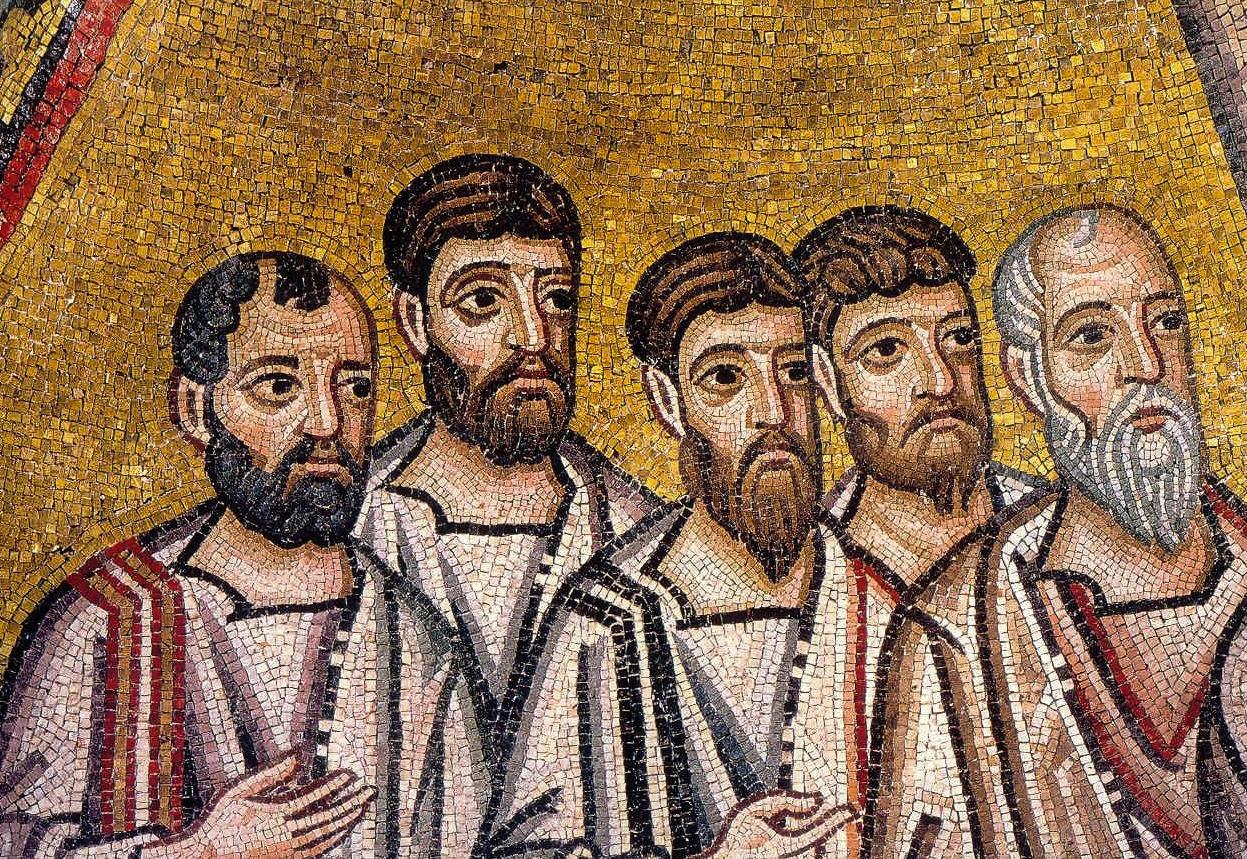
Beginning the Patristic Interpretation of the Tenth Chapter of the Gospel According to Matthew
“And when He had called unto Him His twelve disciples, He gave them power against unclean spirits, to cast them out, and to heal all manner of sickness and all manner of disease.”
Saint John Chrysostom, commenting on this passage, explains that the gifts granted to the apostles by the Lord served as their preparation for the further ascetic struggle. From his interpretation, we see that Christ instructed His apostles with great care. Chrysostom writes:
“From this we see that Jesus is the Actor, that He is the Lord of the harvest, that He is the Lord of the prophets. If the Lord sent them to reap, He sent them not into another’s field but into that which He Himself had sown through the prophets. And He not only encouraged them by calling their service a harvest, but also by granting them power for this service. Yet, since the Spirit had not yet been sent, how then did they cast out demons? By the command and authority of Christ. Observe how timely was this mission: Jesus did not send them from the very beginning, but only when they had long been His followers—when they had seen Him raise the dead, rebuke the sea, cast out demons, heal the paralytic, and cleanse the leper. When they had thus been sufficiently assured both by deeds and by words of His power, then He sent them forth. And the Lord did not send them to dangerous struggles, for there was no danger yet in Palestine—they were exposed only to slander. Nevertheless, He foretold to them the perils that were to come, that they might prepare themselves beforehand and, through frequent reminders, be trained for them.”
Euthymius Zigaben also explains why Jesus spoke of there being few labourers and clarifies what exactly the Lord meant by this. Zigaben writes:
“If there were few disciples, why did Jesus not increase their number by adding others? He did increase them—but not in number, rather in power: He gave them authority; thus Jesus calls them few not because of a lack of power, but because of their small number.”
The Blessed Theophylact continues:
“He chose twelve disciples according to the number of the twelve tribes of Israel, and after giving them power, He sent them to preach, though they were few in number. Thus, few are those who walk the narrow path. The Lord grants them the power to work miracles so that people, being amazed by the wonders, might more readily believe their teaching.”
The Names of the Apostles
“Now the names of the twelve apostles are these: The first, Simon, who is called Peter, and Andrew his brother; James the son of Zebedee, and John his brother; Philip and Bartholomew; Thomas and Matthew the publican; James the son of Alphaeus, and Lebbaeus, whose surname was Thaddaeus; Simon the Canaanite, and Judas Iscariot, who also betrayed Him.”
The Blessed Theophylact of Ohrid notes that the names are not listed in this order by chance, and at the same time he points to the virtue of the author of this Gospel, the Apostle Matthew himself. Theophylact writes:
“Matthew enumerates the names of the apostles on account of those who falsely claimed to be apostles. He first mentions Peter and Andrew, for they were the first to be called, and then the sons of Zebedee. He places James before John, not for honour’s sake, but simply mentioning them in order as they occur… See Matthew’s humility, how he places himself after Thomas. When he came to Judas, he did not say, ‘the accursed Judas, the enemy of God,’ but calls him Iscariot after his native place. There was, indeed, another Judas, also called Lebbaeus or Thaddaeus. Thus there were two Jameses—one the son of Zebedee and the other of Alphaeus; two Judases—Thaddaeus and the betrayer; and three Simons—Peter, the Canaanite, and the betrayer Judas Iscariot, who was also called Simon.”
Saint John Chrysostom also draws attention to the difference in the listing of apostolic names compared to the other evangelists. He writes:
“Mark lists the apostles according to rank, placing Andrew after the two chiefs; but Matthew lists them differently: he places Thomas above himself, who was much inferior. Let us consider them in order, beginning with the first. The first, Simon, who is called Peter, and Andrew his brother. This is already a great commendation: one is praised for virtue, the other for noble character. Next, James the son of Zebedee, and John his brother. You see that the Evangelist does not list them according to dignity. I think John was not only above the rest, but even above his brother… There was also another Judas—Lebbaeus, called Thaddaeus—whom Luke calls ‘Judas, the brother of James’ (Lk. 6:16). Then Matthew, distinguishing one from the other, says, ‘Judas Iscariot, who also betrayed Him.’ Matthew is not ashamed to add, ‘who betrayed Him.’ Thus the Evangelists never conceal anything, even that which might seem blameworthy. The first among the apostles was a simple and unlearned man.”
The Mission of the Twelve
“These twelve Jesus sent forth, and commanded them, saying: Go not into the way of the Gentiles, and into any city of the Samaritans enter ye not: But go rather to the lost sheep of the house of Israel.”
Chrysostom also explains why the Lord Jesus, despite the open hostility of the Jews, first sends His apostles to them:
“Think not,” says Jesus, “that because the Jews speak evil of Me and call Me possessed, I therefore hate and despise them. On the contrary, I strive to correct them before all others, and I forbid you to go to the other nations. To the Jews I send you as teachers and physicians. And not only do I forbid you to preach to any others before them, but I do not even allow you to set foot on the road that leads to the Gentiles or to enter a Samaritan city. The Samaritans, though adversaries of the Jews, would have been easier to convert, for they were more inclined toward faith than the Jews. Yet Jesus sends the apostles to the obstinate Jews, showing thereby His care for them, closing their mouths, and laying the foundation for the apostolic mission, so that later they could not complain that the apostles had gone to the uncircumcised, nor find any pretext for fleeing or avoiding them. By calling them lost sheep, and not straying ones, He in every way suggests the thought of forgiveness and draws their hearts toward repentance.”
Saint Hilary of Poitiers removes a possible doubt that may arise when reading these verses, in case someone wonders why the Lord tells the apostles not to go to the Gentiles:
“The Lord advises the apostles to refrain from going by the ways of the Gentiles; yet this does not mean that He does not send them for the salvation of the Gentiles, but rather that they must avoid the deeds and the way of life of the unenlightened nations. The apostles are likewise forbidden to enter the cities of the Samaritans. But did not Jesus Himself show care for the Samaritan woman? Here the apostles are commanded not to visit the communities of heretics, for distortions of faith differ in nothing from the ignorance of the pagans. Then the Lord sends them to the lost sheep of the house of Israel (Matt. 10:6). Yet it was precisely the Jews who spoke against Him with the tongues of serpents and the howls of wolves! Nevertheless, the heirs of the Law had to possess the right to be the first to hear the Gospel preaching; and the fewer excuses remained in Israel, the greater zeal was required to be shown in exhortation.”
Venerable Isidore of Pelusium continues and interprets as follows:
“Not to go on the way of the Gentiles means not to resemble them in one’s manner of thinking, just as not to enter a Samaritan city does not mean to withdraw from life among them, but not to adopt their deceitfulness and impiety.”
At this point, the saint precisely clarifies that boundary which we Christians should maintain in our contact with people who do not believe in the Lord. We cannot avoid daily contact and interaction with them, but inwardly we must guard ourselves.
Blessed Jerome likewise explains that there is no contradiction here with Christ’s command at the end of the Gospel of Matthew—the command that speaks of the necessity of the missionary work of the Orthodox Church. He offers the following explanation:
“This passage does not contradict the command given later: Go therefore and teach all nations, baptizing them in the name of the Father, and of the Son, and of the Holy Spirit (Matt. 28:19), because the first command was given before the Resurrection, and the second—after the Resurrection. Indeed, at the beginning it was necessary that Christ’s coming be proclaimed to the Jews, so that they might have no pretext to justify themselves by saying that they had rejected the Lord because Jesus had sent the apostles to the Gentiles and Samaritans. In a figurative sense, to us who bear the name of Christians, it is commanded not to wander along the path of heretics and pagans, but that, separating ourselves from them in faith, we should also separate ourselves from them by our way of life.”
Venerable Ephrem the Syrian finally says that through this preaching the apostles were to experience all that the Lord Himself had endured from men:
“Jesus sent them that they might preach the truth, work miracles, and endure sorrows just as He Himself had done; that the apostles might thus know that He was reflected in them as in His own seal.”
From these words we see that through ascetic striving the saints attain deification, and that everything we do in our life for God’s sake serves to make us more like God.
The seventh verse reads:
And as you go, preach, saying: The kingdom of heaven is at hand.
Saint John Chrysostom here draws attention to the theme of apostolic preaching and emphasizes the difference from the preaching of the Old Testament prophets. He says:
“The apostles were not commanded to speak of what is perceptible to the senses, of which Moses and the prophets before them had spoken; they were commanded to speak of new and extraordinary realities. The prophets did not preach about the heavenly kingdom, but about the earth and earthly goods, while the apostles preach about heaven and all that is there. Yet the apostles surpass the prophets not only in this, but also in their obedience.”
Further, the saint answers the objection that the apostles supposedly had everything easy since the Lord was with them. He says:
“Was nothing difficult commanded to them? Do you not hear of prisons, death sentences, persecutions from their own people, of universal hatred? All this, according to Christ’s words, they were soon to experience themselves. He sends them as preachers and distributors of countless blessings to others, while for themselves He declares and foretells unbearable tribulations.”
Gregory the Dialogist wrote very profoundly about the perishing world and the Kingdom that draws near:
“As you go, preach, saying that the Kingdom of Heaven is at hand. If, dearest brethren, the Gospel were silent about this, the world itself would cry out. For its ruins serve as messengers. Shaken by such convulsions, it has been stripped of its glory, clearly pointing to us the nearness of that Kingdom which follows after this world. This world is bitter even for those who love it.”
In a similar manner, a martyr of our Church in this century, Fr. Daniil Sysoev, spoke about how important it is for us Christians not to lose sight of the fact that this world is transient, that our true homeland is yet to come, and that we must preserve within ourselves this awareness, without becoming attached to the earth. He says:
“People have forgotten the Heavenly reward; they have forgotten that we live here in order to receive the reward there. We have become too attached to the earth. You read the Orthodox press—what do you find? Politics, discussions about how to settle here, how to make normal relations here. But, forgive me, we are going to leave this place. Perhaps even today. We all walk before God. Death is not somewhere beyond the mountains, but upon our backs, as they say in Russia. People have forgotten this and do not wish to think about it, that they must prepare themselves for eternity.”
Adapted for the contemporary reader based on Patristic commentary by: Stanoje Stanković